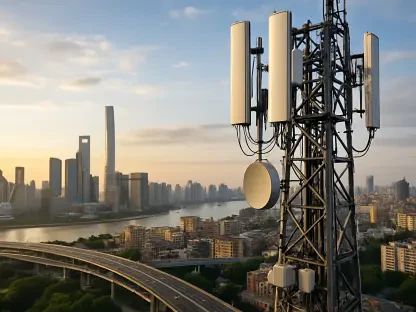

The persistent frustration of a crucial call dropping just as you step into an elevator, a basement, or a modern office building with signal-blocking materials has become an all-too-common part of daily life. For years, the solution seemed to be finding that one specific corner of the room with a bar or two of service, a ritual that undermined the very promise of mobile communication. However, a powerful and increasingly ubiquitous technology known as Voice over Wi-Fi (VoWiFi), or Wi-Fi Calling, is rendering this frustrating search obsolete by transforming nearly any Wi-Fi network into a personal cell tower. This service leverages the internet connections already present in homes, offices, and public spaces to provide crystal-clear voice calls, effectively bypassing the limitations of traditional cellular infrastructure. With major carriers like Bharat Sanchar Nigam Limited (BSNL) recently completing nationwide rollouts, Wi-Fi Calling is rapidly transitioning from a niche feature to a standard expectation for reliable mobile connectivity, ensuring that a weak cellular signal no longer means a missed conversation.
The Technology Behind Seamless Connectivity
At its heart, Wi-Fi Calling operates on the well-established principle of Voice over Internet Protocol (VoIP), the same technology that powers many internet-based communication services. When a call is placed using VoWiFi, the smartphone intelligently converts the user’s voice into digital data packets. Instead of sending these packets to the nearest cellular tower, it routes them through the connected Wi-Fi network to the carrier’s core network over the internet. This process is remarkably efficient and allows for high-definition voice quality that can often surpass that of a standard cellular call, especially when the mobile signal is weak. A key innovation in modern implementations is the ability for the device to seamlessly hand over the call between the cellular network and a Wi-Fi network without interruption. For example, a user can initiate a call on their home Wi-Fi, walk outside and away from the router’s range, and the phone will automatically switch to the cellular network without the call dropping, providing a truly continuous and reliable communication experience.
The elegance of VoWiFi lies in its deep integration within the device’s native operating system, a feat made possible by the IP Multimedia Subsystem (IMS) framework. Unlike early VoIP solutions that required users to download, configure, and launch a separate third-party application, Wi-Fi Calling is designed to be completely transparent. Once enabled in the phone’s settings, it works in the background without any further user interaction. This built-in functionality means individuals can continue to use their existing mobile number, the standard phone dialer, and their synchronized contact list. There are no new accounts to create or apps to juggle; the phone simply makes an intelligent decision based on network quality, prioritizing Wi-Fi when the cellular signal is poor. This seamless, user-friendly approach has been critical to its widespread adoption, as it removes the technical barriers and offers an immediate, tangible improvement to the core function of a mobile phone: making and receiving calls.
Redefining Network Performance and Accessibility
The most significant and immediate benefit of Wi-Fi Calling is its ability to provide robust call connectivity in locations that have historically been cellular dead zones. Concrete and steel-reinforced structures, such as large office buildings, underground parking garages, basements, and even modern energy-efficient homes, are notorious for blocking or weakening cellular signals. Wi-Fi Calling effectively neutralizes this problem by using the building’s internal Wi-Fi network to route calls. This transforms previously disconnected spaces into highly reliable communication hubs. The impact extends beyond urban environments to remote and rural areas where cellular coverage may be inconsistent or nonexistent, but where a satellite or broadband internet connection is available. For residents and businesses in these locations, VoWiFi is not just a convenience but a critical service that ensures they can maintain essential contact for personal safety, remote work, and daily operations, bridging the gap left by incomplete cellular infrastructure.
Beyond improving call quality for the individual user, the widespread adoption of Wi-Fi Calling yields substantial benefits for the entire mobile network ecosystem. By offloading a significant portion of voice traffic from the cellular network to Wi-Fi, carriers can reduce congestion on their radio access networks. This is particularly advantageous in densely populated areas like stadiums, shopping malls, or urban centers, where thousands of users simultaneously compete for limited cellular bandwidth. Freeing up this capacity allows the cellular network to perform more efficiently for data services and for users who are not connected to Wi-Fi. From a consumer perspective, this advanced capability is typically offered as a value-added service at no additional charge. Carriers generally treat calls made over Wi-Fi the same as those made over their cellular network, meaning they draw from the user’s existing plan minutes without incurring extra fees. This cost-neutral approach has made it an incredibly attractive and easily justifiable feature for users to enable.
A New Standard in Communication Reliability
The evolution of Wi-Fi Calling from a supplementary feature into a core component of modern mobile communication marked a definitive shift in the industry. What began as an innovative solution for poor indoor coverage has since been established as a fundamental technology that redefined expectations for call reliability. The service’s seamless integration into native phone operating systems demonstrated that the convergence of cellular and IP-based networks was not only possible but essential for delivering a truly uninterrupted user experience. This successful implementation dismantled the long-held dependency on physical proximity to a cell tower for clear voice communication. It ultimately empowered consumers by providing a resilient and consistent connection in a multitude of environments, solidifying a new baseline for what it meant to have dependable mobile service.