
An invisible war is being waged over a sliver of the electromagnetic spectrum, a resource more valuable than beachfront property and more critical to modern life than the highways crisscrossing the nation. This battleground, known as the C-band, is where the relentless march of technological progress collides with the bedrock services millions of Americans depend on every day. At stake is not just faster downloads, but the reliability of news broadcasts, the safety of air travel, and the integrity of scientific discovery. The Federal Communications Commission (FCC) stands at the epicenter, tasked with a decision that will shape the country’s digital and physical infrastructure for decades.
The Invisible Battlefield Understanding the C Band Controversy
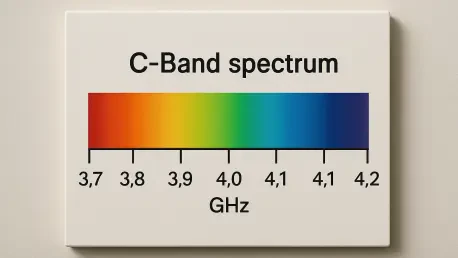
The C-band spectrum, specifically the 3.98GHz-4.2GHz range, serves as a workhorse of modern communications, a reliable conduit for satellite-based television distribution to millions of households, the dissemination of critical weather data, and countless other services. Its physical properties make it resilient to weather interference, a quality that has made it indispensable for decades. However, this same reliability makes it prime real estate for the next wave of wireless technology, which demands robust and clear airwaves to function.
This conflict was set in motion by the One Big Beautiful Bill Act, a piece of legislation that mandates the FCC to auction a portion of this coveted band for 5G, 6G, and future innovations by July 2027. The central question facing regulators is not if the spectrum will be repurposed, but how much. The answer will determine the future of American connectivity, forcing a difficult choice between fueling a data-hungry future and preserving the operational stability of services that form the backbone of the present.
Clash of the Titans The Key Players and Their Demands
The National Association of Broadcasters (NAB) has drawn a firm line in the sand, insisting that the auction be strictly limited to 100MHz of the band. Their argument is one of systemic risk, contending that releasing any more spectrum would “jeopardize broadcast distribution” and make it logistically impossible for them to provide “substantially the same service” to the public. Broadcasters describe the challenge of repacking their operations into a smaller slice of the airwaves as a complex “Tetris-like problem,” one that guarantees disruption. To protect their interests, they demand that the winning bidders of the auction cover 100% of the substantial costs required for incumbent users to transition their technology and infrastructure.
In stark contrast, the wireless industry, represented by the CTIA, is pushing for the maximum possible release of 180MHz. Their position is that more spectrum is not a luxury but a necessity for the United States to maintain its global leadership in wireless innovation. The CTIA argues that these airwaves are the essential fuel required for emergent technologies like artificial intelligence to flourish and for the next generation of wireless networks to meet escalating consumer and industrial demands. Securing “licensed, full-power use” of this band is, in their view, paramount to the nation’s technological and economic growth.
Navigating this polarized landscape, some stakeholders propose a more nuanced path forward. Harmonic, a video technology supplier, suggests a multi-phased approach designed to mitigate disruption. The first phase would involve quickly clearing an initial 100MHz by implementing advanced compression technologies, allowing current satellite services to operate more efficiently. A second, subsequent phase could then free up additional spectrum by relocating some users to the adjacent Ku-band, supplementing this shift with terrestrial fiber to offset the Ku-band’s known susceptibility to weather-related signal degradation. This method, they argue, offers a pragmatic compromise that could satisfy the demand for new spectrum while maintaining service reliability.
Collateral Damage The Unseen Risks and Expert Warnings
The debate over the C-band extends far beyond the concerns of broadcasters and wireless carriers, touching upon issues of national safety and scientific integrity. Echoing a contentious battle fought over a lower portion of the C-band, aviation giants Boeing and Honeywell are sounding the alarm about potential interference with aircraft radio altimeters. These critical instruments, which measure a plane’s altitude above the ground during takeoff and landing, operate in a band directly adjacent to the one being auctioned. Honeywell has submitted data to the FCC indicating that even recently retrofitted altimeters are not compatible with the proposed upper C-band use, creating a significant safety risk. Their ultimatum is clear: new C-band deployments must be postponed until a new, comprehensive wave of equipment retrofits and replacements is completed across the entire commercial aircraft fleet.
Beyond the skies, the conflict threatens our ability to listen to the cosmos and predict the weather. The National Academy of Science’s Committee on Radio Frequencies (CORF) warns that interference from new wireless services could effectively blind radio astronomy observatories. These facilities rely on the quiet 4GHz band to detect incredibly faint cosmic signals from the distant universe, and an increase in terrestrial transmissions could render them unusable. Simultaneously, concerns have been raised about the potential disruption of National Weather Service communications, which use the band to distribute vital satellite imagery and radar data that are essential for forecasting and issuing severe weather warnings.
Clearing the Air Addressing the On the Ground Hurdles
A significant logistical hurdle complicating any transition is the state of the FCC’s own records. Broadcasters and cable operators point to a “temporary” registration freeze on C-band earth stations implemented nearly a decade ago, which has resulted in an official registry that is woefully incomplete and outdated. Groups like ACA Connects, which represents independent cable operators, are urging the FCC to open a new registration window. This would allow countless operational but unregistered earth stations to be formally identified, ensuring they are eligible for the reimbursement funds necessary to cover transition expenses. ACA Connects estimates at least 20 such unregistered stations exist among its members alone, hinting at a much larger nationwide problem.
This problem is particularly acute in rural America, where the proposed alternatives to C-band satellite service are often unworkable. Operators like InterTECH argue that managed IP services are not universally available or reliable in their service areas. Many rural cable headends depend on a single, vulnerable internet connection, leaving them highly susceptible to service disruptions from fiber cuts or severe weather events that could knock out local news and information for entire communities. For these areas, a reliable satellite-based solution remains essential, suggesting that a hybrid model combining Ku-band satellite and IP-based systems may be the only way to ensure continuous and dependable service for underserved populations. The resolution of this C-band battle was about more than just allocating frequencies; it was a complex negotiation that balanced technological ambition against the practical needs of public safety, scientific research, and equitable access to information for all Americans. The final framework reflected a compromise, acknowledging that while the future of wireless is critical, it could not be built by dismantling the essential communication systems of the present.