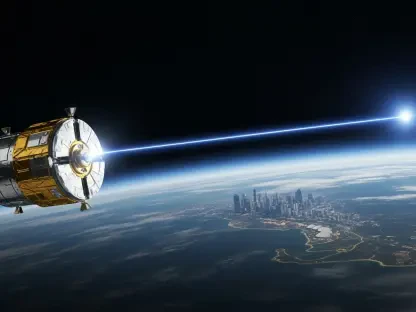

The vast, invisible network of fiber optic cables crisscrossing our continents and oceans, the very backbone of modern communication, may soon awaken to a second, more profound purpose beyond simply transmitting data. A pioneering initiative is now underway to transform this passive infrastructure into an active, continent-spanning sensory system capable of detecting environmental threats and monitoring the health of critical infrastructure in real time. The European Union’s ICON project is at the forefront of this effort, developing technology that leverages the inherent sensitivity of optical fibers to external stimuli. Light traveling through these hair-thin glass strands is exquisitely responsive to minute changes in vibration, pressure, and temperature. By learning to interpret these subtle fluctuations, researchers aim to give our global communication network the ability to listen to the world around it, heralding a new era in early-warning systems and proactive infrastructure management. This approach reimagines millions of kilometers of existing cable as a unified sensor, eliminating the immense cost and logistical challenge of building a comparable monitoring system from the ground up.
A New Sense for a Connected World
At the heart of this technological leap lies a fundamental property of optical physics: the light pulses carrying our data are incredibly sensitive to their physical environment. Any external force, such as the ground shaking from a distant tremor, the pressure change from a water leak, or the thermal stress on a bridge, causes microscopic expansions or contractions in the fiber optic cable. These physical changes, however small, alter the path and timing of the light signals traveling within. By deploying advanced analytical techniques to monitor these signals at their destination, scientists can effectively reverse-engineer the disturbances and pinpoint their location and nature along the cable’s length. This transforms the entire fiber optic line from a simple data conduit into a continuous, distributed sensor. Unlike traditional point sensors that only provide data for a single location, a fiber optic cable can offer a high-resolution profile of conditions along its entire route, which can span hundreds of kilometers through dense urban centers, remote rural landscapes, and deep ocean floors, offering an unprecedented level of situational awareness.
The impetus for developing such a system is driven by a convergence of urgent global challenges that demand more comprehensive and continuous monitoring capabilities. Europe, like many parts of the world, is grappling with the increasing frequency of extreme weather events, the strain of aging public infrastructure, and the heightened vulnerability of its communication and energy grids to both accidental damage and deliberate sabotage. The current paradigm of relying on isolated, dedicated sensors for monitoring everything from seismic activity to pipeline integrity is proving inadequate, as these systems have limited coverage and often leave vast, critical areas completely unobserved. The ICON project proposes a paradigm shift by retrofitting the existing telecommunications network for this new role. This approach promises to provide civil authorities and infrastructure operators with a powerful, large-scale, real-time data source for early-warning systems, enabling faster responses to emerging threats and a more predictive approach to maintenance and security without the disruptive and costly process of laying new, dedicated sensing infrastructure.
The Technology Behind the Vision
A significant technical challenge lies in enabling a single fiber optic cable to perform both its primary communication function and this new sensing role simultaneously, without any degradation in the quality of internet traffic. The data-carrying light signals must remain pristine, while a separate sensing signal coexists and gathers environmental information. To resolve this, the ICON team is engineering two core technological solutions. The first is a sophisticated “intent interpreter,” a software system that functions as a smart network manager. This tool translates high-level, human-readable requests from an end-user—such as a civil protection agency asking to “monitor for unusual vibrations along a specific subsea route”—into the complex, low-level technical instructions required to configure the network for a specific sensing task. It intelligently allocates network resources to ensure that the sensing operation can run effectively without interfering with the primary flow of internet data. This creates a seamless interface for non-expert users to leverage the network’s sensing capabilities on demand.
Complementing the intent interpreter is a “digital twin,” a live, virtual model of the physical fiber optic network that continuously updates with real-world data. This powerful simulation environment allows network operators to test and validate various sensing scenarios before they are deployed on the live infrastructure. An operator could, for example, simulate the impact of activating seismic monitoring along a busy terrestrial fiber route to predict any potential effects on communication services and optimize the parameters of the sensing task to prevent disruption. This risk-free virtual proving ground is essential for building the confidence and operational protocols needed to manage a dual-purpose network. Together, these tools form an integrated management system that promises to make the complex task of balancing high-speed data transmission with high-fidelity environmental sensing both safe and accessible, paving the way for widespread adoption.
A Future Woven from Light and Data
The potential applications stemming from this dual-use technology promised to be transformative across numerous sectors. In urban environments, the dense web of underground fiber could monitor traffic congestion by detecting vehicle vibrations, identify water main leaks through acoustic signatures, or assess the structural integrity of buildings and bridges in real time. Along remote terrestrial routes, the system could significantly augment earthquake monitoring, especially in regions with few traditional seismic sensors, providing a much denser and more detailed picture of ground movements. For subsea cables, the benefits were even more profound; they could provide invaluable early warnings for underwater landslides, which can trigger tsunamis, or track subtle changes in ocean temperature and currents relevant to climate science. Furthermore, the project aimed to bolster the security of critical national infrastructure. Since many fiber optic cables are co-located with gas pipelines, power lines, and railway tracks, the system could serve as a continuous surveillance mechanism, instantly detecting unusual vibrations that might signal accidental damage from construction equipment, anchor strikes, or malicious tampering. The initiative’s roadmap, progressing from laboratory validation to real-world field trials on production subsea cables, represented a critical step in proving the technology’s efficacy and resilience in noisy, high-traffic environments.