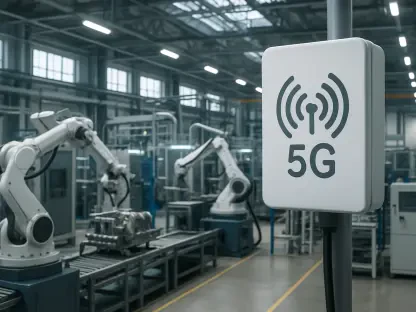

The traditional backbone of global connectivity is undergoing a seismic shift as the relentless push for artificial intelligence efficiency forces a total reckoning of how we build and fund mobile networks. For decades, the Radio Access Network (RAN) was a fortress of proprietary engineering, where each major vendor designed its own “secret sauce” in the form of bespoke hardware. However, a cooling global market and the astronomical costs associated with sub-5nm silicon manufacturing are rapidly making that isolated model obsolete. As the industry pivots, we are seeing a historic consolidation where the distinction between a specialized telecom baseband and a high-performance data center is essentially vanishing.
The Economic Drivers of Silicon Consolidation
Market Contraction: The R&D Sustainability Gap
The financial landscape for mobile infrastructure has transformed into a high-stakes game of survival where only the most scalable players can afford the entry fee. Global RAN spending has experienced a sharp contraction, falling from a high of $45 billion just a few years ago to roughly $35 billion today. This squeeze is particularly painful for Western vendors who find themselves locked out of the massive Chinese market, which historically provided the volume necessary to justify expensive custom chip designs. When the addressable market shrinks, the ability to amortize billion-dollar research and development cycles for Application-Specific Integrated Circuits (ASICs) becomes a mathematical impossibility for individual companies.
Furthermore, the leap to cutting-edge manufacturing nodes requires a level of sales volume that traditional telecom hardware cycles can no longer guarantee independently. Because developing a single flagship chip can now cost hundreds of millions of dollars, the risk of a “miss” is catastrophic. This economic reality is forcing even the most stubborn hardware advocates to reconsider their stance on proprietary silicon. The industry is moving toward a shared-cost model because the alternative is a financial dead end that threatens the very pace of 5G and 6G innovation.
The Shift Toward Virtualization: Cloudified Networks
A powerful industry consensus is emerging around the “cloudification” of the radio network, a movement that seeks to strip away specialized hardware in favor of software-defined environments. Led by forward-thinking giants like Samsung and Nokia, this transition involves moving the most compute-intensive Layer 1 processing tasks onto virtualized platforms. By shifting from dedicated, fixed-function baseband units to off-the-shelf servers, operators can gain unprecedented flexibility in how they deploy and scale their network capacity. This virtual RAN (vRAN) architecture treats the radio network as just another application running in the cloud, breaking the decade-long reliance on vendor-specific boxes.
This evolution is intrinsically linked to the “AI-RAN” concept, which seeks to maximize infrastructure utility by using the same hardware for both network processing and edge artificial intelligence tasks. Instead of having expensive silicon sitting idle during low-traffic periods, carriers can repurpose that computational power to run AI inference for local applications. This dual-use strategy transforms the RAN from a pure cost center into a versatile revenue generator, aligning the goals of telecommunications with the broader explosive growth of the global AI economy.
Industry Maneuvers: Collaborative Frameworks
Nvidia’s Kingmaker Strategy: Telecommunications Evolution
Nvidia has successfully positioned itself as the primary architect of the new telecom silicon landscape, leveraging its massive market capitalization to dictate the terms of network evolution. By deploying billions of dollars in strategic investments across a network of infrastructure players—including Marvell, Nokia, and Intel—the company is ensuring that its GPU-centric vision becomes the global standard. The core of this strategy is the CUDA platform, which Nvidia is using to transform complex radio processing into flexible code. This move effectively threatens to commoditize the specialized knowledge that traditional telecom vendors have guarded for thirty years.
The recent $2 billion investment in Marvell highlights a sophisticated hybrid approach where Nvidia backs custom silicon expertise while simultaneously pushing for a software-defined future. By becoming a major stakeholder in its potential rivals, Nvidia creates a “win-win” scenario where it profits whether the industry chooses pure GPUs or high-end shared ASICs. This “kingmaker” role allows the company to influence the fundamental building blocks of 5G and 6G, ensuring that the next generation of connectivity is built on an AI-first foundation.
Marvell’s Unified Silicon Proposal: Global Vendor Alignment
Marvell is championing a pragmatic middle ground by advocating for a single, industry-wide silicon platform that would serve all non-Chinese RAN vendors. This “one chip to rule them all” strategy aims to stabilize the market by allowing multiple customers, such as Nokia and Samsung, to share the massive R&D burden of modern chip design. If successful, Marvell would essentially become the universal foundry for the world’s radio networks, providing the power efficiency of custom ASICs with the economic scale typically reserved for general-purpose processors.
This approach acknowledges that while software is the future, certain mathematical functions are still performed most efficiently on specialized hardware. By offering a standardized platform, Marvell provides a safety net for vendors who are moving away from internal chip design but are not yet ready to fully commit to the overhead of general-purpose CPUs or GPUs. It is a strategic play to commoditize the hardware layer entirely, forcing competition to shift away from physical components and toward software-driven service differentiation.
Expert Perspectives: Technical Trade-offs
The debate over the ideal silicon architecture often comes down to the grueling physics of performance-per-watt. Industry analysts frequently point to Marvell’s custom ASICs as the gold standard for specific, “arcane” mathematical functions like Viterbi and Polar coding, which are essential for 5G processing. These specialized chips can perform these tasks with a fraction of the energy required by a general-purpose processor. For many operators, especially those in regions with high energy costs, this efficiency remains a critical factor that software-defined solutions struggle to match.
In contrast, thought leaders from Samsung and Intel argue that the flexibility of x86 or ARM-based architectures is the more sustainable path forward. They contend that as software matures and processors become more powerful, the specialized performance gap will narrow to the point of irrelevance. From their perspective, the ability to update a network’s capabilities via a simple software patch outweighs the marginal power savings of a fixed-function chip. Ericsson, however, remains a notable outlier in this conversation, maintaining that its deep, multi-decade investment in internal silicon provides a competitive advantage in performance and integration that shared platforms simply cannot replicate.
Future Outlook: Strategic Implications
The convergence of artificial intelligence and mobile connectivity is set to redefine the very definition of a cell site, blurring the lines between a data center and a radio tower. As we look toward the development of 6G, the distinction between “telecom gear” and “compute gear” will likely disappear entirely. If the unified silicon strategy succeeds, the industry will see a massive shift where vendor competition is defined solely by software innovation and AI integration. This represents a total departure from the historical model where a vendor’s value was tied to the physical properties of its proprietary radio hardware.
However, this transition brings significant risks regarding market concentration. With a small trio of titans—Nvidia, Intel, and Marvell—controlling the fundamental infrastructure of global communication, the industry faces a new type of vendor lock-in. While this consolidation solves the immediate problem of R&D sustainability, it creates a bottleneck where a few companies hold the keys to global connectivity. Ultimately, the demise of purpose-built, vendor-specific baseband hardware seems inevitable as standardized, AI-capable equipment becomes the global norm for carrier networks.
Conclusion: The New Infrastructure Paradigm
The shift toward a unified silicon strategy offered a necessary escape from the economic stagnation that threatened the telecom sector. As proprietary hardware models reached their financial breaking point, the industry successfully pivoted toward shared platforms and general-purpose architectures that aligned with the broader AI revolution. Stakeholders who prioritized software flexibility over hardware isolation were better positioned to navigate the consolidation of the supply chain. This transition ultimately replaced the fragmented legacy systems with a more resilient, cloud-native foundation that viewed connectivity as a specialized form of high-performance computing. Moving forward, the focus must remain on ensuring that this concentrated silicon market continues to foster open innovation rather than creating new digital monopolies. The era of the “black box” radio station was replaced by a transparent, software-defined ecosystem that treated global networks as a unified, programmable resource.