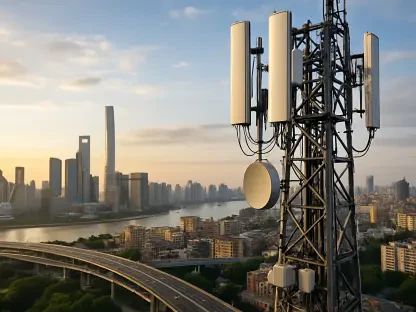
India’s monumental effort to establish one of the world’s most extensive 5G networks has been nothing short of breathtaking, yet recent data suggests this marathon buildout is now entering a more calculated and strategic phase of decelerating growth. As the digital backbone for the nation’s “Digital India” initiative, the fifth-generation wireless technology is critical for unlocking immense economic potential and future innovation. This analysis dissects the latest deployment data, examines distinctive regional trends and the unique strategy of state-owned BSNL, and projects the next chapter in the country’s ambitious 5G journey.
The Current State of 5G Expansion
Growth by the Numbers a Slowing Momentum
The latest figures from the Department of Telecommunications (DoT) confirm the continued, albeit moderating, expansion of 5G infrastructure. As of December, India had a total of 518,854 5G base transceiver stations (BTS) active nationwide. However, the addition of 4,112 new sites during the month marks a noticeable slowdown compared to the 6,010 towers installed in November, signaling a potential shift in deployment priorities for major telecom operators.
This expansion is not uniform, revealing significant regional concentration. Uttar Pradesh has emerged as the clear leader in 5G infrastructure with 60,168 sites, closely followed by Maharashtra with 54,261. This focus on densely populated and economically significant states underscores a strategy aimed at maximizing initial user uptake. Concurrently, southern states like Kerala and Karnataka have also demonstrated robust growth, indicating a broadening but still targeted rollout map.
BSNLs Unconventional 4G First Strategy
In a striking departure from the direct-to-5G approach of its private competitors, state-owned carrier BSNL is pursuing an unconventional path. The operator has committed to first installing approximately 23,000 new 4G sites across the country. This foundational network will then serve as the platform for a future upgrade to 5G, a move designed to establish broad coverage before introducing next-generation speeds.
What makes BSNL’s plan particularly noteworthy is its commitment to technological self-reliance. The eventual 5G upgrade will be powered exclusively by a homegrown Indian telecom stack developed by partners such as the Centre for Development of Telematics (C-DOT) and Tejas Networks. Further diversifying its model, BSNL is exploring a novel revenue-sharing framework that would allow private entities to deploy 5G equipment on its infrastructure, a stark contrast to the vertically integrated strategies of Bharti Airtel and Reliance Jio.
Expert Commentary on the Deployment Dynamics
Telecom analysts suggest the slowdown in network expansion is a natural evolution rather than a cause for concern. Many believe that private operators have largely achieved their initial coverage targets in major urban centers and are now shifting their focus from rapid infrastructure deployment to optimizing capital expenditure. This phase involves fine-tuning network performance and preparing for a sustained push into monetization and enterprise-level services.
The viability of BSNL’s indigenous stack strategy remains a topic of intense discussion among industry experts. Proponents highlight the immense benefits of fostering a self-reliant telecom ecosystem, reducing dependence on foreign vendors and boosting domestic innovation. However, critics point to potential integration challenges and the risk of falling behind competitors who are leveraging globally proven technologies. The success of this venture could fundamentally reshape India’s position in the global telecom manufacturing landscape.
This strategic divergence between private and state-owned carriers is expected to profoundly influence market dynamics. The aggressive, direct-to-5G rollouts by Jio and Airtel have already provided millions with high-speed connectivity, setting a high bar for consumer expectations. In contrast, BSNL’s methodical, phased approach, coupled with its focus on homegrown technology, could appeal to a different market segment and introduce new competitive pressures centered on cost and national technological sovereignty.
Projecting the Next Phase of Indias 5G Journey
Looking ahead, the Indian 5G landscape is poised for significant evolution. The immediate focus for private telcos will likely pivot from relentless network expansion toward developing and marketing compelling use cases, particularly for enterprise clients. This involves a strategic shift to service monetization, exploring revenue streams beyond simple data plans. Simultaneously, the industry will be closely watching BSNL’s progress as it works to complete its 4G rollout, a critical precursor to its 5G debut.
The long-term benefits of a mature, nationwide 5G network are transformative. This infrastructure is the key enabler for developing smart cities, deploying advanced Industry 4.0 solutions in manufacturing, and delivering next-generation digital services in healthcare, education, and entertainment. Realizing this vision depends on moving beyond basic connectivity to building a robust ecosystem of applications and services that leverage 5G’s unique capabilities.
Despite the rapid progress, significant hurdles remain on the path to ubiquitous 5G adoption. Bridging the persistent urban-rural digital divide is a paramount challenge that requires targeted investment and innovative deployment models. Furthermore, ensuring the long-term profitability for operators is crucial for sustained network investment, while the success of the homegrown telecom ecosystem hinges on its ability to scale efficiently and compete on a global stage.
Conclusion a Strategic Pause in a Digital Marathon
The analysis of India’s 5G deployment revealed a market in transition. The initial explosive growth had given way to a more measured pace, reflecting a strategic pivot by major operators who have largely met their primary coverage goals. The data highlighted not only this slowing momentum but also significant regional disparities in infrastructure density and the emergence of a distinct, self-reliant path being forged by the state-owned BSNL.
This maturing rollout underscored the foundational importance of a robust 5G network as a cornerstone for India’s future. The technology was positioned as the critical enabler for the nation’s technological sovereignty and long-term economic aspirations, promising to fuel innovation across every sector of the economy.
Ultimately, the narrative of India’s 5G journey was far from over. This phase of strategic diversification, driven by a quest for technological independence and the pressing need for widespread adoption, marked the beginning of a new chapter. The focus had clearly shifted from the speed of the rollout to the depth and sustainability of the digital transformation it would inspire.