
The traditional cellular network is shedding its skin as a simple conduit for data and reinventing itself as a high-performance computational engine capable of thinking in real time. For decades, the telecommunications industry has relied on a “pipe” model, where the primary goal was to move packets of data from point A to point B with as little interference as possible. Today, the collaboration between T-Mobile, Nokia, and Nvidia signals a departure from this static past, ushering in an era of the “intelligent fabric” where the network behaves more like a biological nervous system than a set of wires.
This evolution is driven by the AI RAN Alliance, a strategic collective determined to move beyond the limitations of traditional SIM card sales and basic connectivity. By focusing on “bits and tokens”—the fundamental units of both communication and artificial intelligence—carriers are positioning themselves to capture value from the exploding demand for generative AI. The urgency for real-world deployment is no longer a theoretical debate; it is a competitive necessity for operators who want to provide the underlying infrastructure for a world where every device is an AI-enhanced endpoint.
Why the Move to AI RAN Is Critical for the Future of Mobile Data
Traditional, single-purpose hardware has reached a breaking point in an era where data demands are growing exponentially and unpredictably. Standard Radio Access Network (RAN) equipment is often rigid, designed for specific telecommunications tasks that cannot easily scale or adapt to the localized needs of modern applications. Integrating AI directly into the RAN architecture addresses the fundamental economic challenges of 5G and the early frameworks of 6G, allowing the network to optimize itself and allocate resources dynamically based on real-time traffic patterns.
Strategic necessity now dictates that the network must become an open platform for third-party innovators. By breaking down the silos of proprietary hardware, operators can offer edge computing capabilities that were previously reserved for massive data centers. This transformation allows the network to serve as a distributed AI computer, making it possible for developers to build applications that require ultra-low latency, such as autonomous systems or immersive augmented reality, directly on the carrier’s infrastructure.
Breaking Down the AI RAN Trial: Technology, Timing, and Objectives
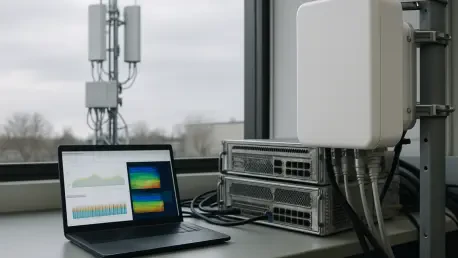
T-Mobile has issued a clear mandate to move from laboratory prototypes to active field trials within the next twelve months. This aggressive timeline reflects a desire to validate the performance and economic feasibility of software-defined radio in complex, real-world environments. By leveraging Nvidia’s GPU-accelerated platforms to power Nokia’s sophisticated radio software, the partnership seeks to prove that a single hardware stack can handle both the heavy lifting of wireless communication and the intensive processing required for AI workloads.
A primary objective of these trials is the validation of simultaneous workloads. Engineers are working to ensure that telco-specific tasks, such as beamforming and signal modulation, can coexist with AI applications without any loss in performance. A successful proof of concept recently demonstrated this capability through real-time video captioning; the network processed high-bandwidth video and generated descriptive text simultaneously, proving that the hardware can multitask at the edge without compromising the user’s connection quality.
Industry Perspectives: Redefining the Value Proposition of Carriers
The “up the food chain” philosophy is gaining traction among global leaders like SoftBank, Vodafone, and BT, who view the evolution of network architecture as a survival strategy. These experts argue that if carriers remain mere providers of connectivity, they risk being sidelined by the very platforms that run on their networks. By integrating AI agents into the core, operators can offer sophisticated services—like T-Mobile’s live translation feature—that utilize direct API integration to process language data within the network itself, rather than sending it to a distant cloud server.
Nokia has established a roadmap that distinguishes between the immediate experimental phase and long-term commercialization. While the current field trials focus on optimizing 5G software with advanced MIMO technologies, the target for a full-scale commercial rollout of AI-driven 5G is set for 2027. This phased approach allows the partners to refine the software-defined parameters of the network, ensuring that by the time the technology reaches the mass market, the transition will be as simple as a software update.
Strategic Implementation: How AI RAN Transforms Network Operations
Moving toward a software-driven infrastructure is a critical step in lowering the total cost of ownership (TCO) for mobile operators. Instead of replacing expensive physical base stations every time a new standard emerges, carriers can future-proof their investments by utilizing flexible GPU-based hardware. This shift toward 6G planning emphasizes seamless software updates over hardware overhauls, allowing the network to evolve at the speed of code rather than the speed of construction.
Operators are now developing frameworks to balance network reliability with high-performance AI processing at the edge. The goal is to transition from selling rigid phone plans to fostering a diversified service-based economy where enterprises pay for “compute-on-demand” alongside their data. As these trials moved forward, the focus shifted toward establishing global standards that ensured interoperability between different vendors. This cooperative approach enabled a more resilient ecosystem where AI-driven efficiency became the baseline for all future connectivity, ultimately transforming the carrier from a utility provider into a central pillar of the global AI economy.