
Vladislav Zaimov has spent his career at the heart of the world’s most complex communication infrastructures, navigating the shift from simple voice calls to the massive data demands of the modern era. As an expert in enterprise telecommunications and the risk management of vulnerable networks, he understands that the next leap in technology isn’t just about faster downloads, but about the seamless orchestration of physical movement. In this conversation, we explore the emerging concept of “kinetic tokens” and how the transition to 6G will turn mobile networks into the central nervous system for autonomous robots, drones, and industrial automation.
Informational tokens typically summarize or predict data, while kinetic tokens trigger physical actions like movement in drones and autonomous vehicles. How do the millisecond latency requirements for these physical actions change network architecture, and what specific challenges arise when coordinating these tokens in the real world?
When we talk about the shift from informational to kinetic tokens, we are moving from the world of “thinking” to the world of “doing.” Informational tokens are like a brain processing a thought—they describe or predict—but kinetic tokens are the electrical impulses that actually move the muscles of a drone or a robot. This creates a high-stakes environment where a delay of even a few milliseconds isn’t just a buffering icon; it’s a potential collision or a mechanical failure. To support this, we have to move away from centralized architectures and bake the intelligence directly into the edge of the network so that the distance the signal travels is physically minimized. The coordination challenge is immense because you are managing thousands of moving parts in three-dimensional space, all requiring a level of precision that traditional networks simply weren’t built to handle.
While centralized data centers handle massive compute, physical AI requires edge supplementation to ensure time-space coherency. Why are traditional cloud environments often ill-equipped for this level of synchronization, and how can mobile infrastructure serve as a more effective distribution hub for these real-time workloads?
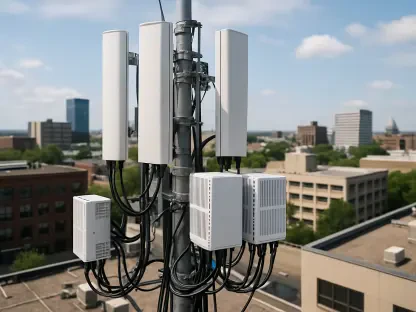
Traditional clouds are designed for massive scale and storage, but they lack the “time-space coherency” that physical action demands. When you send a command from a distant data center, the journey through the various layers of the internet introduces jitter and lag that makes perfect synchronization nearly impossible. Mobile operators, however, have been perfecting synchronization for decades; every time you make a phone call, the entire system must be perfectly aligned to deliver that voice data without a break. We are now taking that professional expertise in synchronization and applying it to the radio network, turning cell sites into distribution hubs that live right next to the action. This proximity allows the network to recognize specific workloads and provide a dedicated Quality of Service that a distant cloud provider can’t match without constant, high-latency check-ins.
6G is being developed as an AI-native generation, building on foundations like 5G Standalone and 5G Advanced. How is AI currently being used to optimize cell site placement based on user experience, and what technical steps are necessary to transition these capabilities into a fully integrated 6G environment?
We aren’t actually waiting for 6G to start this journey, as the foundations were laid when the first nationwide 5G Standalone core launched in 2020 and were furthered by the rollout of 5G Advanced last April. Today, we use AI to implement what we call “customer-defined coverage,” which is a sophisticated way of letting the user’s actual experience dictate the network’s evolution. Instead of guessing where signal is needed, AI analyzes real-world performance data to tell us the exact optimal location for the next cell site. To move this into a 6G environment, we need to transition from using AI as a planning tool to using it as the primary operating system of the network. This involves moving toward an AI-RAN architecture where every radio component is capable of making split-second processing decisions to support the kinetic demands of the devices connected to it.
Integrating GPUs into radio access networks represents a significant shift from traditional ASIC and CPU processing. Given the differing industry opinions on AI deployment, how can operators balance various vendor requirements with the need for a system that processes both bits and tokens with maximum efficiency?
For the longest time, the telecommunications industry was a world of ASICs and CPUs, which are great for specific, repetitive tasks but lack the raw, parallel processing power needed for AI. The introduction of GPUs into the RAN—highlighted by massive $1 billion investments from major players—is a fundamental rethinking of how we handle telco computation. As an operator, the goal is to avoid being prescriptive about specific chips or hardware and instead focus on the ultimate requirement: a network that handles traditional data bits and modern kinetic tokens simultaneously. By picking world-class vendors and giving them strict performance and cost-efficiency targets, we can foster a competitive environment where different hardware approaches all strive for the same goal. It’s a delicate balancing act, but the result is a future-proof network that acts as a “token factory,” producing the physical actions that will drive the next industrial revolution.
Physical AI signals a shift from generating digital content to orchestrating real-world industrial automation and robotics. Which specific enterprise use cases do you anticipate will reach the market first, and what metrics should be used to measure the success of these remotely managed, AI-driven operations?
I anticipate that the first wave of meaningful market adoption will be in remotely managed drones and autonomous logistics robots within smart factories. These are environments where the precision of movement is critical, and the network can provide the necessary low-latency “connective tissue” to keep them operating safely. When we measure success, we have to look beyond traditional metrics like download speeds and move toward “reliability of intent”—how accurately a remote command translates into a physical action. We will be watching for how these enterprises pay for guaranteed performance levels, essentially treating the network as a reliable utility for their robotics. If a factory can run 24/7 with zero “desync” events between its AI brain and its mechanical limbs, that will be the ultimate proof of the kinetic token’s value.
What is your forecast for physical AI?
My forecast for physical AI is that it will serve as the primary catalyst for 6G, transforming the mobile network from a communication tool into a global orchestration platform for physical movement. We are going to see a surge of interest around MWC 2026 as the industry realizes that “kinetic tokens” represent a massive new revenue stream that goes far beyond selling data plans. Within the next decade, the synchronization expertise of mobile operators will be the backbone of a world where autonomous cars, delivery drones, and robotic assistants move with the same fluid reliability we currently expect from a high-definition video call. The network will no longer just be a pipe for information; it will be the very thing that makes the physical world smarter, safer, and infinitely more coordinated.