
In a remarkable display of operational resilience that has become a hallmark of the modern space industry, SpaceX has successfully resumed its ambitious launch schedule following a brief, self-imposed stand-down. The rapid return to flight, which saw a Falcon 9 rocket ascend from the California coast less than a week after an in-flight anomaly, serves as a powerful testament to the company’s mature investigative processes. More significantly, the swift and transparent resolution of the technical issue garnered the full confidence of its most crucial partner, as NASA officially cleared the upcoming Crew-12 mission for its journey to the International Space Station. This sequence of events, from a minor malfunction to a full-scale operational recovery and human spaceflight clearance, highlights the intricate dance between innovation, regulation, and trust that defines today’s access to orbit, demonstrating that even a momentary setback can ultimately reinforce the robustness of the entire launch system when handled with precision and openness.
Anatomy of an Anomaly
From Mission Success to Off-Nominal Event
The chain of events was set into motion on February 2, during what initially appeared to be a flawless execution of the Starlink 17-32 mission. The Falcon 9 rocket performed its primary task perfectly, successfully deploying its full payload of 25 satellites into their designated orbit, a procedure that has become almost routine in the era of megaconstellations. However, the mission’s final phase encountered an unexpected snag. As the rocket’s second stage prepared for its crucial deorbit burn, a maneuver designed to ensure the stage’s controlled and safe disposal to prevent it from becoming long-term space junk, it experienced what engineers term an “off-nominal condition.” The Merlin Vacuum (MVac) engine, responsible for this final propulsive push, failed to ignite as planned. While this failure did not jeopardize the primary mission’s success, it immediately triggered a meticulous review process, underscoring the high standards required for every single phase of a spaceflight operation, from launch to atmospheric reentry.
The implications of such a failure, even on an uncrewed mission, extend far beyond the single piece of hardware involved. The deorbit burn is a critical component of SpaceX’s commitment to responsible orbital stewardship, a practice that is becoming increasingly vital as low-Earth orbit becomes more congested. The inability to perform this maneuver meant the upper stage would undergo an uncontrolled, albeit safe, atmospheric reentry. In response to this deviation from the mission plan, SpaceX immediately demonstrated its cautious approach by pausing its launch operations. This decision directly impacted the Starlink 6-103 mission, which was already on the launch pad at Cape Canaveral Space Force Station. The rocket and its payload were promptly rolled back to the hangar, signaling to the industry and its partners that no detail is too small to warrant a thorough investigation, especially when the integrity of the Falcon 9 platform is in question, a platform that serves as the backbone for both commercial satellite deployment and human spaceflight.
A Swift Investigation
In the immediate aftermath of the anomaly, SpaceX initiated a formal mishap investigation in close coordination with its regulatory overseer, the Federal Aviation Administration (FAA). The process was characterized by its speed and transparency, with engineering teams working around the clock to dissect telemetry data and pinpoint the exact cause of the engine’s failure to ignite. The investigation quickly concluded that the root cause was not a fundamental design flaw but rather a specific operational issue: a gas bubble had formed in the engine’s transfer tube, creating a void that prevented the proper flow and ignition of propellants. This precise diagnosis was crucial, as it allowed the company to develop targeted corrective actions rather than embarking on a lengthy and costly redesign. The findings, along with a comprehensive plan of technical and organizational preventative measures, were presented to the FAA for review. This collaborative effort between the commercial operator and the government regulator is central to maintaining safety standards in the fast-paced environment of modern space launch.
Following the investigation, the ultimate fate of the errant second stage was confirmed. Despite its inability to perform the powered deorbit burn, the stage’s autonomous systems functioned exactly as designed for such a contingency. It successfully “passivated” itself by venting all remaining propellants and pressurants, rendering it inert and mitigating any risk of an on-orbit explosion. Approximately 10.5 hours after its mission began, the stage naturally reentered Earth’s atmosphere over a remote stretch of the Southern Indian Ocean. Critically, no sightings of debris were reported, and there was no third-party damage, validating the predictive models for its reentry trajectory. Satisfied with SpaceX’s thorough investigation and the implemented corrective actions designed to prevent a recurrence, the FAA officially closed its inquiry on the evening of Friday, February 6. This final step provided the official authorization for SpaceX to resume its FAA-licensed flights, clearing the path for a return to its characteristically high launch tempo in less than a week.
Back in the Saddle
The Starlink 17-33 Mission
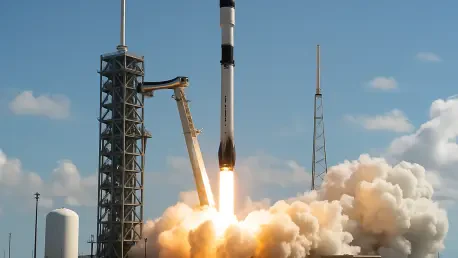
With the formal green light from the FAA, SpaceX demonstrated its operational agility by proceeding with its next launch without delay. On February 7, just five days after the anomaly, a Falcon 9 rocket roared to life at Space Launch Complex 4E at Vandenberg Space Force Base in California, carrying the Starlink 17-33 mission. The successful liftoff served as a powerful and immediate statement of confidence in the rocket’s reliability and the effectiveness of the recently concluded investigation. The mission flawlessly delivered another 25 Starlink satellites into low-Earth orbit, continuing the relentless expansion of the company’s global internet service. The seamless execution, from countdown to payload deployment, underscored the company’s ability to isolate a specific technical issue, implement a solution, and return to its high-cadence launch schedule with minimal disruption. This rapid turnaround is a key element of SpaceX’s business model and a significant advantage in the competitive commercial launch market.
The successful launch was not merely a symbolic return to flight; it represented a tangible continuation of one of the most ambitious satellite deployment campaigns in history. With the addition of the Starlink 17-33 satellites, the total number of spacecraft in the megaconstellation surged to over 9,600. Each launch further solidifies the network’s capacity and coverage, bringing high-speed internet to underserved regions across the globe. For SpaceX, the ability to maintain this launch pace is paramount. The swift resolution of the deorbit burn anomaly ensured that the deployment schedule for its flagship satellite program remained largely on track. This event provided a real-world stress test of the company’s internal processes, proving that its system for identifying, analyzing, and rectifying in-flight issues is robust enough to handle unexpected challenges without causing cascading delays across its packed manifest, a critical capability for an operator managing multiple commercial, civil, and national security missions simultaneously.
Reusability as Routine
The return-to-flight mission also served as another prominent showcase for the maturity and reliability of SpaceX’s pioneering reusability program. The workhorse for the Starlink 17-33 launch was a flight-proven Falcon 9 first stage booster, identified by its tail number, B1088. This particular booster was embarking on its 13th journey to space, a testament to the durability and efficiency of the reusable architecture. Its extensive flight history includes a diverse range of missions, demonstrating its versatility by launching payloads for NASA’s astrophysics division (SPHEREx), commercial ride-share customers (Transporter-12), and the U.S. National Reconnaissance Office. This level of reuse, once considered a distant dream in the aerospace industry, has become a standard and expected component of every SpaceX launch, fundamentally altering the economics of accessing space and enabling the high launch frequency that defines the company’s operations. The successful flight of a veteran booster sent a clear message that the recent anomaly was contained to the second stage and had no bearing on the integrity of the reusable first stage.
Further cementing the routine nature of its operations, the B1088 booster completed its mission with a picture-perfect landing. Nearly eight and a half minutes after liftoff, the first stage descended through the atmosphere and touched down precisely on the deck of the autonomous drone ship ‘Of Course I Still Love You’, which was positioned in the Pacific Ocean. This successful recovery marked the 176th landing on that specific drone ship and represented SpaceX’s 568th successful booster recovery overall. These staggering numbers illustrate how the once-extraordinary feat of landing an orbital-class rocket has been transformed into a standard, almost mundane, part of the launch sequence. Each successful landing not only saves millions of dollars in hardware costs but also provides invaluable data that engineers use to refine the system, improve turnaround times, and push the boundaries of what is possible in launch vehicle reusability. This operational efficiency is the engine that drives SpaceX’s ability to respond so quickly to challenges and maintain its leadership in the global launch market.
Mission Confidence and Future Flights
NASA’s Seal of Approval for Crew-12
The timing of the second-stage anomaly could not have been more sensitive, as it occurred just days before the scheduled launch of NASA’s SpaceX Crew-12 mission to the International Space Station. The prospect of any technical issue, no matter how minor, on the same model of rocket slated to carry astronauts naturally triggers an exceptionally high level of scrutiny. As part of its rigorous, multi-day Flight Readiness Review, NASA officials conducted an exhaustive evaluation of SpaceX’s investigation data, methodology, and proposed corrective actions. The agency’s safety panels and engineering experts delved deep into the specifics of the failure, seeking to understand not only what happened but also whether any potential risk, however remote, could carry over to a crewed flight. The collaboration between the NASA and SpaceX teams during this review was intensive, reflecting the shared commitment to crew safety as the absolute highest priority in human spaceflight endeavors.
Ultimately, NASA’s comprehensive assessment concluded that the deorbit burn failure posed no increased risk to the safety of the Crew-12 astronauts. The key determining factor in this decision was a fundamental difference in the mission profile for the Falcon 9 second stage when launching a Dragon spacecraft compared to a Starlink mission. The trajectory and deorbit sequence for a crewed launch are distinct and do not involve the same operational parameters that led to the gas bubble formation in the Starlink 17-32 mission. With this critical distinction established and all questions satisfactorily answered, NASA officially gave its seal of approval. The agency, alongside SpaceX, formally declared that they were “go” to proceed with the Crew-12 launch, which remained on schedule for February 11. This decisive clearance was a powerful vote of confidence in SpaceX’s investigative capabilities and its transparent partnership with the agency, reaffirming the trust that underpins the public-private model for sending American astronauts to space.
A Commitment to Orbital Safety
The investigation into the anomaly also provided a valuable window into SpaceX’s evolving philosophy regarding the mitigation of space debris. In a public update, the company reaffirmed its deep commitment to performing controlled deorbit burns of its upper stages whenever possible, a practice essential for maintaining a sustainable orbital environment. The statement highlighted that SpaceX has been actively developing “novel methods” to enable deorbit burns even on performance-constrained missions where, in the past, an upper stage might have been left passivated in orbit. This proactive approach demonstrates a forward-looking strategy aimed at minimizing the company’s long-term environmental impact in space. By treating every launch as an opportunity to refine and improve its disposal procedures, SpaceX aims to set a high industry standard for responsible operations, acknowledging that the privilege of accessing space comes with the duty to protect it for future generations of explorers and operators.
This commitment was further contextualized with specific data from recent years. The company noted that in the period spanning 2024 and 2025, a total of 16 upper stages had been left passivated in orbit without a deorbit burn. Of those, 10 were on missions whose profiles were not originally designed to include the final maneuver. The incident with the Starlink 17-32 mission, therefore, was framed not just as a failure but as part of a continuous improvement process. The lessons learned from the gas bubble issue have been integrated into a broader effort to enhance the overall reliability of the Falcon platform’s end-of-life systems. The incident, and the rapid, transparent response to it, ultimately served to reinforce the trust of regulators and partners. It demonstrated that SpaceX possesses a mature system capable of handling anomalies effectively, ensuring that even when things do not go exactly as planned, public safety and the long-term health of the orbital environment remain paramount considerations.