
The intricate orchestration of cranes, vehicles, and personnel within a major deep-sea port generates a torrent of data that older wireless technologies simply cannot manage effectively. Private 5G technology represents a significant advancement in the maritime and logistics sector. This review will explore the evolution of private wireless in ports, its key features and applications, performance metrics demonstrated by real-world deployments, and the impact it has on operational efficiency and safety. The purpose of this review is to provide a thorough understanding of the technology’s current capabilities, using the Port of Tyne as a key case study, and its potential for future development across the industry.
The Dawn of a New Era in Port Connectivity
The introduction of private 5G networks marks a pivotal shift for maritime ports, moving them from siloed industrial sites to fully integrated digital ecosystems. Unlike traditional Wi-Fi, which often struggles with coverage gaps, interference, and handover issues in large, metallic environments, private 5G offers a dedicated, secure, and highly reliable connectivity layer. This technology is not merely an incremental upgrade; it is a foundational pillar of the Industry 4.0 transformation, providing the robust communication backbone necessary for the large-scale deployment of IoT sensors, autonomous systems, and data-intensive analytics.
At its core, a private 5G network is a localized cellular network designed for a specific enterprise, granting complete control over data, security, and quality of service. Its components include a compact 5G Core, radio access network (RAN) equipment, and dedicated spectrum, which together create a high-performance bubble of connectivity across the entire port facility. This tailored approach ensures that critical operational traffic is prioritized, free from the congestion and variability of public networks, thereby enabling a new class of applications that demand unwavering performance.
Core Capabilities and Technical Architecture
High Performance Low Latency Network Infrastructure
The success of any smart port initiative hinges on the underlying network’s ability to transmit vast amounts of data with minimal delay. The deployment at the Port of Tyne, operational since 2023, exemplifies this principle. The infrastructure, installed by Projex Cellular Infrastructure UK, provides coverage across 19 outdoor sites using a strategic combination of BT’s licensed and shared access spectrum for both 5G and LTE. This hybrid spectrum approach guarantees both broad coverage and high-capacity hotspots where needed.
This architecture delivers the high-bandwidth and low-latency connectivity essential for real-time industrial applications. Whether processing live video feeds from high-resolution cameras or transmitting telemetry data from moving vehicles, the network ensures that information arrives instantly and intact. This level of performance is critical for systems that rely on immediate feedback, such as remote equipment control and automated decision-making, forming the reliable digital nervous system of the entire port.
Integration with Artificial Intelligence and IoT
Private 5G serves as the crucial enabler for a suite of advanced, data-driven applications that would be impractical over less capable networks. Its true power is unlocked when combined with Artificial Intelligence (AI) and the Internet of Things (IoT). The network’s ability to connect thousands of sensors and devices reliably allows for the collection of comprehensive, real-time data from every corner of the operation.
At the Port of Tyne, this synergy is evident in how connectivity fuels sophisticated monitoring, analysis, and automation. AI algorithms process video streams to detect safety compliance, analyze road conditions, and track assets with unparalleled accuracy. This fusion of reliable data transport and intelligent processing transforms raw information into actionable insights, driving the significant operational gains that have defined the project’s success.
Industry Trends and the Competitive Landscape
The Port of Tyne project is not an isolated experiment but rather a prominent example of a broader industry trend toward private 5G adoption in the maritime sector. Technology provider Ericsson has established a significant global footprint, with its solutions powering numerous port facilities worldwide. This growing portfolio signals that private wireless has matured from a promising concept into a proven, mission-critical solution for complex industrial environments.
This movement has also fostered a competitive market landscape. While Ericsson has secured a leading position, key rivals like Nokia remain formidable forces. Nokia’s success in securing a deal at the UK’s Thames Freeport, for instance, underscores the widespread demand for these advanced networks. This healthy competition continues to drive innovation and demonstrates the industry’s collective confidence in private 5G as the definitive connectivity standard for the ports of the future.
Real World Impact The Port of Tyne Case Study
Driving Operational Efficiency and Automation
The tangible benefits of private 5G are most clearly seen in the optimization of daily operations. At the Port of Tyne, use cases have directly translated into enhanced productivity and streamlined workflows. For example, live container scanning allows for faster cargo processing, significantly reducing vessel turnaround times. Furthermore, the deployment of drones for stock control and infrastructure inspection provides near-real-time inventory data and proactive maintenance insights, replacing time-consuming manual processes.
Automation extends to ground-level logistics, where AI-powered cameras analyze road conditions to optimize vehicle routing and prevent costly delays or damage. These applications, all dependent on the network’s continuous data flow, work in concert to create a more efficient, predictable, and cost-effective operational environment. The result is a port that can handle more throughput with greater accuracy and less friction.
Revolutionizing Worker Safety and Site Security
Beyond efficiency, the private 5G network has fundamentally reshaped the approach to worker safety and site security. AI-driven video analytics actively monitor for correct personal protective equipment (PPE) usage and detect unauthorized entry into restricted areas, providing immediate alerts to safety personnel. This proactive system helps prevent accidents before they occur. The network also supports advanced emissions monitoring, contributing to a healthier and more sustainable work environment.
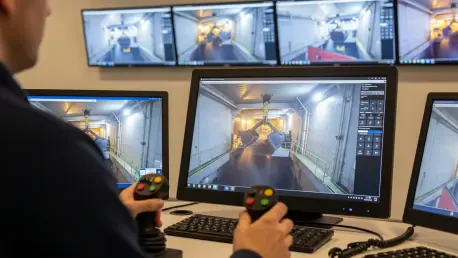
A groundbreaking application of this technology is the implementation of Caterpillar’s CatCommand system. This allows operators to control heavy machinery like shovels remotely from a safe, centralized location, removing them from the hazardous conditions inside a ship’s hold. This single use case perfectly illustrates the technology’s potential to not only optimize processes but also to create a fundamentally safer workplace by distancing humans from inherent operational dangers.
Challenges and Implementation Considerations
Despite its clear advantages, deploying a private 5G network in a sprawling and dynamic port environment is not without its challenges. One of the primary technical hurdles is the integration with legacy operational technology (OT) systems, which often were not designed for modern network connectivity. Ensuring seamless communication between new 5G-enabled devices and older, established control systems requires careful planning and specialized expertise.
Furthermore, regulatory complexities surrounding spectrum licensing can present a significant obstacle. Securing the appropriate frequencies is a critical step that varies by region and can involve intricate negotiations with national regulators and carriers. Finally, the market barrier of the significant initial investment required for infrastructure, hardware, and integration services must be considered. While the long-term return on investment is compelling, the upfront capital expenditure remains a key consideration for port authorities.
The Future of Smart Ports with 5G Evolution
Looking ahead, the evolution of 5G technology promises to unlock even more transformative capabilities for the maritime industry. The foundation laid by current deployments will pave the way for the expansion of fully autonomous vehicle fleets, where trucks, straddle carriers, and cranes can coordinate their movements with millisecond precision, creating a seamless flow of goods from ship to shore.
The future will also see deeper integration of AI for applications like predictive maintenance, where sensors on critical equipment can anticipate failures before they happen, drastically reducing downtime. Over the long term, these advancements will contribute to the creation of hyper-efficient, sustainable, and globally competitive logistics hubs. As networks evolve toward 6G, the potential for even more immersive and intelligent port operations will continue to expand, further solidifying the role of dedicated wireless as the lifeblood of modern trade.
Conclusion A Proven Model for a Connected Future
The comprehensive review of private 5G’s role in port networks found that the technology delivered on its promise of high-performance connectivity. The implementation at facilities like the Port of Tyne served as a powerful testament to its capability to support a new generation of data-intensive industrial applications. The project’s success in leveraging this infrastructure for tangible gains in productivity, automation, and worker safety was clearly demonstrated. Ultimately, the Port of Tyne case study established a new and validated standard for the industry, providing a proven model for building the connected, intelligent, and secure ports of the future.