
Beneath the tranquil surface of the world’s oceans, a silent and ferociously competitive construction boom is underway, laying the physical foundation for the abstract intelligence that is rapidly reshaping our planet. The internet is not a cloud; it is a sprawling, tangible network of over 500 active fiber-optic cables resting on the seabed, forming the circulatory system of the global economy. As artificial intelligence evolves from a niche technology into a ubiquitous utility, its insatiable demand for data is forcing a radical and expensive overhaul of this critical infrastructure. The central question is no longer about connecting people, but about connecting massive, continent-spanning machine minds, prompting a multi-billion-dollar race to the bottom of the sea.
A Paradigm Shift Beneath the Waves from Telecoms to Tech Giants
For decades, the construction of subsea cables was the domain of large telecommunications consortia. These groups of national carriers would pool immense resources to undertake the technically challenging and financially demanding task of linking continents. This model, based on shared risk and collective benefit, defined the first great eras of global connectivity, slowly and methodically wiring the world. It was a utility-driven approach, designed to carry the aggregated communications traffic of entire nations.
That era has decisively ended. The primary drivers, funders, and increasingly, the sole owners of new subsea cable systems are now the hyperscale technology giants: Google, Meta, Amazon Web Services (AWS), and Microsoft. This fundamental transformation is motivated by an entirely different strategic imperative. Instead of connecting countries, these companies are connecting their own vast, proprietary networks of global data centers. As they build out colossal cloud regions and AI processing hubs, they require private, ultra-high-capacity data highways to move petabytes of information between their facilities with minimal latency, turning the ocean floor into an extension of their private networks.
The year 2025 stands as the pivotal moment when this trend has not just matured but become the undisputed industry standard. The sheer scale of private capital being deployed has dwarfed previous investment cycles, fundamentally reordering the power dynamics of global data infrastructure. The decisions made in the boardrooms of Silicon Valley now dictate where and how the next generation of the world’s most critical communication arteries are laid, shifting the focus from public interconnectivity to private, performance-driven architecture.
Mapping the New Digital Empires with a Flurry of Hyperscaler Projects
The evidence of this new reality is etched across global maritime maps in the form of ambitious new cable projects. Google Cloud, for instance, announced the TalayLink cable, a strategic system designed to connect Australia and Thailand. This route purposefully runs west of the congested Sunda Strait, providing a resilient and diverse pathway that enhances the robustness of connectivity in the region. This project is not merely a data pipe but a strategic move to build new connectivity hubs and fortify its infrastructure footprint.
Meanwhile, Meta has demonstrated an unparalleled appetite for scale. This year saw the completion of the 45,000-kilometer 2Africa cable, a monumental achievement that now stands as the largest subsea network in existence, encircling the African continent and linking it to 33 countries. Not content to rest, Meta has already announced its next colossal venture: Project Waterworth. Projected to span an astonishing 50,000 kilometers and cost an estimated $10 billion, it represents Meta’s first wholly-owned global system, a clear signal of its long-term infrastructure ambitions.
This trend is industry-wide. AWS has made its own significant move toward independence with the announcement of Fastnet, its first wholly-owned trans-Atlantic cable connecting the U.S. to Ireland, set to be operational by 2028. Microsoft, while often favoring partnerships, has also doubled down on its investments, striking deals with both Hibernia and Aqua Comms to bolster the crucial data corridors between its North American and European data centers. This flurry of activity is reflected in market data from TeleGeography, which projects a staggering $13 billion investment in new cables between 2025 and 2027, an amount that nearly doubles the capital deployed in the prior three-year period.
The AI Catalyst and Really Expensive Warehouses Without Connectivity
The driving force behind this unprecedented spending can be summarized in one acronym: AI. Alex Aime, Meta’s vice president of network investments, articulated the logic directly, stating that AI is dramatically increasing the company’s need for subsea infrastructure. He offered a stark analogy, comparing multi-billion-dollar data centers to “really expensive warehouses” if they lack the robust connectivity to function as an integrated network. This perspective reveals the core truth of the modern digital economy: computational power is useless if the data it needs to process is stranded on another continent.
This logic is inescapable. Training large language models and other generative AI systems requires shuttling massive datasets between specialized GPU clusters located in different data centers around the world. Once deployed, these models must serve billions of user queries in real-time, a task that demands ultra-low-latency connections. The private subsea cables being built by hyperscalers are the only infrastructure capable of providing the necessary bandwidth and reliability to support these demanding, distributed AI workflows.
While private builds dominate the headlines, the overall demand for data is lifting the entire sector. In the data-intensive intra-Asian corridors, consortium-led projects remain critical for adding massive capacity. This year, key systems like the Asia Direct Cable (ADC) and the Southeast Asia-Japan Cable 2 (SJC2) became operational, adding vital terabits of capacity between major hubs like Singapore, Hong Kong, and Japan. This concurrent growth in both private and shared infrastructure underscores the truly global and all-encompassing nature of the AI-driven data explosion.
Navigating Geopolitical Fault Lines and Emerging Threats
As the value of this undersea infrastructure soars, so too does its vulnerability to geopolitical conflict and sabotage. The waters around Taiwan have become a flashpoint, with multiple cable disruptions this year. A civilian cargo ship was suspected of deliberately severing a key cable, an act that experts describe as a prime example of “gray zone tactics”—disruptive actions that fall just below the threshold of declared warfare but can cripple a nation’s communications.
In response, Taiwan is moving swiftly to harden its infrastructure. The government is subsidizing the construction of new international landing stations and promoting a diversified communications strategy that includes non-physical backups like microwave and satellite technologies. Concurrently, its legislature is advancing new laws that impose far harsher penalties for damaging submarine cables, elevating the crime to the same level as sabotaging critical national utilities. This multi-pronged approach reflects a growing recognition that digital sovereignty depends on physical resilience.
This heightened security consciousness is not limited to Asia. Spurred by events in the Taiwan Strait and suspected sabotage in the Baltic Sea, the U.S. Federal Communications Commission (FCC) adopted comprehensive new rules to secure the subsea cable supply chain. In a clear message, regulators are now explicitly prohibiting the use of hardware from entities deemed a security risk, such as Huawei and ZTE, in these critical systems. The race to build is now inextricably linked to a race to secure.
The Achilles Heel of an Aging Fleet and the Looming Repair Crisis
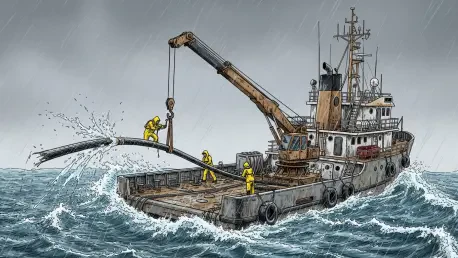
For all the focus on building new, high-tech cables, a critical vulnerability lies in the aging, low-tech fleet of ships responsible for their maintenance. A sobering report from the SubOptic Association forecasts a looming crisis: by 2040, an alarming 47% of the world’s cable repair vessels will have reached the end of their 40-year service lifespans. These specialized ships are the only defense against the inevitable faults caused by anchors, fishing trawlers, and seismic activity.
This pending obsolescence is colliding with explosive network growth. The same report projects that the total length of deployed cable will grow by 48% by 2040, yet the capacity to perform repairs is only expected to increase by 36%. This growing “disconnect,” as the report authors warn, creates the potential for significantly prolonged outages, especially in high-risk areas. A single fault that might take days to repair today could take weeks in the future, with cascading economic consequences.
Addressing this shortfall requires immediate and substantial investment. An estimated $3 billion is needed to fund 15 replacement vessels for the aging fleet and add five new ships just to maintain current service levels. The market is beginning to respond to this clear need. In a significant move, the Singapore-based firm Keppel acquired Global Marine Group, one of the largest independent providers of subsea cable maintenance. This acquisition signals that major industry players are recognizing that the undersea gold rush is not just about laying fiber, but also about securing the ability to repair it.
The events of 2025 painted a clear and complex picture of the world’s digital backbone. It was a year defined by a historic, AI-fueled investment surge that saw technology giants pour billions into creating private data oceans. This aggressive expansion, however, unfolded against a backdrop of rising geopolitical threats that forced nations to treat these commercial assets as strategic national infrastructure. Finally, the industry was confronted with the quiet, looming crisis of its own aging maintenance fleet, a logistical vulnerability that threatens the very reliability of the network it is so frantically trying to build. The great undersea cable buildout of this era was not merely about adding capacity; it was an endeavor that tested the intersection of technology, security, and logistical foresight.