
The modern smartphone user rarely considers the physics of a cellular signal until they step into an elevator or a basement and the bars on their screen abruptly vanish. For years, the dream of direct-to-device (D2D) satellite connectivity has promised to erase those “dead zones” once and for all, yet most current solutions still require a clear, unobstructed view of the open sky. As we move through 2026, the industry is no longer content with providing a mere emergency lifeline for wilderness explorers; the new benchmark is “five-bar” service inside the concrete-and-glass fortresses of our cities.
This transition represents the most significant technical hurdle since the inception of commercial satellite networks. While the ability to send a text from the middle of the Pacific Ocean is an engineering marvel, it does little for the suburban professional whose home office happens to be a cellular blind spot. If satellite providers cannot penetrate the physical barriers of modern architecture, the technology will likely remain a specialized backup service rather than the universal connectivity solution it aspires to be.
Moving Beyond the “Emergency-Only” Era of Satellite Connectivity
The narrative of satellite communication is rapidly evolving from a niche safety feature into a legitimate contender for daily mobile traffic. In previous years, the primary goal was ensuring that a stranded hiker could reach emergency services via a low-bandwidth burst. Today, however, consumer expectations have shifted toward seamless integration, where a video call or data stream continues uninterrupted as a user moves from a terrestrial 5G zone into a satellite-serviced area.
To achieve this, the industry must overcome the inherent limitations of high-frequency signals, which are easily deflected or absorbed by common building materials. A signal that has traveled 350 miles from low Earth orbit arrives at the ground with very little energy left to spare. Consequently, the challenge for engineers in 2026 and 2027 is to ensure that these faint whispers from space can survive the final fifty feet through shingles, insulation, and reinforced concrete.
Why the In-Building Hurdle Defines the Success of Satellite D2D
The recent discussions at Mobile World Congress highlighted a growing rift between the theoretical capabilities of orbital constellations and the messy reality of urban living. Materials like low-e glass, designed to reflect heat for energy efficiency, are particularly effective at blocking the exact frequencies used by D2D satellites. This creates a “goldilocks” problem: the signal must be strong enough to reach the phone, but the phone’s own battery-constrained transmitter must also be powerful enough to talk back to the satellite.
This barrier is not merely a technical annoyance but a fundamental threat to the mass-market business model. If a user loses their connection the moment they step under a patio roof, the perceived value of a satellite subscription drops significantly. For the technology to achieve true ubiquity, it must work in the places where people spend 90% of their time—indoors—without requiring them to stand near a window or walk outside to finish a conversation.
Analyzing the Hardware Arms Race Between AST SpaceMobile and Starlink
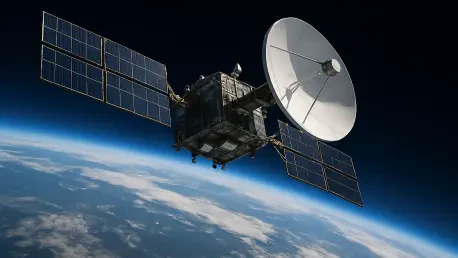
Two distinct engineering philosophies are currently competing to solve the indoor penetration puzzle. AST SpaceMobile is leaning into “brute force” by deploying massive, high-gain antenna arrays in space. These giant structures act like a specialized hearing aid, designed to pick up the incredibly weak signals emitted by a standard smartphone hidden deep inside a building. This approach seeks to keep the complexity in orbit, leaving the user’s experience unchanged and hardware-free.
In contrast, SpaceX’s Starlink is iterating on a more compact satellite design that prioritizes a high volume of spacecraft over individual antenna size. This strategy may eventually necessitate a hybrid ground layer, where small, low-cost repeaters or Customer Premise Equipment (CPE) are installed on rooftops to bridge the gap. While this ensures a robust indoor signal, it shifts the logistical and financial burden back to the consumer, potentially slowing down the pace of universal adoption compared to a truly direct-to-phone model.
Expert Perspectives on the Economic Viability of Satellite Solutions
Economists and industry veterans remain divided on whether a “hardware-heavy” indoor strategy can actually succeed in a competitive market. Joe Madden of Mobile Experts suggested that the 2026–2027 window will be the ultimate proving ground for these competing models. If satellite providers require building owners to install expensive boosters, they will likely face stiff resistance from a real estate industry that is already wary of additional infrastructure costs.
Furthermore, Tim Farrar pointed out that satellite players are not operating in a vacuum; they must compete with established cable giants and Mobile Virtual Network Operators (MVNOs). These terrestrial competitors already possess the “indoor advantage” through dense Wi-Fi networks and small-cell deployments. For a satellite service to be economically viable, it must offer a level of convenience and cost-effectiveness that makes it an invisible, frictionless upgrade rather than a cumbersome secondary utility.
Strategic Blueprints for Navigating the Indoor Frontier
Navigating the future of indoor coverage requires a multi-pronged approach that extends beyond simple satellite-to-phone links. Many providers are now exploring the use of outdoor-to-indoor units that capture satellite signals and rebroadcast them via localized cellular frequencies or Wi-Fi. This mimics the Fixed Wireless Access (FWA) models that have successfully brought 5G internet into homes, providing a reliable bridge for users in rural or underserved suburban areas.
Ultimately, the focus for upcoming satellite launches in 2027 will be on increasing receiver sensitivity and optimizing spectrum usage to mitigate “building loss.” Success in this sector will likely be measured by how little the user has to think about the technology. If providers managed to create a world where the transition from a city tower to a satellite beam was completely unnoticeable, they paved the way for a global network that truly knew no boundaries. Moving forward, the industry prioritized the development of standardized protocols that allowed terrestrial and celestial hardware to work in tandem, ensuring that the next generation of connectivity was as resilient inside a skyscraper as it was in the middle of a desert.