
Vladislav Zaimov is a seasoned telecommunications strategist who has spent years navigating the high-stakes world of enterprise networks and critical infrastructure risk. His perspective is vital as the industry undergoes a massive shift, driven by a two-billion-dollar commitment to modernize the backbone of American emergency services through 5G integration. This interview explores the intersection of commercial telecommunications and national security, focusing on the shift from urban-centric models to rural reliability, the operational advantages of high-bandwidth tools for first responders, and the competitive landscape of government-backed infrastructure.
Building 5G infrastructure in remote areas often yields lower financial returns than in urban centers. How does a multi-billion dollar investment change the feasibility of rural expansion, and what specific technical hurdles must be overcome to ensure network reliability during a natural disaster?
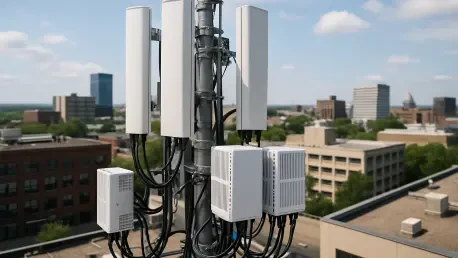
The $2 billion investment by AT&T essentially flips the traditional economic script where rural areas are ignored because they lack the density to generate quick returns. By leveraging the FirstNet contract, the focus shifts from immediate profit to the government mandate of universal coverage, ensuring that a first responder in a remote forest has the same lifeline as one in a city. Technically, we have to overcome the “digital dead zone” phenomenon by deploying hardened towers and 5G nodes that can withstand the literal and figurative storms of nature. This expansion isn’t just about bars on a phone; it’s about creating a resilient web that remains standing when consumer-grade infrastructure might buckle under the pressure of a disaster.
Transitioning to 5G allows for high-bandwidth tools like real-time body camera feeds and increased device capacity. In a high-stress emergency scenario, how do these capabilities alter on-the-ground decision-making, and what steps are necessary to prevent network congestion when thousands of devices connect simultaneously?
During a chaotic incident, the move to 5G changes everything by providing a crystal-clear, real-time visual of the scene through live body camera feeds, allowing commanders to make life-saving decisions from a distance. The increased capacity means that when a major incident occurs and thousands of devices are active in a small radius, the network doesn’t seize up or drop critical calls. We manage this congestion through dedicated spectrum and priority access, ensuring that emergency data always has a “fast lane” that is physically and logically separated from the noise of public traffic. It transforms the sensory experience for responders, replacing static-filled radio reports with high-definition data that can pinpoint exactly where help is needed most.
Public safety networks often rely on a model where the government provides spectrum while private operators manage the infrastructure. What are the long-term trade-offs of this partnership, and how does this arrangement influence the competition among major carriers vying for government contracts?
This partnership creates a structured investment landscape where the government provides the valuable spectrum and long-term backing, which in turn gives private operators like AT&T the confidence to spend billions on infrastructure. The trade-off is that the operator must meet incredibly high standards for uptime and reach, often in places where it makes zero financial sense to build. This high-stakes environment has intensified the rivalry with competitors like Verizon and T-Mobile, who are also pushing their own public safety solutions to capture these prestigious contracts. It creates a race to the top in terms of network quality, where the primary winner is the public official who needs a reliable signal in the middle of a crisis.
When infrastructure is shared between specialized public safety networks and general consumer services, what are the primary benefits for the average user? How do providers balance the priority of emergency traffic with the daily data demands of the public during extreme weather events?
The average user benefits immensely from the “trickle-down” effect of these upgrades, as the hardening of towers and the expansion into rural zones for FirstNet naturally improves general connectivity for everyone. When we build a tower to survive a hurricane for emergency use, that same tower provides more stable service for local residents during the same storm. The balance is maintained through sophisticated software that recognizes emergency signatures, instantly giving priority to responders while the general public’s data is managed to prevent a total system crash. It’s a symbiotic relationship where the rigorous demands of public safety act as a catalyst for a more robust national network that serves everyone better.
Resilience has become a priority as climate challenges and extreme weather patterns increase. Beyond expanding coverage maps, what specific hardware and software upgrades are required to harden a network against physical damage, and how is success measured in these high-stakes environments?
Hardening a network involves moving beyond just coverage and focusing on physical fortitude, such as reinforced tower structures and backup power systems that can run for days without a grid connection. On the software side, we implement self-healing protocols that can reroute traffic automatically if a primary node is destroyed by fire or flood. Success in these environments isn’t measured by speed tests or revenue, but by uptime during the worst possible conditions—specifically, how the network performs when the power is out and the wind is at its peak. We look at the data loads and the connection success rates during these events to prove that the $2 billion investment has translated into a literal lifeline for the community.
What is your forecast for the future of emergency communication networks?
I expect that the distinction between public safety and national infrastructure will continue to blur, with emergency networks becoming the standard-bearer for all connectivity resilience. As we move deeper into the 5G era, we will see these networks integrate even more deeply with AI-driven disaster prediction and autonomous response systems that can deploy without human intervention. The multi-billion dollar investments we see today are just the foundation for a future where a network failure is considered as unacceptable as a power grid failure. Ultimately, the industry will pivot toward a model where total reliability is the only acceptable metric, ensuring that no first responder is ever left in the dark.