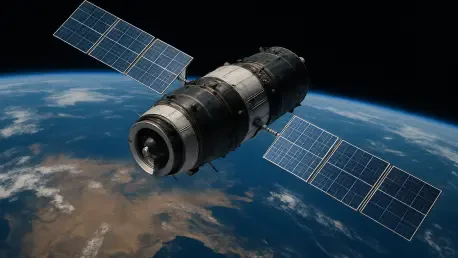

The rapid expansion of orbital infrastructure has reached a critical tipping point as the number of active satellites in low Earth orbit scales toward unprecedented heights. On January 30, 2026, SpaceX submitted a landmark application to the Federal Communications Commission detailing a proposal for a megaconstellation that could eventually encompass one million individual units designed to support space-based data centers. These satellites are intended to operate at altitudes ranging from 500 to 2,000 kilometers, with many positioned in orbits that ensure near-constant exposure to sunlight. This filing represents a massive leap from the 14,000 active satellites currently in orbit as of February 2026, highlighting a shift toward an industrialized orbital environment. As these projects move from the drawing board to deployment, the absence of comprehensive regulatory oversight regarding the visual and environmental impact of such massive arrays becomes increasingly apparent. The current approval process focuses almost exclusively on narrow technical parameters, leaving a significant gap in how the global community addresses the preservation of the night sky for future generations.
Beyond the immediate technical challenges of managing orbital traffic, the sheer volume of proposed hardware threatens to fundamentally alter the human experience of the cosmos. Astronomers warned years ago that the proliferation of bright, moving points of light would eventually make satellites as common as stars in the night sky. With over 1.2 million satellite projects now in various stages of development globally, the prospect of “shifting baseline syndrome” becomes a reality, where younger generations may never know a sky free from artificial interference. These satellites reflect sunlight long after sunset, appearing as persistent streaks that disrupt both professional research and traditional cultural practices. Furthermore, the environmental cost of maintaining these constellations is significant; the constant cycle of launching rockets and burning up old satellites in the atmosphere releases metallic particles into the stratosphere, potentially damaging the ozone layer. This mounting pressure has led experts to advocate for a new regulatory framework known as the Dark Skies Impact Assessment to ensure that the celestial commons are not sacrificed for short-term commercial gain.
1. Collect Testimony From All Interested Parties
The first essential pillar of a comprehensive Dark Skies Impact Assessment involves gathering extensive evidence from a diverse spectrum of global stakeholders. Currently, the licensing process for satellite launches is often a closed loop between private corporations and national regulators, which frequently overlooks the broader social and scientific implications of orbital expansion. A formalized assessment would require testimony from professional astronomers who rely on pristine dark skies for deep-space observation, as well as amateur stargazers and educators who use the heavens as a classroom. Moreover, environmental researchers must provide data on how increased launch frequencies and satellite re-entries affect atmospheric chemistry. By opening the floor to these experts, regulators can move beyond simple frequency allocation and address the holistic impact of placing hundreds of thousands of new objects into the environment that surrounds our planet.
In addition to scientific perspectives, the assessment must prioritize the voices of communities whose cultural and spiritual identities are intrinsically tied to the night sky. For many Indigenous groups, the constellations serve as vital tools for navigation, agricultural timing, and the preservation of oral traditions that have survived for millennia. The introduction of thousands of flickering artificial lights threatens to sever these ancient connections, turning a shared heritage into a crowded industrial zone. Industry leaders and satellite operators also play a crucial role in this dialogue, as they can provide insights into the technical feasibility of mitigation strategies. By fostering a multi-disciplinary conversation, the assessment ensures that the decision-making process is not merely a bureaucratic checkbox but a meaningful evaluation of how space development affects humanity as a whole. This inclusive approach creates a foundation for more balanced policies that weigh economic innovation against the preservation of natural and cultural resources.
2. Simulate the Total Combined Consequences
To accurately gauge the impact of megaconstellations, regulators must move away from evaluating individual launches and instead simulate the cumulative effects of entire satellite ecosystems. This involves advanced modeling to determine how the combined presence of millions of satellites will contribute to “skyglow,” a form of light pollution that brightens the background of the night sky and obscures faint celestial objects. Engineers and physicists can use these simulations to predict the visual density of satellites at various times of night and across different geographical latitudes. Such data is vital for understanding the long-term degradation of the orbital environment, particularly as companies design their constellations for continuous replacement. Without these bird’s-eye view models, the true scale of the interference remains hidden until the hardware is already in place, making any corrective actions significantly more difficult and expensive to implement.
Furthermore, these simulations must address the escalating risk of orbital congestion and the potential for a Kessler syndrome scenario, where a single collision triggers a catastrophic chain reaction of debris. With over 50,000 tracked objects already cluttering low Earth orbit, the addition of massive new constellations increases the statistical probability of major accidents occurring every few days if collision avoidance maneuvers are not perfectly executed. A Dark Skies Impact Assessment would model these traffic patterns to identify high-risk zones and evaluate the impact of debris on both space operations and ground safety. By calculating the danger of atmospheric re-entry and the resulting chemical deposits in the stratosphere, regulators can establish a clearer picture of the environmental footprint of the space industry. These predictive models serve as an early-warning system, allowing authorities to set limits on satellite density before the orbital theater becomes too crowded to manage safely.
3. Establish Specific Standards for Sky Preservation
A critical step in safeguarding the heavens is the creation of firm, measurable benchmarks that define when and where an unobstructed view of the sky is mandatory. Regulators currently lack a unified set of criteria to protect specific regions of the sky for scientific research or maritime navigation. For instance, certain areas of the celestial sphere are essential for tracking near-Earth asteroids or conducting deep-field surveys that require long-exposure photography. By establishing protected “dark sky zones” in orbit, the international community can ensure that critical scientific work continues without the constant interference of satellite streaks. These standards would act as a baseline for all future satellite applications, requiring companies to prove that their hardware will not exceed specific brightness thresholds or interfere with designated astronomical search windows.
These preservation standards must also extend to schooling, traditional ceremonies, and global heritage sites where the night sky is a core component of the landscape. Just as national parks protect terrestrial wilderness, celestial heritage protections would recognize the sky as a natural resource that belongs to everyone. Clear regulatory criteria would mandate that satellite operators avoid certain orbital inclinations or altitudes that would place them directly over sensitive cultural areas during peak viewing times. This framework provides a legal mechanism for communities to defend their right to a dark sky, transforming an abstract concern into a concrete regulatory requirement. When the view of the stars is classified as a protected public good, the burden of proof shifts to the corporations to demonstrate that their projects will not cause irreversible harm to this shared human experience.
4. Develop Strategies to Minimize Interference
Once the potential harms and necessary standards have been identified, the assessment process must outline clear technical pathways for reducing the interference caused by megaconstellations. This approach encourages engineering innovation, such as the development of satellite coatings that absorb rather than reflect sunlight, or the use of “sunshades” to block reflections from reaching the ground. Additionally, operators can be required to adjust the orientation of their satellites during specific phases of their orbit to minimize their visual signature. Deployment adjustments, such as staggering launch schedules or selecting flight paths that avoid densely populated or scientifically significant regions, offer another layer of protection. These strategies transform the problem from a binary choice between technology and nature into a design challenge that can be solved through sophisticated engineering and careful planning.
Beyond physical modifications, the regulatory framework should introduce incentives for companies to achieve their connectivity goals using the smallest possible number of units. This could involve promoting inter-satellite laser links that allow for more efficient data routing, thereby reducing the need for a massive, dense grid of hardware. By rewarding spectral and orbital efficiency, regulators can curb the current trend toward “land-grabbing” in low Earth orbit, where companies rush to launch as many satellites as possible to secure their market position. The assessment process should also explore alternative technologies, such as high-altitude platform stations or improved terrestrial infrastructure, which might provide similar services with a fraction of the orbital footprint. When companies are pushed to prioritize quality and efficiency over sheer quantity, the overall impact on the night sky is naturally lessened, preserving the orbital environment for a wider variety of uses.
5. Ensure Open Reporting and Regulatory Accountability
The final component of an effective Dark Skies Impact Assessment is the implementation of transparent reporting mechanisms that hold satellite operators and national regulators accountable. All findings from the assessment, including the stakeholder testimonies and the results of environmental simulations, must be made accessible to the public in a timely manner. This transparency prevents the “black box” style of regulation that has historically allowed large-scale projects to proceed without sufficient public scrutiny. Independent review panels, consisting of scientists, legal experts, and community representatives, should be empowered to audit these reports and provide recommendations. Making these findings a mandatory factor in the licensing process ensures that environmental and cultural concerns are given the same legal weight as technical and financial considerations, creating a more robust and democratic system of space governance.
Building on this foundation of accountability, the regulatory framework must include provisions for ongoing monitoring after a constellation has been deployed. If a project is found to exceed the brightness or debris levels predicted in the initial assessment, regulators should have the authority to impose fines, require hardware modifications, or even suspend operating licenses. This ensures that the promises made during the application phase are upheld throughout the lifetime of the satellites. As we move deeper into the 2020s, the international community must transition toward a model where space is managed as a sustainable environment rather than an infinite frontier. By establishing clear consequences for non-compliance, governments can foster a culture of responsibility within the private space sector. Ultimately, the goal is to create a predictable and fair system that allows for technological progress while ensuring that the light of the stars remains visible to everyone on Earth.
The transition toward a formalized Dark Skies Impact Assessment represents a necessary evolution in how humanity manages its relationship with the orbital environment. This approach moved beyond mere observation of the problem and provided a structured pathway for integrating scientific, cultural, and environmental values into the core of space policy. Previous attempts to address satellite brightness relied on voluntary agreements that lacked the enforcement mechanisms required to handle a million-satellite constellation. By codifying these assessments into national and international law, policymakers established a clear precedent that the right to an unobstructed sky is a global priority. The integration of transparent modeling and multi-stakeholder input successfully shifted the conversation from a narrow focus on commercial expansion to a broader discussion about the long-term stewardship of the cosmos. These measures did not halt the progress of space-based internet or data services, but they did ensure that such innovations were developed with a higher degree of technical precision and social responsibility. Moving forward, the focus shifted toward refining these assessment tools to keep pace with emerging technologies like direct-to-cell satellite services and lunar exploration. The implementation of these rigorous standards ensured that the night sky remained a source of wonder and discovery rather than an industrial graveyard.