
In the rapidly evolving landscape of global connectivity, Vladislav Zaimov stands as a pivotal figure in telecommunications and risk management for vulnerable networks. With a career dedicated to ensuring the resilience of enterprise-level infrastructure, Zaimov has become an advocate for integrating space-based solutions with traditional terrestrial grids. This discussion explores the ambitious leap from fiber optics to laser-based satellite rings, examining how this shift addresses the persistent vulnerabilities of subsea cables and the logistical hurdles of high-speed data transmission across the equator. We dive into the technical breakthroughs of real-time modulation, the scaling of orbital constellations, and the strategic deployment of wireless laser hardware in disaster-prone regions.
You are building a 40-satellite laser ring around the equator to augment subsea cable infrastructure. What are the specific technical challenges of maintaining 100 Gbit/s uplinks, and how do you ensure seamless data routing between these space-based nodes and your existing ground stations?
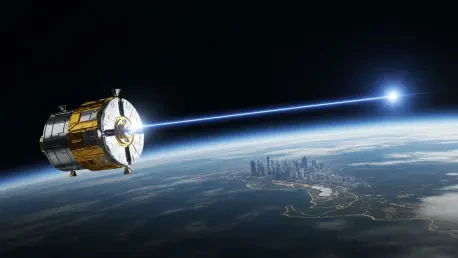
Establishing a terabit-per-second laser ring requires extreme precision because we are essentially trying to hit a moving target from hundreds of miles away with a beam of light. To maintain those 100 Gbit/s uplinks, we have to overcome atmospheric turbulence and the physical vibration of the satellites, which can disrupt the alignment needed for optical data transfer. Our strategy involves a constellation of 40 satellites that function as orbital data centers, allowing us to route information dynamically around the planet. By utilizing established ground stations in locations like Singapore and Barcelona, we create a hybrid architecture where the space-based nodes act as a high-speed bypass for congested or damaged subsea cables. This ensures that even if a physical cable is severed on the ocean floor, the data can be instantly rerouted through our laser links to maintain a continuous, high-bandwidth flow of information.
Wireless laser technology has historically struggled with signal loss during heavy rain. Since your system uses a hair’s-breadth beam to punch through weather, how does the real-time modulation adjustment work, and what performance metrics have you observed in tropical climates like Indonesia or the Philippines?
The failure of early free-space optics was largely due to wide, power-hungry beams that couldn’t penetrate heavy moisture, but we have solved this by collapsing the beam to the width of a human hair. In tropical regions like Indonesia and the Philippines, where monsoon rains are a constant reality, our systems utilize real-time sensors to detect signal degradation the moment a downpour begins. The technology then automatically adjusts the signal power and data modulation, “punching” through the rain with concentrated energy that remains within strict safety limits. We have successfully demonstrated that by narrowing the beam, we can maintain high-speed connectivity in environments where older wireless optical systems would have simply blacked out. This resilience has allowed us to serve as a reliable fiber substitute for partners like Globe Telecom, even during the most intense weather events.
With four commercial craft launching in October and full operations slated for 2027, what does the scaling process look like? What specific infrastructure milestones must be met to reach full capacity, and how will your upcoming capital raises support this rapid global expansion?
Scaling an orbital network is a phased journey that began with our first test satellite and is now accelerating toward a critical mass of infrastructure. The upcoming launch of four commercial-grade craft this October is a vital milestone, as it allows us to move from experimental validation to providing consistent commercial services. To reach our goal of full operational capacity by the end of 2027, we need to complete the deployment of the remaining satellites in the 40-unit ring and expand our terrestrial ground station footprint. Having already raised $34.7 million from backers like Airbus Ventures and the Singapore government, our next move is to secure funding from large capital partners within the next six to twelve months. This influx of capital will specifically fund the mass production of our satellite nodes and the logistical costs of global deployment, ensuring we stay on track for our 2027 deadline.
Major carriers are currently using laser links as fiber substitutes or for emergency disaster recovery. How do you handle the logistics of redeploying this hardware between different districts, and what steps are involved in integrating this technology into an existing national telecommunications grid?
One of the greatest advantages of wireless laser hardware is its portability compared to the years of labor required to lay physical fiber-optic cables. In places like Taiwan, where natural disasters can suddenly sever national grids, our kits are deployed as interim connectivity solutions for operators like Taiwan Mobile to restore service in hours rather than weeks. The logistics are straightforward: once a permanent fiber line is eventually laid in a district, the laser hardware is simply uninstalled and moved to the next area on the waiting list. Integration involves aligning the laser terminals with the existing network core, effectively “plugging” the wireless optical link into the carrier’s switching center as if it were a standard fiber line. This flexibility allows national carriers to expand their reach into remote or damaged areas without the massive capital expenditure of traditional trenching.
Moving a laser from a fiber core into a wireless environment offers significant cost-per-bit efficiencies. What are the operational trade-offs of this wireless approach compared to traditional cabling, and how do you manage signal safety levels while maintaining enough power to transmit over long distances?
The primary trade-off in moving from a glass fiber core to the open air is the loss of a controlled environment, which we compensate for through sophisticated beam-steering and power management. By removing the physical cable, we eliminate the high costs of maritime installation and maintenance, achieving a much more favorable cost-per-bit ratio for our clients. To manage safety, our systems are designed to keep the energy density of the hair’s-breadth beam below the thresholds that would pose a risk to eyes or aircraft, even when we “pump up” the power during heavy rain. It is a delicate balance of physics; we use the narrowest possible energy focus to maximize distance and throughput while our software ensures the beam never exceeds regulated safety levels. This allows us to deliver the same optical bandwidth you would expect from a fiber core but with the agility of a wireless signal.
What is your forecast for laser-based space connectivity?
I believe we are entering an era where the “terabit ring” will become as fundamental to global commerce as the shipping lanes of the ocean. Within the next decade, I expect laser-based satellite networks to move from being an “alternative” or “backup” to becoming the primary backbone for high-speed data transmission between continents. As we prove the reliability of these links in the most challenging tropical climates, we will see a shift where terrestrial fiber is reserved for local distribution, while the vast majority of long-haul traffic moves to the stars. The cost efficiencies and rapid deployment capabilities of this technology will finally bridge the digital divide, bringing 100 Gbit/s speeds to regions that were previously too geographically isolated or economically unfeasible to reach with traditional subsea cables.