
The calendar has turned to 2026, marking the deadline for a vision where every digital signal across India would travel on the superhighways of 5G, yet the nation’s technological symphony is still composed of multiple, indispensable generations of connectivity. The ambitious proclamation that India could run “entirely on 5G” by this year has met the complex reality of a subcontinent grappling with vast diversity in technology access, economic disparity, and infrastructure readiness. While the nation has executed one of the most rapid 5G deployments in global history, the goal of a complete network overhaul remains a distant prospect.
This situation highlights a critical distinction between technological capability and practical implementation. The narrative is not one of failure, but of a necessary recalibration of expectations. The sprint toward 5G has been undeniably impressive, transforming India’s digital landscape. However, the foundational networks of the past continue to serve as the bedrock of connectivity for millions, proving that in a nation as varied as India, a multi-layered approach is not a compromise but a strategic necessity for inclusive growth.
The 2026 Proclamation: An Ambitious Vision or a Technological Fantasy?
The declaration, made by Union Minister of Commerce and Industry Piyush Goyal, captured the spirit of a nation determined to lead the global digital revolution. It was a bold statement of intent, designed to galvanize the industry and signal to the world that India was not just a participant but a pace-setter in the 5G era. This vision served as a powerful catalyst, accelerating investment and deployment schedules at a rate few thought possible, framing the 5G rollout as a matter of national prestige and economic imperative.
However, from its inception, the concept of an “all-5G” nation by 2026 was viewed by telecom experts as more aspirational than achievable. The sheer logistics of replacing or upgrading the infrastructure that supports hundreds of millions of 2G and 4G users presented a monumental challenge. Industry analysts consistently pointed to the enduring value of legacy networks for providing baseline connectivity, voice services, and a safety net for those not yet part of the 5G ecosystem, suggesting a more gradual and integrated transition was the only feasible path.
The 5G Sprint: Charting India’s Record-Breaking Network Expansion
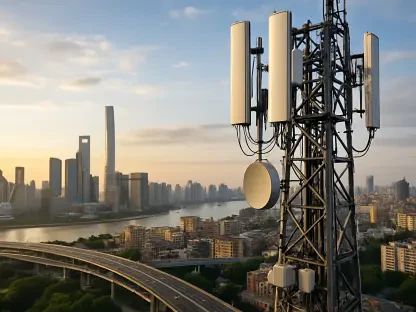
India’s journey since the commercial launch of 5G in October 2022 is a testament to its execution capabilities. In a remarkably short period, telecom operators like Reliance Jio and Bharti Airtel blanketed the country with next-generation connectivity. Supported by the installation of over 500,000 base stations, 5G services now reach an estimated 85% of the population and are available in nearly every district. This rapid expansion is one of the fastest in telecom history, fundamentally altering the potential for high-speed data services nationwide.
The rapid network deployment has been matched by strong consumer uptake, with subscriber numbers projected to be around 394 million. Beyond mobile broadband, a key application driving adoption has been fixed wireless access (FWA), offering fiber-like speeds to homes and businesses without the need for physical cable installation. This use case demonstrates 5G’s potential to bridge the last-mile connectivity gap, providing a tangible benefit that has spurred its growth and integration into daily life.
The Unseen Scaffolding: Why 4G Remains the Backbone of India’s Digital Infrastructure
A critical technical detail often overlooked in the hype surrounding 5G is its reliance on existing infrastructure. Airtel’s 5G network, for example, is built on a non-standalone (NSA) architecture, which means it leverages a 4G core for its operations. In this setup, 5G provides a high-speed data layer, but the underlying functions of signaling and connection management are handled by the 4G network. Consequently, 4G is not just a legacy system running in parallel; it is an integral component of the current 5G experience.
Moreover, 4G continues to be the workhorse of India’s digital ecosystem. It provides essential coverage continuity in areas where 5G signals are weak or unavailable and serves as the primary network for voice calls through Voice over LTE (VoLTE) technology. Data consumption patterns further underscore this reality. While 5G adoption has been swift, traffic from the new network only began to surpass 4G in the first quarter of this year, indicating that for the majority of users and use cases, 4G remains the dominant and most reliable data carrier.
The Digital Divide DilemmThe Socio-Economic Barriers to a 5G-Only Nation
The vision of a 5G-only India overlooks the vast number of citizens who rely on older technologies. The country still has a significant base of feature phone users and those with older smartphones that are not 5G-compatible. For these millions, 2G and 4G networks are not outdated relics but essential lifelines for communication, digital payments, and accessing basic online services. A forced shutdown of these networks would effectively disconnect a substantial portion of the population, deepening the digital divide rather than closing it.
This challenge is compounded by the price-sensitive nature of the Indian market and the staggered pace of network evolution among service providers. Forcing a massive device replacement cycle is not economically viable for a large segment of consumers. Furthermore, the state-owned operator BSNL only managed to launch its 4G services in late 2025 and has yet to begin its 5G rollout. This disparity among operators makes a uniform, nationwide transition to a single technology platform entirely impractical.
Beyond the Hype: A Multi-Generational Network as the Pragmatic Path Forward
Ultimately, India’s path forward lies in embracing a multi-generational network strategy, a model adopted by virtually every major economy worldwide. In this pragmatic approach, different network technologies coexist to serve distinct purposes. 5G offers unprecedented speed and capacity for dense urban areas and demanding applications, while 4G provides robust, widespread data coverage. At the same time, 2G can be maintained for basic voice services and machine-to-machine communications where its low power consumption and broad reach are advantageous.
The 2026 goal, though not realized in its literal sense, ultimately served a valuable purpose. It pushed the nation to achieve a remarkable technological feat and positioned India as a formidable force in the global telecom landscape. The real success was not found in the unrealistic ambition of erasing older networks but in the accelerated construction of a sophisticated, layered digital infrastructure. This mature ecosystem, which balances cutting-edge innovation with the inclusive need for universal access, was the true and lasting achievement.