
Bridging the final, crucial gap in internet delivery to homes and businesses remains one of the most persistent and expensive challenges in modern telecommunications. This “last mile” problem is precisely what Taara, a newly independent company spun off from Alphabet on March 17, 2025, aims to solve. Born from the ambitious yet discontinued Project Loon, Taara is led by CEO Mahesh Krishnaswamy and a small, dedicated team based in California. The company has entered the competitive connectivity market with a powerful and distinct value proposition: to deploy internet infrastructure that is not only significantly more affordable than laying traditional fiber optic cables but also substantially faster than a standard terminal for a satellite service. By targeting the vast global population of three billion people who still lack access to reliable, high-speed internet, Taara is positioning itself as a key enabler of digital equity, armed with a technology that uses beams of light to transmit data at incredible speeds. Its independence from Alphabet allows it to pursue direct investment and strategic partnerships, accelerating its mission to reshape global connectivity from the ground up.
Harnessing the Power of Light
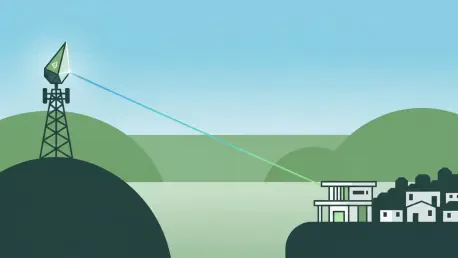
At the heart of Taara’s innovation is a sophisticated ground-based system that uses focused beams of light, a technology known as free-space optical communication. The company has branded its solution “Lightbridges,” which consist of compact units comparable in size to a traffic light. These devices are designed for easy installation on existing structures like rooftops or utility poles, completely eliminating the need for the costly, time-consuming, and disruptive civil engineering work associated with burying fiber optic cables. Once installed, a pair of Lightbridge units can transmit data at speeds of up to 20 gigabits per second (Gbps) across distances as far as 20 kilometers, requiring only a clear line of sight between them. This capability makes the technology an ideal solution for overcoming significant geographical obstacles, such as spanning wide rivers, connecting buildings separated by valleys, or establishing high-speed networks in isolated regions where trenching for cable is either financially or logistically unfeasible.
While the concept of transmitting data through light in open air is not new, with early explorations dating back to the 1990s, previous iterations of the technology were notoriously unreliable. These earlier systems were highly susceptible to disruption from adverse weather conditions like fog, rain, or even atmospheric turbulence, which could scatter the light beam and sever the connection. Furthermore, they relied on fragile and precise alignment mechanisms that could be easily knocked out of place by wind or vibrations, leading to frequent service interruptions. Taara claims to have definitively solved these historical shortcomings through years of research and development. The company has engineered its Lightbridge system with advanced, self-correcting beam-tracking algorithms that can automatically adjust for atmospheric distortion and minor physical shifts. This, combined with robust, durable hardware built to withstand the elements, ensures a stable and consistent connection, transforming a once-fickle technology into a commercially viable and dependable solution for modern connectivity needs.
From Pilot Projects to Market Disruption
Taara’s technology has been rigorously validated through a series of successful deployments in diverse and challenging real-world environments, proving its readiness for commercial scale. In Africa, the Lightbridge system has been instrumental in bridging critical infrastructure gaps. A notable project in Kinshasa, the capital of the Democratic Republic of the Congo, utilized the technology to connect communities separated by the Congo River, where laying subaquatic fiber would have been prohibitively expensive. Similarly, in Nairobi, Kenya, Taara’s system provided essential connectivity to underserved areas, demonstrating its effectiveness in dense urban landscapes. In the United States, the technology proved its mettle by providing high-speed, reliable internet for the massive Coachella Valley Music and Arts Festival in California, a scenario that demands robust connectivity for tens of thousands of users in a temporary, high-density environment. These trials have conclusively shown that Taara’s light-speed system is a powerful and practical alternative in situations where deploying fiber is simply not an option.
Despite frequent comparisons to Elon Musk’s Starlink, Taara operates in a fundamentally different and complementary market niche. Starlink utilizes a massive constellation of low Earth orbit satellites to provide broad, global internet coverage, making it an excellent solution for reaching extremely remote and disparate locations like isolated homes, research stations, or vessels at sea. In contrast, Taara focuses on providing high-capacity, point-to-point terrestrial links. It is not designed for blanket global coverage but rather to serve concentrated, localized demand by connecting specific points on the ground. This could involve linking a cell tower to a central network, connecting a business district to the internet backbone, or providing a high-speed link for an entire village. CEO Mahesh Krishnaswamy has highlighted this key distinction, noting that a Taara link can be “10 to 100 times faster” than a standard Starlink terminal, underscoring its advantage in delivering focused, high-bandwidth connectivity where terrestrial infrastructure is more practical and efficient.
A Vision for Scalable Connectivity
The company’s path forward was paved by a forward-looking approach to innovation and accessibility. A key milestone on its roadmap was the planned introduction of a miniaturized version of its Lightbridge system, ingeniously embedded into a microchip small enough to rest on a fingertip. This technological leap, scheduled for 2026, was engineered to use a section of the electromagnetic spectrum between infrared and visible light while remarkably retaining the system’s impressive 20-kilometer transmission range. The development represented a critical step toward achieving widespread adoption, as it was designed to dramatically slash installation costs and simplify the setup process. By eliminating the need for bulky mounts and complex optics, the technology moved decisively toward a “near plug-and-play” model, which was essential for scaling operations globally. This strategic focus, combined with the successful field trials, solidified Taara’s position as a newly independent and highly ambitious company that was poised to address a critical gap in the world’s internet infrastructure.