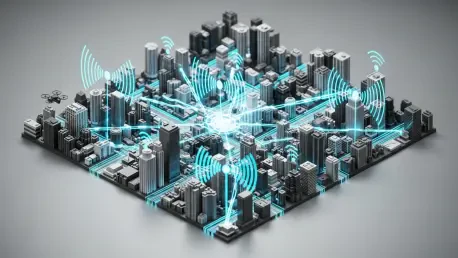

The modern telecommunications landscape is currently witnessing a fundamental shift where the network acts as much like a radar system as it does a traditional data pipe. As we move through 2026, the industry is no longer satisfied with merely moving bits and bytes across a spectrum; instead, the focus has pivoted toward Integrated Sensing and Communications, or ISAC. This breakthrough technology promises to turn every base station into a perceptive node, allowing the network to feel the physical world around it. By unifying these capabilities, operators are preparing to launch a system that provides both high-speed connectivity and environmental awareness through a single, streamlined infrastructure.
Mapping the Shift from Pure Communication to Integrated Sensing
The transition from the data-heavy focus of 5G to the perceptive nature of 6G represents a departure from decades of engineering silos. Historically, radar for object detection, GPS for localization, and cellular waves for data transfer existed as entirely separate entities with dedicated hardware. This fragmentation created inefficiencies and increased the cost of hardware for any device needing both awareness and connectivity. 6G seeks to dissolve these boundaries by utilizing a unified radio-frequency front-end, which allows the same antenna arrays to handle communication and environmental scanning simultaneously.
Unifying these functions is particularly significant for macro-cellular environments where coverage must be both broad and intelligent. Defining the scope of these new networks involves understanding how radio waves bounce off physical objects to create a map of the surroundings. By analyzing these reflections, the network can determine the position, speed, and shape of objects in its vicinity. This evolution transforms the airwaves into a pervasive sensor, effectively providing “vision” to the network without the need for traditional optical cameras in every corner of a city.
The Technological Convergence Driving Next-Generation Automation
Unleashing ISAC through Multi-Modal Sensing and Unified Waveforms
The practical impact of ISAC is most visible in the rapid development of Industry 4.0 and autonomous systems. In a smart factory or a busy shipping port, the ability for a network to track assets with centimeter-level precision while maintaining low-latency control is a game-changer. Furthermore, drone management and autonomous vehicle networks will rely on this synergy to prevent collisions and navigate complex urban corridors. By using a unified waveform, the system reduces interference and ensures that sensing tasks do not compromise the speed of data transmission.
Beyond cellular signals, the future of automation relies on a multi-modal strategy that blends RF data with non-cellular inputs. Video feeds, infrared sensors, and environmental detectors work alongside ISAC to build a comprehensive digital twin of reality. This virtual mirror of the physical world allows for sophisticated monitoring in healthcare, where patient movements can be tracked without invasive cameras, or in retail, where high-precision asset tracking becomes standard. This layer of physical intelligence turns the network into a foundational utility for the modern autonomous economy.
Projecting the Commercialization Path for Sensing-Enabled Networks
As the industry looks toward the late 2020s, the commercial path for these technologies centers on the 7–24 GHz mid-band and sub-6 GHz spectrum. While these frequencies offer a balance of range and capacity, the real high-resolution sensing will occur in the terahertz and millimeter-wave bands. These higher frequencies allow for the detection of minute movements, though they require a much higher density of equipment. Early 6G deployments will likely focus on enhanced mobile broadband, with mature ISAC capabilities arriving as a secondary phase of the rollout.
Market influence is currently being shaped by major research bodies and industry leaders like ETSI, who are finalizing the technical requirements for these sensing-enabled nodes. Projections suggest that while the technology is being tested today, the full economic weight of sensing networks will be felt when interoperability is perfected. Investors are increasingly focusing on companies that can bridge the gap between hardware manufacturing and software-defined sensing, as the ability to extract value from environmental data becomes a primary revenue driver for carriers.
Navigating the Logistical and Technical Barriers to Ubiquitous Sensing
A significant hurdle to making the network “perceive” is the sheer density of infrastructure required. Unlike traditional cellular coverage, environmental perception through radio waves requires a massive densification of base stations to eliminate blind spots. This means that for a city to be fully sensing-capable, hardware must be placed on almost every streetlight and utility pole. Balancing the high resolution of short-range terahertz waves with the need for broad-coverage mid-bands creates a complex architectural puzzle for network planners.
Moreover, the software integration complexities of early 6G infrastructure cannot be overstated. Managing the high capital expenditure associated with sensing-ready hardware requires strategic planning to ensure a return on investment. Operators must find ways to upgrade existing sites without discarding current 5G investments, all while ensuring that the new software stacks can handle the massive influx of sensing data. Overcoming these logistical barriers is essential if ubiquitous sensing is to move from the laboratory to the city street.
Establishing Standards and Privacy Frameworks for a Perceiving Network
The road to a finalized 6G standard is currently paved with regulatory and technical challenges that must be resolved by the late 2029 deadline set by groups like 3GPP. One of the most pressing concerns involves data privacy in a network that can effectively “see” its environment. If a cellular tower can detect the presence and movement of people within a building, strict compliance measures must be established to prevent unauthorized surveillance. Regulatory frameworks will need to evolve just as quickly as the technology to protect individual rights in a sensing-heavy world.
Standardizing waveforms is another critical step to ensure that equipment from different vendors can talk to one another. Without a common language for sensing, the market risks becoming fragmented into proprietary “walled gardens” that limit the reach of autonomous services. In sensitive sectors like healthcare and heavy industry, compliance with safety and privacy standards is mandatory. Establishing these rules early on will provide the legal certainty needed for businesses to invest heavily in sensing-integrated infrastructure.
Reimagining the Decade Ahead as the Network Becomes the Sensor
As we look toward the 2030s, the evolution of 6G will likely move away from the initial marketing hype and toward practical, long-term utility. The shift from specialized private IoT sensing to global cellular coverage will redefine how we interact with our environment. Potential market disruptors are already emerging in the fields of urban air mobility and autonomous logistics, where the network serves as a safety layer for flying taxis and delivery robots. This transition marks the moment when the cellular network stops being an invisible service and starts being a tangible part of the physical world.
The speed of this rollout will be heavily influenced by global economic conditions and the ability of nations to fund massive infrastructure projects. While some regions may leapfrog ahead with dense sensing grids, others might focus on more traditional connectivity. Anticipating these shifts requires a keen eye on how private sector innovation interacts with public policy. The eventual transition will likely see the network acting as a global nervous system, providing a layer of physical intelligence that was once the domain of science fiction.
Balancing Ambition with Reality in the 6G Evolution
The push toward a smarter, sensing-integrated network architecture represents one of the most ambitious goals in the history of telecommunications. Stakeholders recognized that moving from a simple data pipe to a physical intelligence platform required more than just faster speeds; it demanded a complete rethink of how radio waves interact with the world. Strategies for investors now prioritize the mid-band spectrum, which serves as the backbone for these new services, and industrial automation firms that can leverage ISAC to increase efficiency.
Widespread commercial sensing became a reality only after the industry moved past the initial logistical hurdles of base station densification and software complexity. It was determined that a phased implementation was the only way to manage the high capital costs while still delivering on the promise of 6G. Ultimately, the successful integration of sensing and communication provided a foundation for a new era of physical intelligence, turning the network itself into a vital tool for navigating the complexities of the modern world.