
The rapid expansion of next-generation mobile networks has inadvertently set the stage for a critical conflict in the skies, creating a severe and prolonged challenge for the aviation industry. A comprehensive analysis of the evolving global threat posed by 5G mobile network interference reveals a significant divide between proactively managed, low-risk environments and a broader international landscape fraught with regulatory uncertainty and potential safety hazards. The central issue, identified by the International Air Transport Association (IATA), is the potential for powerful 5G signals to disrupt aircraft radio altimeters, which are vital for safe landings and other essential flight operations. While some nations have successfully mitigated this risk through strategic planning and low-power deployment, the lack of uniform international standards has created a complex and hazardous environment for global airline operations, a problem that is now expected to persist for the next decade. This disparity underscores a growing tension between technological advancement and foundational safety protocols.
A Tale of Two Approaches
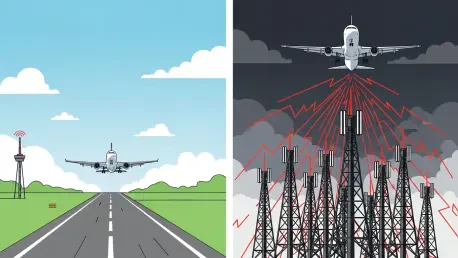
In a clear demonstration of successful risk management, Singapore has effectively created a safe harbor from 5G interference for aviation. The Civil Aviation Authority of Singapore (CAAS) has confirmed no reported cases of 5G signals affecting aircraft, a success attributed to a combination of deliberate technical and regulatory foresight. Singapore’s 5G network was designed to operate within a frequency band of 3.45 GHz to 3.65 GHz, a crucial decision that provides a substantial buffer from the 4.2 GHz to 4.4 GHz band used exclusively by aircraft radio altimeters. Furthermore, 5G base stations across the island operate at relatively low power emission levels, which dramatically diminishes the possibility of signal bleed-over. This proactive strategy, bolstered by live local trials confirming the absence of interference, was developed through close collaboration with the Infocomm Media Development Authority (IMDA) and local telecommunications firms. This framework ensures the safe coexistence of current 5G and future 6G networks, a positive outcome echoed by major carriers like Singapore Airlines and Cathay Pacific.
In stark contrast to Singapore’s controlled and predictable environment, the global situation is far more precarious and dangerously inconsistent. At a recent media event, IATA voiced significant concerns about the perils of “regulatory fragmentation.” While the International Telecommunication Union allocates aviation frequencies on a global scale, individual countries retain the sovereign authority to regulate adjacent spectrum bands. This has resulted in a chaotic patchwork of differing national approaches. In some major markets, 5G networks have been permitted to operate on frequencies that are directly next to the protected aviation band, often at much higher power levels than those seen in Singapore. This uneven regulatory landscape creates profound uncertainty and risk for airlines conducting international operations, particularly as high-power 5G infrastructure continues its rapid deployment near airports and along critical flight paths, turning a manageable technical issue into a widespread safety concern for the entire industry.
The Technical Underpinnings of a Modern Threat
The technical nature of the risk stems from two primary sources that create a perfect storm for potential interference. First, modern telecommunications systems, while highly advanced, can unintentionally allow their powerful signals to “spill” into adjacent frequency bands. This leakage can easily overpower the highly sensitive but lower-power signals used by critical aircraft systems. Second, a significant portion of the global aircraft fleet consists of older models that were designed and built long before the advent of today’s dense, high-power radio environment. Consequently, their onboard systems, particularly the radio altimeters, often have limited filtering capabilities, making them far more susceptible to interference from nearby 5G transmissions. The radio altimeter is the most sensitive and critical system at risk, as this device functions by bouncing radio waves off the ground to provide the flight crew with precise measurements of the aircraft’s height above terrain, information that is indispensable for automated landing systems and crucial pilot decision-making, especially in low-visibility conditions.
The consequences of such interference extend far beyond minor technical glitches, disrupting vital communication and navigation functions that are the bedrock of modern aviation safety. These disruptions can lead to significant operational issues, including cascading flight delays, costly rerouting to avoid affected areas, and restrictions on runway use, which in turn reduces overall airport capacity. More critically, when automated systems are compromised by interference, pilots and air traffic controllers are forced to revert to more manual procedures. This sudden shift not only increases their immediate workload but, as safety experts have noted, also introduces a greater potential for human error in a cockpit environment that has become increasingly reliant on automation for precision and safety. The U.S. Federal Aviation Administration (FAA) acknowledged this risk, reporting in 2022 that it had received accounts from pilots about suspected 5G interference causing strange and unpredictable behavior in aircraft instruments, a clear warning of the potential dangers.
Charting a Course Through a Decade of Risk
A major challenge facing the industry is a critical “timing gap” between the expiration of temporary safeguards and the widespread availability of a permanent technological solution. The long-term fix involves upgrading the global aircraft fleet with new, more resilient radio altimeter designs that are certified as “5G-tolerant.” However, these next-generation altimeters are not expected to be widely available and installed across the majority of aircraft until approximately 2032 to 2035. Meanwhile, the voluntary mitigation measures currently in place in several key countries—which include limiting 5G power levels, pointing antennas away from airport approach paths, and lowering operating frequencies—are set to expire much sooner. In nations like Australia and Canada, these safeguards are due to lapse in 2026, while in the United States, they are scheduled to end in 2028. This creates a dangerous window of nearly a decade where the aviation industry will face increased risk without a permanent fix, a problem one IATA official summarized as a major challenge for “the next 10 years or so.”
Navigating a Path to Global Harmonization
To navigate this challenging period, the International Air Transport Association advocated for a globally coordinated response to what it viewed as a growing threat. The organization urged for greater harmonization of international standards for spectrum use, a process that was to be primarily driven through the International Civil Aviation Organization (ICAO). Furthermore, a call was issued for much closer and more institutionalized cooperation between national telecommunications regulators and their aviation authority counterparts to ensure that safety was prioritized over commercial expediency in all future spectrum allocation decisions. Finally, IATA emphasized the critical need for transparent and universal access to data regarding 5G deployments at and around airports. This transparency was seen as essential to allow airlines and regulators to better assess and manage the potential risks, ensuring that interference-free access to protected aviation frequencies remained a cornerstone of global aviation safety for the foreseeable future.