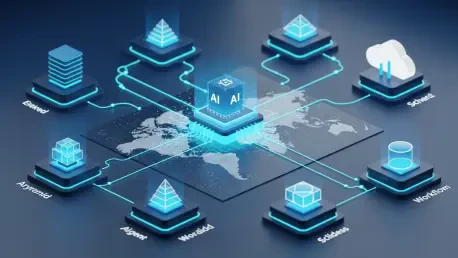

The shifting landscape of enterprise artificial intelligence has reached a critical turning point with the recent decoupling of the exclusive partnership between Microsoft and OpenAI. As a specialist in telecommunications and network risk management, I have watched how these architectural shifts in cloud delivery impact the core stability and strategic flexibility of large-scale organizations. This transition moves us away from a monoculture of AI service providers and into a more complex, multi-cloud environment where the focus shifts from simple chatbots to sophisticated autonomous agents. The following discussion explores the strategic implications of this shift, covering the integration of multi-cloud strategies, the operational requirements for AI agents, and the evolving necessity of robust governance in a world where digital “coworkers” handle critical business workflows.
The primary themes of our conversation center on the move toward non-exclusive licensing and the resulting commercial leverage for IT leaders. We examine how the emergence of platforms like Frontier and Microsoft 365 Copilot are redefining productivity from mere content generation to complex workflow execution. Additionally, we address the balance between operational speed and the risks associated with autonomous AI actions, emphasizing the need for structured human oversight in an increasingly automated enterprise landscape.
OpenAI models are no longer exclusive to Azure and are becoming available through providers like AWS. How does this multi-cloud accessibility change the way CIOs negotiate with vendors, and what specific strategies prevent data governance from becoming unmanageable across different platforms?
The termination of the exclusivity arrangement established in 2019 is a groundbreaking development that restores significant commercial leverage to CIOs. Now that OpenAI products can be distributed through multiple cloud providers, IT leaders can play vendors against each other to secure better pricing or more favorable service-level agreements. To prevent governance from spiraling into chaos, organizations must establish a centralized data policy that remains agnostic to whether the model is running on Azure or AWS. Even though Microsoft retains certain licensing rights until 2032, the shift toward a $50 billion investment partnership with Amazon demonstrates that the future is multi-cloud. Successful leaders will focus on building a unified security layer that wraps around these diverse integrations, ensuring that sensitive enterprise data doesn’t leak between different ecosystem alliances.
AI agents are moving beyond chat toward executing workflows across CRM systems and internal software. What are the step-by-step requirements for setting up an autonomous agent, and how can companies determine if an automated workflow is actually saving time versus creating more oversight work?
Setting up an autonomous agent through a platform like Frontier requires a meticulous integration process that starts with connecting the AI to specific data repositories and CRM systems. The first step involves defining the boundaries of the agent’s permissions so it can navigate internal software without triggering security alerts or unauthorized data access. Companies then need to map out multi-step tasks—such as processing a customer order or updating a database—and test the agent’s ability to move between these steps without losing context. To measure true efficiency, managers should track the “reduction in touches” per workflow; if an employee has to spend more time correcting an agent’s errors than they previously spent doing the task manually, the automation is failing. True success is felt when the agent handles the heavy lifting of data assembly, leaving only the final approval to the human lead, thereby streamlining the entire operational pipeline.
Tools like Microsoft 365 Copilot now focus on executing multi-step tasks rather than just generating content. How should managers redesign team roles to account for these digital “coworkers,” and what metrics should they use to track the ROI of moving from content creation to workflow execution?
The launch of Copilot as a “coworker” necessitates a shift in team roles from “doers” to “orchestrators” who supervise the execution of complex business processes. Managers must redesign job descriptions to emphasize strategic oversight and final decision-making, as the AI takes over the assembly of data from various applications. For instance, if an agent can gather market data, format it into a report, and draft a response, the human worker’s value lies in their ability to affirm the accuracy and tone of that output. To track ROI, organizations should move away from measuring volume—like the number of emails sent—and instead focus on cycle-time reduction for end-to-end workflows. Seeing a multistep task that once took four hours shrink to twenty minutes of automated execution followed by a five-minute review provides a tangible, high-impact metric for success.
The use of advanced agent platforms necessitates a balance between strict governance and operational flexibility. What specific risks arise when AI agents perform tasks without constant supervision, and how can organizations build a “human-in-the-loop” system that doesn’t stifle the speed of the AI?
The greatest risk of unsupervised AI agents is the potential for “automated errors” to propagate across an entire CRM or financial system before anyone notices a problem. If an agent executes a workflow based on a slight misunderstanding of a command, it could update thousands of records incorrectly, creating a massive cleanup task for IT teams. To build an effective “human-in-the-loop” system, organizations should implement “checkpoint triggers” where the AI is allowed to perform the legwork but must pause for an affirmative user approval before any permanent changes are committed. This maintains the speed of AI-driven data processing while ensuring that a human remains the final authority on impactful business actions. Striking this balance prevents lax regulations from leading to errors, while avoiding the overly strict controls that would otherwise stifle the innovation and productivity gains these platforms promise.
Future AI competition is shifting toward ecosystem alliances and distribution capabilities rather than simple model ownership. What is your forecast for the enterprise AI landscape?
The enterprise AI landscape is moving toward a highly interconnected environment where success is determined by the strength of distribution alliances rather than who owns the most sophisticated model in isolation. We will see a shift where the dependency on specific cloud infrastructures decreases, but the complexity of managing AI ecosystem alignments across multiple providers like Google Cloud and AWS increases. I expect that by 2032, the most successful companies will be those that have mastered “AI orchestration”—the ability to seamlessly move workloads between different models and platforms depending on cost and performance needs. The excitement of this digital era will be driven by those who view AI not just as a tool for answering questions, but as a robust engine for autonomous business execution. Ultimately, the competitive edge will go to organizations that can maintain strict data governance while remaining flexible enough to adopt new distribution channels as they emerge.