
The Dawn of the Opticalization Era
Light-based data transmission is no longer a luxury for telecommunications giants but has become the fundamental lifeblood of the global intelligence economy. For over a decade, the optical networking market remained relatively stagnant, hovering around a consistent valuation of $12 billion to $13 billion. However, the explosive rise of generative artificial intelligence has acted as a catalyst for a transformation often described as “opticalization.” As artificial intelligence moves from a niche research interest to the backbone of the modern enterprise, the demand for high-speed, high-capacity data transmission is skyrocketing. This analysis explores whether this momentum is sufficient to double the market size, analyzing the strategic shift from traditional electrical connections to advanced fiber-optic pathways.
Historical Context and the Stagnant Decade
To understand the significance of the current surge, one must look at the historical trajectory of the telecommunications and networking industries. Following the dot-com bubble of the early 2000s, the optical sector entered a long period of incremental improvements rather than radical expansion. While data consumption grew, hardware efficiency kept pace, leading to a flat market where equipment providers competed fiercely for stable but limited budgets. This era was defined by standardized service provider upgrades and a reliance on copper-based electrical interconnects for short-range data center tasks. These historical factors explain why the current increase in capital expenditure is so jarring; the industry is moving from an era of maintenance toward an era of fundamental reconstruction.
The Architectural Shift Driven by AI Clusters
The Transition from Electrical to Optical Interconnects
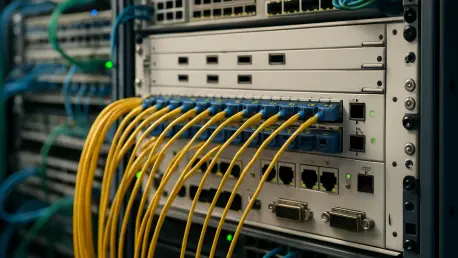
A critical driver of market expansion is the physical limitation of traditional hardware. As companies deploy massive GPU clusters to handle AI training and inferencing, they are discovering that traditional electrical connections simply cannot handle the heat or the bandwidth required at scale. Opticalization refers to the movement of fiber-optic technology deeper into the data center and directly into the server rack. Industry leaders are increasingly pivoting toward direct connect technology. By replacing copper with light-based transmission, operators can overcome the power wall, enabling the extreme speeds necessary for modern computing. This shift is not merely an upgrade; it is a necessity for the physical survival of AI infrastructure.
The Rise of Distributed AI Training and Hyperscale Spending
The current growth cycle is heavily concentrated among the largest hyperscalers, whose combined capital expenditures are projected to reach record highs this year. Because of massive power requirements and space constraints, tech giants can no longer house all their GPUs in a single room. Instead, they are building virtual clusters that span across multiple physical sites. This decentralized architecture creates an unprecedented demand for high-speed connectivity to link these distributed nodes. Recent market data indicates hundreds of millions of dollars in orders specifically tied to training algorithms, suggesting that the initial phase of AI deployment is creating a massive market for managed optical fiber networks.
Regional Dynamics and Service Provider Recovery
While AI is the primary engine, the market is also being bolstered by a secondary wave: the recovery of global service providers. After nearly five years of underinvestment, telecommunications companies—particularly those outside the United States—are aggressively upgrading backbones to support the data-heavy needs of hyperscale clients. There is a common misunderstanding that optical growth is solely a local phenomenon; in reality, the demand is global. Emerging markets are increasingly adopting managed optical services to attract big-tech investments, creating a diversified revenue stream that protects equipment vendors from regional economic downturns.
Future Trends and the Evolution of Network Power
Looking ahead, several emerging trends suggest that the growth in optical networking is sustainable. A shift is occurring where the network is no longer viewed as a peripheral utility but as the new power—a resource as vital as electricity to the functioning of a data center. Technological innovations like pluggable 800G and 1.6T optics will become the new standard, further driving down the cost per bit while increasing market volume. Economically, as AI inferencing moves toward the edge of the network, a secondary boom in metropolitan optical rings is expected. Regulatory shifts regarding energy efficiency may also mandate optical transitions, as fiber is significantly more energy-efficient than copper over long distances.
Strategic Takeaways for the Digital Infrastructure Sector
For businesses and investors, the primary takeaway is that the networking sector has reached a structural inflection point. The traditional $13 billion ceiling has been shattered by the specific, high-bandwidth requirements of the AI revolution. To capitalize on this, organizations should prioritize optical-first infrastructure strategies and look for vendors that offer integrated software and hardware solutions. Best practices now involve planning for step-function growth rather than linear projections. Companies must also account for supply chain resilience, as the rapid increase in demand has historically outpaced the production capacity of high-end optical components.
The Long-Term Significance of Optical Connectivity
The rise of AI successfully transformed the optical networking market from a stagnant hardware niche into a primary engine of global economic growth. Market leaders recognized that doubling the total addressable market required a complete architectural overhaul of how data centers functioned. Strategic investments in high-capacity fiber and decentralized cluster connectivity proved essential for maintaining competitive advantages. Decision-makers prioritized the transition to 800G and 1.6T technologies to mitigate rising energy costs and physical space limitations. Ultimately, the industry established that optical connectivity was the only viable path for scaling intelligence, ensuring that the infrastructure remained as dynamic as the algorithms it supported.