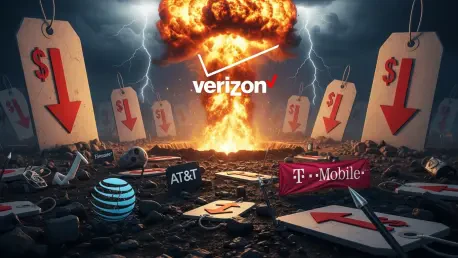

A Strategic Gamble That Shakes the Wireless Landscape
In a move that has sent shockwaves through the telecommunications industry, Verizon has launched an aggressive series of rate cuts, signaling a dramatic pivot in its market strategy. Spearheaded by its new CEO, Dan Schulman, this is no mere holiday promotion; it is a calculated gambit that market observers fear could catalyze a damaging, industry-wide price war. The action, designed to staunch the outflow of the carrier’s valuable postpaid customers, has been met with significant alarm from financial analysts who question its long-term rationality. This article will delve into the specifics of Verizon’s bold new pricing, explore the starkly divided perspectives between Wall Street and the company’s leadership, and analyze the profound implications for the future of the U.S. wireless market.
The Calm Before the Storm: A Market Primed for Disruption
For the past several years, the U.S. wireless industry has enjoyed a period of relative stability. The major carriers—Verizon, AT&T, and T-Mobile—largely shifted their competitive focus from pure price wars to metrics like 5G network quality, reliability, and the value of bundled services such as streaming subscriptions. This détente allowed for steady growth in Average Revenue Per User (ARPU), a critical measure of profitability. However, the relentless pressure to acquire and retain high-value postpaid subscribers has remained a constant undercurrent. It is within this fragile equilibrium that Verizon’s latest move lands with such force. An aggressive price reduction from a market leader is not easily ignored and has the potential to unravel the unwritten rules of engagement that have kept the industry’s profitability intact.
Deconstructing Verizon’s Aggressive Pivot
The Anatomy of the Price Cuts and Analyst Alarm
Verizon’s new strategy directly targets multi-line accounts, slashing rates across its Unlimited Ultra, Unlimited Plus, and Unlimited Welcome plans with a three-year price lock. This move effectively repositions the carrier as a discount leader in key segments. According to analysis by LightShed Partners, Verizon’s premium plans for two to four lines are now 2% to 5% cheaper than comparable offerings from AT&T. More strikingly, its entry-level plans for three to four lines are priced 5% to 17% below those of T-Mobile, the longtime price disruptor. This deliberate undercutting has triggered widespread concern among financial analysts. KeyBanc Capital Markets labeled the move Schulman’s “first strategic mistake” and “irrational,” fearing it will provoke a destructive cycle of retaliatory price cuts. A primary risk they identified is “back book repricing”—the likelihood that existing loyal customers will demand the new, lower rates, cannibalizing Verizon’s own revenue streams and eroding profit margins.
Verizon’s Counter-Narrative: A Calculated Play for Convergence
In a direct rebuttal to the wave of criticism, Verizon executives have mounted a spirited public defense. Sowmyanarayan Sampath, CEO of Verizon Consumer, framed the new pricing not as a desperate tactic but as a “win-win” for both customers and the business. He argued that the low headline prices are a powerful customer acquisition tool, drawing consumers in before many are successfully upsold to higher-tier, higher-margin plans. Sampath emphasized that the strategy’s success is bolstered by a high “attach rate,” where new customers frequently add profitable products, additional lines, and devices over time. The cornerstone of this defense, however, is Verizon’s long-term convergence strategy. The company is using aggressive mobile pricing as a lever to drive adoption of its fiber internet services, creating a “fast follow on” effect where mobile subscribers are incentivized with significant discounts to add a fiber plan, building a larger, more integrated, and ultimately more profitable customer ecosystem.
New Leadership, New Rules: The Schulman Doctrine in Action
This contentious pricing strategy is the latest and most significant action from CEO Dan Schulman since his surprise appointment in October. It follows his call for a “full reboot” of the company and his first major decision: announcing over 13,000 job cuts, or about 13% of the workforce. These consecutive, aggressive moves signal a clear and decisive shift in Verizon’s corporate strategy under new leadership. Rather than an isolated promotion, the rate cuts appear to be a core component of a broader plan to aggressively fight for market share and restore customer growth. The result is a deep chasm in perspective: while analysts see a high-risk, value-destroying gamble, Verizon’s leadership presents a sophisticated, data-driven plan to acquire and cultivate long-term, multi-service customer relationships.
The Ripple Effect: Projecting the Industry’s Next Moves
Verizon’s unilateral move places its primary competitors, AT&T and T-Mobile, in a difficult position. The central question now is how they will respond. If they hold their ground and focus on non-price differentiators, Verizon may successfully capture market share. However, if they feel compelled to retaliate with their own price cuts, the industry will officially enter the price war that analysts fear, threatening industry-wide profitability and putting downward pressure on ARPU. The future trajectory hinges on this competitive reaction. Furthermore, Verizon’s explicit link between mobile pricing and fiber adoption may force its rivals to double down on their own convergence and bundling strategies, accelerating the trend of telecommunications companies vying to become the all-in-one provider for the connected home.
Navigating the Fallout: Key Takeaways for Stakeholders
The situation presents a stark conflict: what analysts decry as a race to the bottom, Verizon champions as a strategic investment in long-term customer value. For investors, this creates a complex risk-reward scenario, balancing the immediate threat of margin erosion against the potential for market share gains and a successful ecosystem play. For consumers, the short-term benefits are clear in the form of lower monthly bills. However, a prolonged price war could eventually impact carriers’ ability to invest heavily in next-generation network infrastructure. The most critical indicator for all stakeholders in the coming months will be the competitive responses from AT&T and T-Mobile, which will ultimately determine whether this is a temporary skirmish or the beginning of a new, more aggressive era.
A High-Stakes Wager on the Future of Connectivity
In conclusion, Verizon’s aggressive rate cuts have fundamentally challenged the wireless industry’s recent stability, replacing it with a period of profound uncertainty. The core takeaway is that this battle is no longer just about mobile subscribers; it is an escalation in the war to own the customer’s entire digital life through a converged ecosystem of mobile and home internet services. Whether Dan Schulman’s opening salvo is remembered as a stroke of strategic genius or a reckless gamble that damaged an entire industry remains to be seen. What is certain is that Verizon has dealt a new hand, and the U.S. telecom landscape will be reshaped by how its rivals choose to play.