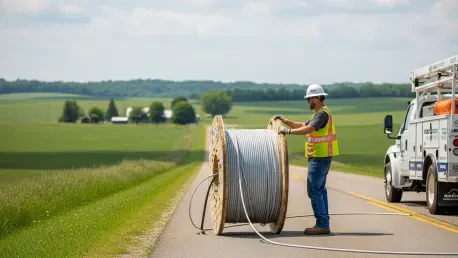

The quiet hum of progress is growing louder across America as high-speed internet cables unfurl into previously disconnected towns, transforming a digital divide into a bridge for economic opportunity. In a sweeping series of coordinated efforts, more than 34,000 homes and businesses across seven states are gaining access to the digital world, marking a significant milestone in the nation’s push to wire its last-mile communities. This wave of expansion, driven by a powerful synergy between private investment and public funding, is not just about faster downloads; it represents a fundamental upgrade to the country’s critical infrastructure, laying the groundwork for a more equitable and prosperous future.
From Digital Divide to Economic Opportunity The Momentum Behind Americas Broadband Push
The national urgency to expand high-speed internet has solidified its place as a top infrastructure priority. Access to reliable broadband is no longer a luxury but a foundational requirement for participation in the modern economy, enabling everything from remote work and online education to advanced telehealth services. For underserved rural and remote communities, this connectivity is a lifeline, unlocking pathways to economic growth that were previously out of reach. It levels the playing field, allowing small businesses to compete globally and students to access educational resources once confined to urban centers.
The recent surge in network construction showcases a multi-faceted approach to wiring America, one community at a time. This progress is not the result of a single policy or company but a complex interplay of forces. A crucial synergy between private telecommunications investment and strategic public funding is proving to be the most effective formula. By examining the different strategies at play, from the large-scale deployments of industry giants to the targeted projects of regional providers and state-led initiatives, a clear picture emerges of how this collaborative model is successfully closing the digital gap.
A Mosaic of Growth Unpacking the Strategies Driving Nationwide Connectivity
Spectrums Rural Onslaught How a Telecom Giant is Wiring the Heartland
At the forefront of this expansion is Charter’s Spectrum, which is executing a massive, multi-state buildout that accounts for the majority of the newly connected locations. Through a combination of corporate investment and support from federal programs like the Rural Digital Opportunity Fund (RDOF), Spectrum is pushing deep into the heartland, targeting communities where the need for reliable internet is most acute across Ohio, Kentucky, and North Carolina.
The scale of this initiative is evident in the numbers. In Ohio, new services have been launched for 11,540 homes and businesses, with significant projects in Muskingum and Hardin counties connecting thousands of locations. Kentucky has seen a similar surge, with 9,120 new connections established in areas like Lincoln and Madison counties. Even a smaller project in North Carolina, bringing service to 500 locations in Wilson County, contributes to the broader effort. These deployments underscore how a major telecommunications provider can leverage its resources to tackle large, geographically diverse challenges.
However, wiring rural America presents significant economic and logistical hurdles, including vast distances between homes and challenging terrain. Public-private partnerships are the key to making these extensive projects financially viable. Federal subsidies help offset the high costs of construction in low-density areas, de-risking the investment for companies and creating a compelling business case to build where the market alone might not justify the expense.
Beyond the Behemoths Regional Fiber Players Cementing Local Dominance
While industry giants make headlines with their large-scale rollouts, a dynamic ecosystem of agile regional providers is proving equally critical to achieving nationwide connectivity. Companies like GoNetspeed and ImOn Communications are deploying nimble, focused strategies to establish a strong presence in local markets, often achieving deep penetration through sustained, community-centered investment.
A compelling case study is GoNetspeed’s work in Manchester, Connecticut. The company recently committed an additional $1.6 million to connect another 5,000 locations, building on a previous $6.6 million project. This brings its total investment in the community to $8.2 million, demonstrating a phased, multi-year strategy to methodically build out its network and capture the market. This approach fosters local familiarity and trust while steadily expanding the fiber footprint.
Similarly, ImOn Communications’ successful project completion in Mount Pleasant, Iowa, illustrates another key regional strategy. By building a new fiber network to connect over 3,500 addresses, the company has strategically transitioned the community from legacy cable to a future-proof infrastructure. This move not only provides superior service today but also positions the town for future technological advancements, showcasing how regional players can lead the charge in modernization.
The Power of the Portfolio How Private Equity and Acquisitions Are Fueling the Fiber Frenzy
Behind many of these network expansions is the growing influence of major financial players and corporate acquisitions. Private equity and infrastructure funds are injecting massive amounts of capital into the broadband sector, enabling providers to accelerate their deployment schedules, enter new markets, and scale their operations far more rapidly than they could on their own.
In the Pacific Northwest, Lightcurve’s new fiber construction in Selah, Washington, is a direct result of this trend. The project, which will serve 2,900 locations, was initiated after the company, formerly known as Rainier Connect, was acquired by Palisade Infrastructure in 2023. This infusion of external capital and new corporate leadership provided the impetus for rebranding and aggressive expansion into new territories.
This pattern is reinforced by ImOn Communications’ journey. The company’s acquisition by Goldman Sachs in 2022 was a pivotal moment, providing the financial backing needed to undertake ambitious projects like the complete fiber overhaul in Mount Pleasant. This demonstrates how external capital empowers regional providers to not only compete with larger incumbents but also to execute comprehensive infrastructure upgrades that might otherwise be financially prohibitive.
From Policy to Pavement Californias State-Led Blueprint for Universal Access
In contrast to models driven primarily by federal funding or private capital, direct state-level intervention has emerged as another powerful catalyst for last-mile connectivity. California offers a compelling blueprint for how targeted state grants can effectively address specific connectivity gaps and achieve broad community benefits, operating as a distinct and complementary strategy.
The California Public Utilities Commission (CPUC) recently approved $21 million in grant funding to expand broadband access in unserved and underserved areas of three counties. While these funds will directly connect 1,752 high-priority locations, the commission estimates the projects will benefit approximately 64,000 residents by wiring homes, businesses, and essential community anchor institutions. This illustrates the significant ripple effect of precise, government-led investment.
This latest funding round marks a landmark achievement for the state, as California has now successfully awarded last-mile broadband funding to projects in all 58 of its counties. This comprehensive, wall-to-wall approach presents a replicable model for other states, proving that a dedicated, state-administered program can systematically and equitably drive progress toward the goal of universal access.
Key Takeaways for a Connected Future Blueprints for Successful Deployment
The recent connection of over 34,000 locations synthesizes a primary finding: effective broadband expansion relies on a flexible and diverse mix of strategies. There is no one-size-fits-all solution. Instead, success is built upon a combination of large-scale corporate rollouts in rural territories, targeted regional investments by nimble fiber players, and strategic government grants that fill the most critical gaps. This mosaic of approaches creates a resilient and adaptive national deployment effort.
This dynamic environment offers actionable strategies for local leaders. Municipal and utility district officials can position their communities to attract investment by streamlining permitting processes, identifying unserved areas, and actively engaging with providers. Furthermore, by becoming experts in leveraging available state and federal funding programs like the Broadband Equity, Access, and Deployment (BEAD) Program, they can create powerful incentives for public-private partnerships.
For network operators, the path forward involves building a sophisticated business case for underserved markets. The most successful models blend private capital with public subsidies to mitigate financial risks and ensure a return on investment. By strategically layering different funding sources and demonstrating a clear plan for community impact, operators can unlock the resources needed to build the next generation of digital infrastructure.
The Unfinished Mile Charting the Next Phase of Americas Digital Transformation
The progress in connecting these 34,000 locations represented a significant victory in what remains a much larger, ongoing campaign to achieve digital equity. Each new connection is a testament to the power of collaborative action but also a reminder of the work that lies ahead. These buildouts are not just engineering projects; they are long-term investments in the nation’s economic resilience and social fabric.
The long-term implications for the national economy were profound. Empowering a remote workforce, revitalizing rural towns with new opportunities, and ensuring equitable access to education and healthcare are all direct outcomes of a more connected America. These networks are the foundational infrastructure upon which future innovation and prosperity will be built.
Ultimately, the accelerating synergy between public policy and private enterprise has been fundamentally reshaping the nation’s digital landscape. This hybrid model, proven effective in these recent deployments, has provided a clear and powerful blueprint for the future. The challenge of the unfinished mile was significant, but the momentum was undeniable, charting a clear course toward a fully connected nation.