
Vladislav Zaimov is a seasoned telecommunications strategist with a deep-seated focus on enterprise network resilience and the mitigation of risks in vulnerable communication infrastructures. With a career dedicated to bridging the gaps in global connectivity, Zaimov has become a leading voice on how orbital technology can bolster terrestrial systems during catastrophic failures. His insights provide a technical roadmap for the integration of low-Earth orbit satellite constellations into the existing mobile ecosystem, focusing on the shift from emergency text services to high-capacity broadband delivered directly to consumer handsets.
The following discussion explores the logistical and engineering feats required to scale satellite-to-cell technology, including the deployment of massive phased-array antennas and the role of reusable heavy-lift rockets. We delve into the coordination necessary for life-saving emergency alerts, the transition toward “terrestrial-like” speeds of 150 Mbps, and the collaborative nature of hybrid networks that combine the strengths of global carriers with orbital nodes.
Satellite-delivered emergency alerts have reached over 4 million people during natural disasters when terrestrial networks failed. How do you coordinate with local governments to trigger these life-saving notifications, and what technical steps are required to adapt the 2 GHz S-band spectrum for emergency services in international markets?
The coordination process is a high-stakes ballet between orbital infrastructure and local emergency management agencies, particularly when fires or floods have rendered local cell towers useless. During the January 2025 wildfires in Los Angeles, for example, we successfully delivered over 150 Wireless Emergency Alerts by acting as a temporary celestial cell tower for the 4.4 million people in the affected zones. Technically, expanding this to Europe and beyond involves leveraging the S-band spectrum acquired from previous strategic deals to ensure that signals can penetrate the atmosphere and reach standard handsets without modification. We are currently working with chipset designers like MediaTek to ensure their test devices, specifically using band N66, can flawlessly receive these test alerts in a way that feels instantaneous to the person in danger.
Moving from basic text services to “terrestrial-like” speeds of 150 Mbps requires phased-array antennas five times larger than previous hardware. What are the primary engineering challenges of deploying these massive satellites, and how will this improved link performance specifically change the way mobile users interact with high-bandwidth apps?
The engineering leap here is staggering because the new phased-array antennas are five times larger than what we have previously flown, creating a massive surface area that must survive the rigors of launch and thermal cycling in space. This hardware upgrade is designed to provide 20 times the link performance of our current direct-to-cell satellites, which is the only way to achieve that 150 Mbps threshold for a single user. For the person on the ground, this changes everything; it moves the experience away from “light data” or simple messaging into the realm of high-performing 5G. You will be able to stream video, upload high-resolution files, and use data-heavy enterprise applications in the middle of a desert or the deep ocean just as easily as you would in a city center.
Next-generation satellite constellations are becoming increasingly dependent on massive, fully reusable launch vehicles capable of carrying 50 units at a time. What are the logistical milestones for integrating these larger spacecraft into a launch manifest, and how does the iterative design of the rocket impact the 2027 rollout timeline?
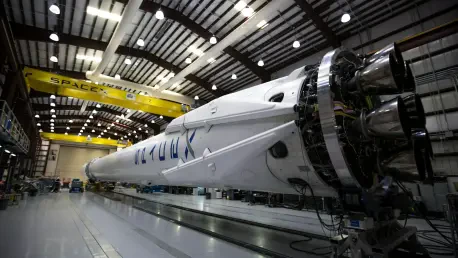
Integrating these massive V2 satellites requires a launch vehicle of unprecedented scale, which is why the progress of the Starship program is the heartbeat of our 2027 rollout. We are moving toward a V3 design of the rocket that incorporates lessons from earlier failures to ensure we can reliably place at least 50 of these heavy units into orbit in a single mission. The logistical milestone we are watching closely is the transition from experimental test flights to a cadence of regular, orbital deliveries that can populate the constellation rapidly. If the rocket design stabilizes as planned, we will begin the primary deployment of these larger satellites in mid-2027, finally giving us the orbital density needed to support “terrestrial-like” connectivity.
Rather than replacing traditional cellular providers, new satellite services are being positioned as hybrid network partners for global carriers. How do you manage data capacity handoffs between terrestrial towers and orbital nodes, and what collaborative work is being done with modem manufacturers to ensure existing handsets remain compatible?
The goal is never to replace the terrestrial tower, as satellite technology simply cannot match the extreme data density of a local 5G cell in a crowded city, but rather to fill the “blanks” on the map. We manage this through a hybrid network model where the satellite acts as an additional layer of capacity or a backup when the ground infrastructure is absent or overwhelmed. On the hardware side, we are working hand-in-hand with manufacturers like Qualcomm, whose current modems already support the N256 band required for our upcoming services. By mid-2027, our aim is for this compatibility to be standard on most devices in major markets, allowing a user’s phone to switch to a satellite link as seamlessly as it would switch between two different carrier towers.
With projections suggesting the active user base will jump from 10 million to 25 million by the end of 2026, scaling infrastructure is a major priority. Beyond increasing satellite count, what operational strategies are essential to maintain 100 Gbit/s download throughput across six continents as the network grows?
Scaling to 25 million users requires a fundamental shift in how we manage throughput, moving beyond just “more satellites” to achieving a massive 100 Gbit/s download and 50 Gbit/s upload capacity across the entire constellation. We have to optimize the handoff algorithms between our 10,000 active satellites to ensure that as a user moves, their data session remains stable and high-speed. Our operational strategy involves a global distribution of ground stations and inter-satellite laser links that allow data to hop across the vacuum of space, bypassing congested terrestrial bottlenecks. This ensures that whether a user is in one of the 32 countries we currently serve or in a newly added region, the “terrestrial-like” feel of the 5G connection remains consistent regardless of the total load on the network.
What is your forecast for Starlink Mobile?
I believe that by 2027, the distinction between “satellite phones” and “standard phones” will effectively disappear for the average consumer. We will see a world where 150 Mbps speeds are available in the most remote corners of the globe, supported by a fleet of massive satellites launched 50 at a time on reusable rockets. This will not be a niche service for explorers but a standard safety and connectivity net for over 25 million people, fundamentally closing the connectivity gap that has existed since the dawn of the mobile age. The partnership with major global carriers will ensure that “dead zones” become a relic of the past, creating a truly ubiquitous global network that saves lives during disasters and powers the next generation of high-bandwidth mobile applications.