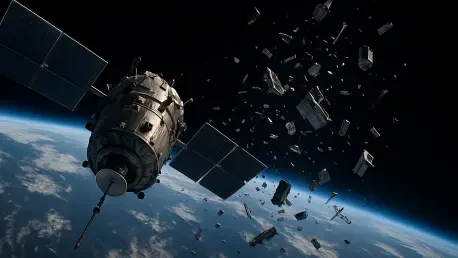

The sheer velocity of modern satellite deployment has turned the thin veil of our atmosphere into a theater of high-stakes litigation where a handful of kilometers determines the difference between a seamless connection and a catastrophic orbital collision. In a span of just a few hours, the Starlink constellation was forced to execute 30 emergency collision avoidance maneuvers to dodge newly deployed satellites—a scenario that sounds like science fiction but is currently the center of a heated legal battle. As the race to blanket the globe in high-speed internet intensifies, the void of space is becoming a crowded parking lot where a few kilometers of altitude can spark a multi-billion-dollar dispute. This friction between SpaceX and Amazon is no longer just about market share; it is about who controls the safety protocols of the orbital highway.
Recent developments have seen SpaceX holding a massive lead with over 10,000 satellites in orbit serving 10 million customers, while Amazon’s Project Kuiper is in the early stages of its 3,236-satellite constellation. Currently operating around 180 units with plans to reach 700 by mid-year, Amazon is catching up quickly, but the limited room in Low-Earth Orbit (LEO) has turned their technical trajectories into legal battlegrounds. This rivalry is further intensified by rumors that both companies are interested in acquiring Globalstar to bolster their respective networks, suggesting that the fight for orbital supremacy will only grow more complex as they vie for every available megahertz and meter of altitude.
The High-Stakes Duel for the Edge of Earth’s Atmosphere
The technical challenges of space safety are becoming inextricably linked with aggressive regulatory maneuvering as these two titans vie for dominance. When the Federal Communications Commission (FCC) issued licenses for these constellations, the intent was to foster competition, yet the proximity of these massive fleets has created an environment where operational overlap is inevitable. Each maneuver performed by a Starlink satellite to avoid a Kuiper unit represents not just a mechanical adjustment, but a consumption of precious onboard fuel and a temporary disruption in service efficiency.
This friction has moved from the vacuum of space into the hearing rooms of the FCC, where technical data is being used as a weapon to claim administrative territory. The dispute highlights the growing realization that the current “first-come, first-served” model of orbital occupancy is reaching its physical limits. Without a change in how these companies interact, the risk of a Kessler syndrome event—a chain reaction of collisions—becomes a statistical probability rather than a remote theory.
Why Low-Earth Orbit is the New Frontier of Corporate Warfare
The dispute over orbital safety represents a critical turning point in the commercialization of space, shifting from exploration to high-density infrastructure management. With SpaceX currently dominating the skies and Amazon rapidly scaling its constellation, the margin for error has vanished. This conflict highlights a systemic vulnerability: the lack of a unified international framework for orbital management, forcing the FCC to step in as a referee for technical maneuvers that carry catastrophic risks. The regulatory body now finds itself mediating complex technical disagreements that go far beyond its traditional telecommunications remit.
Furthermore, the scale of these constellations means that even a minor disagreement over orbital parameters can have global repercussions for space accessibility. The orbital space just above the atmosphere is no longer a boundless frontier but a finite resource that requires precise governance to remain viable. As more private entities enter the fray, the precedent set by the SpaceX-Amazon clash will likely dictate the rules of engagement for all future commercial space ventures.
Allegations and Altitudes: Dissecting the SpaceX-Amazon Friction
The core of the conflict lies in a series of April filings where SpaceX accused Amazon and its partner, Arianespace, of flagrantly ignoring approved orbital debris mitigation plans. According to SpaceX, Amazon’s satellites are being deployed at altitudes 50 to 90 kilometers higher than the 400-kilometer limit authorized by the FCC, creating immediate hazards for the Starlink fleet. This “unauthorized insertion” into orbits above 450 kilometers is cited as the direct cause of the recent surge in emergency maneuvers, raising questions about whether Amazon’s launch trajectory is a matter of technical necessity or regulatory negligence.
SpaceX argued that these deviations were not mere technical glitches but a systemic failure to adhere to the safety profiles that were the basis for Amazon’s operational license. By deploying satellites into the “orbital path” of the established Starlink fleet, Amazon allegedly bypassed the safety buffers intended to keep the constellations segregated. This forced SpaceX to act as a reactive traffic controller for Amazon’s incoming hardware, a situation SpaceX claimed was unsustainable for the long-term safety of the LEO environment.
Defensive Maneuvers and the Argument of Regulatory Hypocrisy
Amazon’s rebuttal introduced a complex layer of operational transparency and industry irony that complicated the narrative provided by its rival. By utilizing SpaceNav, an independent collision assessment firm, Amazon argued its operations meet the highest safety standards and that its license allows for flexibility “at or near” the 400-kilometer mark. Most notably, Amazon pointed out a perceived hypocrisy: SpaceX itself launched several of these disputed satellites using Falcon 9 rockets without raising safety concerns at the time of launch. This suggests that the safety issues might be more of a legal strategy than a purely technical alarm.
Moreover, Amazon contended that the current congestion is largely a byproduct of SpaceX lowering its own Starlink orbits, effectively “claiming” more space than initially intended by its own original filings. Amazon maintained that it remained open to proposed cooperative solutions, but alleged that SpaceX refused to engage in meaningful cross-platform coordination. This counter-accusation shifted the focus from Amazon’s deployment heights to SpaceX’s perceived attempt to use the regulatory process to stifle a burgeoning competitor by monopolizing specific altitude bands.
Navigating the Crowded Commons: A Framework for Orbital Coordination
The industry eventually realized that it required a move away from litigation and toward standardized operational frameworks to ensure long-term viability. Practical strategies for maintaining safety included the adoption of universal third-party verification systems to provide unbiased risk assessments for all operators. Furthermore, companies moved toward automated, cross-platform data sharing to ensure collision avoidance maneuvers were synchronized rather than reactive. This transition helped mitigate the risk of two satellites maneuvering into each other while trying to avoid the same point of contact.
By establishing clear altitude buffers and mandatory cooperative engagement periods before launches, the industry transitioned from regulatory maneuvering to a sustainable model of shared orbital stewardship. The FCC ultimately played a pivotal role in enforcing these new standards, ensuring that technical transparency became a prerequisite for license retention. These steps fostered a more collaborative environment where the pursuit of global connectivity no longer came at the expense of orbital safety. The resolution of this clash provided a blueprint for how private space entities managed the increasingly crowded commons of the Earth’s atmosphere.