
A Tale of Two Fortunes: Geopolitical Hope Amidst Financial Gloom
Nokia stands at a critical crossroads, a position defined by a stark and challenging dichotomy. On one side, the Finnish telecommunications giant faces a potential windfall, with CEO Justin Hotard celebrating the European Union’s push to ban Chinese vendors like Huawei from its 5G networks—a move that could unlock billions in much-needed revenue. On the other, this geopolitical optimism is severely undercut by a recent string of disappointing financial results that have rattled investors and exposed deep-seated weaknesses in the company’s core mobile business. This article explores how Nokia is navigating this turbulent environment, balancing a high-stakes reliance on political intervention with an aggressive internal campaign of cost-cutting and strategic realignment to secure its future in a rapidly evolving global market.
The Long Shadow of a Shifting Market
To understand Nokia’s present predicament, one must look at the seismic shifts that have reshaped the global telecom landscape over the past several years. The company’s largest division, Mobile Networks, has been in a prolonged state of decline, with revenues nearly €4 billion lower than in 2019. This downturn is not solely a Nokia problem; the entire global Radio Access Network (RAN) market has contracted significantly, shrinking by an estimated $10 billion between 2022 and 2024. Compounding this industry-wide pressure, Nokia lost critical market share in the lucrative U.S. market before Hotard’s tenure, further squeezing its margins. This financial strain has been unfolding against a backdrop of rising geopolitical tensions, where the European Commission’s initial “5G toolbox”—a mere recommendation against using “high-risk vendors”—proved insufficient, compelling Brussels to consider a mandatory ban that could fundamentally alter the competitive dynamics in Nokia’s favor.
A High-Stakes Bet on Politics and Restructuring
The Geopolitical Lifeline: Turning Europe “Green”
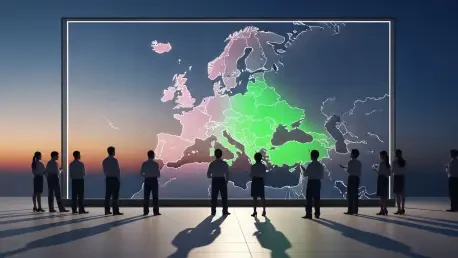
Nokia’s strategy is now inextricably linked to geopolitics, a reality encapsulated by the company’s color-coded map of the world. “Grey” countries like China and Russia are deemed inhospitable, dominated by local champions. “Pink” countries represent open, competitive battlegrounds, while “green” territories are secure markets closed to Chinese rivals. CEO Justin Hotard’s primary hope is to see the vast “pink” expanse of Europe turn “green.” The European Commission’s proposal to make its 5G security toolbox mandatory is the catalyst for this change, a move Hotard hailed as a vital step for European sovereignty. The opportunity is substantial; with rival Ericsson estimating that Chinese vendors hold between 33% and 40% of the European market, Hotard quantifies Huawei’s relevant annual business at a tantalizing €2 billion to €2.5 billion—a revenue stream Nokia is desperate to capture.
The Stark Reality of Financial Headwinds
This potential political victory stands in sharp contrast to Nokia’s current financial performance. The company’s latest results triggered a 5% drop in its share price, reflecting deep investor concern. While group revenues saw a modest organic increase of 2%, net income plummeted by a staggering 27% to just under €1.6 billion, largely due to a slump in high-margin licensing income. The situation in the Mobile Networks division is particularly dire. With an operating margin of a razor-thin 2.8%—dwarfed by Ericsson’s 9.6%—the unit is struggling for profitability. This poor performance underscores the immense pressure on Nokia and clarifies why the potential exclusion of a major competitor in its home market is viewed not just as an opportunity, but as a critical lifeline.
An Aggressive Overhaul and a Strategic Retreat
Faced with this grim financial picture, Nokia’s leadership has initiated a radical and painful restructuring. The company’s headcount fell by over 9,000 in just one year, with more cuts planned. Hotard has also launched a sweeping organizational overhaul, consolidating separate business functions into centralized units and merging three divisions—Mobile Networks, Cloud and Network Services, and Nokia Technologies—into a single “Mobile Infrastructure” group. The stated focus is now on “managing profit,” a clear signal of intense cost-cutting ahead. This internal consolidation is paired with a strategic retreat from challenging markets, most notably China. With sales in the region collapsing from €2.2 billion in 2018 to just €913 million today, Nokia’s recent move to acquire full ownership of its Chinese joint venture, Nokia Shanghai Bell, is widely seen as a precursor to an eventual exit, allowing the company to redirect resources to more promising fronts.
The Search for a New Growth Engine
Amid the struggles in its mobile division, Nokia’s Network Infrastructure group has emerged as a solitary bright spot. Bolstered by the 2025 acquisition of optical specialist Infinera, the division reported impressive revenue growth of 23%, driven by massive investments from U.S. hyperscalers building out the data center capacity needed for artificial intelligence. However, this success comes with caveats. The growth, while strong, is not on the same exponential scale as that of AI chipmakers like Nvidia, and the division’s operating margin contracted as it absorbed integration costs and ramped up investment to compete with market leader Ciena. Furthermore, a critical question hangs over the company’s long-term competitiveness. While overall R&D spending has increased, the budget for the beleaguered Mobile Networks division has actually shrunk, raising concerns about Nokia’s ability to innovate and keep pace with a more focused Ericsson.
Navigating a Path to Stability
The key takeaways from Nokia’s current situation are clear. Its immediate future hinges on two pivotal factors: the successful and swift execution of its internal restructuring and the timely materialization of the EU’s ban on Huawei. The company’s own financial guidance, which projects an operating profit between €2 billion and €2.5 billion for the coming year, suggests minimal organic growth is expected without a significant market shift. For business leaders and investors, the primary strategy is to watch for signs of progress on both fronts. The success of Nokia’s cost-cutting measures will be a leading indicator of its ability to stabilize its financial base, while any official movement from Brussels on the Huawei ban will be the key external catalyst that could redefine its revenue outlook.
A Future Forged by Policy and Performance
In conclusion, Nokia is waging a war on two fronts. Internally, it is undergoing a painful but necessary transformation to streamline operations and restore profitability. Externally, it is banking on a geopolitical sea change in Europe to provide the market share and revenue it desperately needs to fund its long-term recovery and R&D efforts. The company’s high-stakes gamble highlights the profound degree to which the global technology sector is now shaped by political forces. For Nokia, the hope is that a policy decision in Brussels will provide the lifeline required to pull its struggling mobile business back from the brink and chart a sustainable course toward future growth.