
The digital world’s insatiable demand for instantaneous data processing is pushing the centralized cloud to its limits, creating a critical bottleneck for the very artificial intelligence systems designed to revolutionize industries. This has ignited a race to a new technological frontier: the network edge. For telecommunications titan Telefónica, this represents a pivotal moment to leverage its vast infrastructure and deep network intelligence, positioning AI not just as a use case but as the primary catalyst to build and command this emerging computational landscape. The company’s strategy is a calculated response to a market that now values proximity and real-time response as much as raw processing power.
The Imperative for Local Processing at the Edge
A fundamental transformation is underway, marking a departure from the long-held paradigm of centralized cloud computing. The industry is rapidly moving toward a distributed model where data processing occurs closer to where data is created and consumed. This migration is fueled by the escalating demands of enterprises for applications that cannot tolerate even milliseconds of delay, such as autonomous vehicle navigation, factory-floor robotics, and immersive augmented reality experiences. For these technologies to function effectively, computation must be local, immediate, and reliable.
This shift is propelled by the twin imperatives of low latency and data sovereignty. Processing data locally addresses the physics of data transmission, eliminating the round-trip delay to a distant data center, which is critical for real-time control systems. Simultaneously, it allows enterprises to meet increasingly stringent data governance and privacy regulations by ensuring that sensitive information remains within specific geographical or national boundaries. This capability is becoming a non-negotiable requirement for businesses operating in sectors like healthcare, finance, and public services.
Consequently, this evolution redraws the competitive map. The battle for digital dominance is no longer confined to the massive data centers of cloud hyperscalers. Instead, it is moving to the edge of the network, where telcos hold a natural advantage. Their extensive physical infrastructure, from cell towers to local exchanges, provides the ideal foundation for a distributed computing network. This new arena pits the telcos’ network integration and physical presence against the hyperscalers’ cloud software and services, creating a fresh dynamic in the technology ecosystem.
A Strategic Blueprint for Dominating the Edge Market
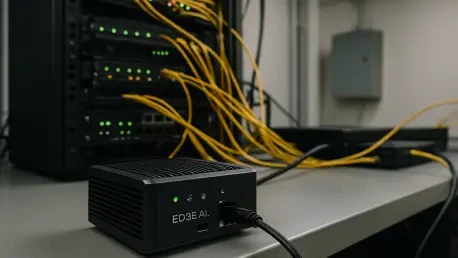
Telefónica’s strategy is grounded in a meticulously planned national rollout. The company is executing a plan to establish 17 commercial edge nodes, one for each of Spain’s autonomous regions. Demonstrating both innovation and sustainability, Telefónica is repurposing its legacy copper exchanges, transforming these remnants of a past era into modern hubs for advanced data processing and analytics. With ten nodes already operational and the remaining seven activated this year, the company is rapidly building a dense, nationwide compute fabric.
Beyond its domestic ambitions, Telefónica envisions being a cornerstone of a federated European “Cloud Continuum.” This initiative, aligned with the EU’s goals, aims to create a seamless network of interconnected edge clouds across the continent. The goal is to offer enterprises a unified platform where they can deploy applications fluidly across various central clouds, edge locations, and private networks without managing the underlying complexity. This orchestration is key, as the edge cannot thrive in isolated silos; it must be a fluid extension of the broader cloud environment.
The primary driver for this ambitious infrastructure build-out is artificial intelligence. As Telefónica’s head of telco edge computing, Cristina Santana Casillas, notes, AI is what “is really going to push the deployment of these edge nodes.” This is not merely a theoretical assertion. A pilot project with transport system manufacturer CAF in Bilbao provides tangible proof. The system uses 5G and edge computing to power an AI-driven computer-vision solution that analyzes real-time video from trains, detecting occupancy levels and identifying suspicious objects instantly—a task unfeasible with a traditional cloud architecture.
Voices from the Edge on the Telco Advantage
Industry experts widely concur that telcos are uniquely positioned to lead the edge revolution. Santana Casillas emphasizes that Telefónica’s core differentiator is its “tight integration with the network.” Unlike cloud providers, telcos can use deep network intelligence to dynamically optimize compute workloads, creating a symbiotic relationship where the network and compute layers enhance each other. This is a powerful advantage that hyperscalers, lacking control over the last-mile network, cannot easily replicate.
The sheer scale of a distributed edge network, potentially spanning thousands of sites, makes automation an absolute necessity. Timo Jokiaho, the telco field CTO at SUSE, asserts that “end-to-end automation and large-scale automated deployments and automated configuration is a must.” Managing such complexity manually would be operationally impossible. To this end, Telefónica partners with specialists like Nearby Computing to orchestrate its services, ensuring its pan-European vision of a federated cloud continuum is both achievable and manageable.
This sentiment is strongly supported by other ecosystem partners. Luis Zas of Nearby Computing argues that “no one else better than the telcos knows how to handle…the challenges at theedge.” He urges them to leverage their existing infrastructure to drive new B2B revenue, framing inaction as a missed strategic opportunity. This view is validated by market analysts, with STL Partners’ director Tilly Gilbert positioning Telefónica as being “ahead of the curve” in Europe. The relatively lower penetration of hyperscalers in Spain gives Telefónica a unique window to establish a strong foothold with its differentiated, deeply distributed offering.
The Winning Playbook in Telefónica’s Strategy
Telefónica’s success hinges on three key strategic pillars. The first is its ability to leverage the inherent advantage of its deep network integration. By combining its 5G network capabilities with localized compute resources, the company can offer unparalleled performance, reliability, and security for edge-native applications. This synergy transforms the network from a simple data conduit into an intelligent, programmable platform, creating value that extends far beyond basic connectivity.
The second pillar is the masterful orchestration of a complex and diverse ecosystem. Realizing that no single company can build the edge alone, Telefónica has cultivated strategic partnerships with technology providers, software specialists, and automation experts. By leveraging solutions like Nearby Computing’s Federation Manager, it can seamlessly integrate and manage services from various providers, presenting a simple, unified interface to its enterprise customers. This focus on orchestration is crucial for delivering the promised “cloud continuum.”
Finally, Telefónica’s strategy rightly focuses on the power of distribution over raw capacity. While its edge nodes will not compete with the massive scale of hyperscaler data centers, their value lies in their strategic placement across a wide geography. This distributed network creates a fundamentally new “compute landscape” designed for a new class of applications. STL Partners projects that while total telco edge capacity will be modest, its distribution across over 1,600 sites by 2030 will unlock innovation in AI, IoT, and real-time enterprise services, firmly cementing the role of telcos in the next digital era.