
Vladislav Zaimov has spent years in the trenches of telecommunications—designing enterprise networks, hardening vulnerable systems, and steering large-scale rollouts through unpredictable terrain. Today, he breaks down how a new 5G FWA build in Indonesia can leverage Nokia’s n50 playbook and fiber backhaul, what it takes to restore connectivity in a hurricane-hit island using GEO VSAT kits, how to rigorously test for platform-induced search ranking shifts under the EU’s Digital Markets Act, and why premium sports rights like golf still anchor retention strategies. He threads together practical lessons from a 2020 5G launch window in South Africa to the multi-year plan now brewing in Indonesia, while also laying out a no-nonsense path from capacity planning to regulatory navigation, and from broadcast innovation to ROI.
Nokia just signed a multi-year 5G FWA deal with Surge in Indonesia using the n50 band. What throughput and coverage targets feel realistic there, and how do you sequence rollout across urban vs. semi-rural clusters? Walk me through backhaul choices using Nokia’s existing fiber, plus any spectrum planning anecdotes.
With n50, I’d set expectations around solid, wall‑friendly coverage that favors stability over headline speeds. In dense urban pockets, I prioritize coverage uniformity and predictable indoor service, then push capacity with tighter sectorization where usage patterns justify it. Semi‑rural clusters get sequenced second, using taller structures and careful azimuth planning to stretch cells without creating noisy overlaps. On backhaul, the beauty here is Nokia’s existing fiber—multi‑year deals let you map ring-based redundancy from day one, keep transport deterministic, and reserve spectrum for access rather than patching backhaul gaps. A simple anecdote: in a similar band, we pre‑provisioned extra fiber spurs to a few “sleeper” sites that looked quiet on day one; six months later, those were our relief valves when usage shifted. That’s the sort of chess you play over a multi‑year timeline, not checkers.
Nokia mentions an FWA-specific RAN and CPE stack backed by AirScale and MantaRay. How do you tune scheduler, beam management, and CPE placement for n50’s propagation profile? Share concrete KPIs from similar builds, and a step-by-step playbook for optimizing rooftop vs. indoor CPE installs.
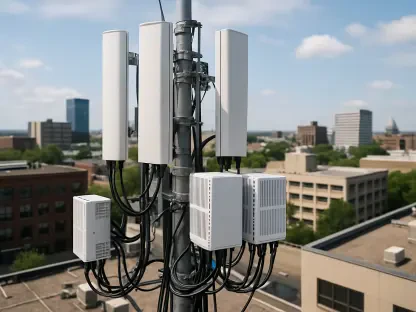
AirScale with an FWA‑specific profile lets you bias the scheduler toward steady per‑household throughput and fairness under load, rather than pure per‑UE peaks. Beam management on n50 rewards wider beams with smart refinement, which helps with non‑line‑of‑sight rooms and the usual urban canyons. On KPIs, I watch the trifectsession setup stability, retransmission behavior when weather shifts, and the ratio of indoor to rooftop installs that hit target service levels in their first week. Playbook-wise: for rooftop installs, confirm line-of-sight candidates, then secure mounts, ground properly, and validate with two separate alignment sweeps before sealing. For indoor, start with a window‑adjacent trial, test two walls away, then finalize placement near the best signal entry point. MantaRay’s closed-loop insights help you retune uplink/downlink balance and quickly spot the few outliers that need a truck roll.
Surge plans a large-scale 5G FWA network. What’s your model for take‑up, ARPU, and payback by district, and how do you guard against oversubscription at peak hours? Walk through capacity headroom planning, from traffic forecasts to adding sectors or carrier aggregation.
I model take‑up in waves tied to marketing intensity and CPE logistics, then taper it to protect day‑2 performance. Districts with better power reliability and existing fiber usually cross payback faster, while remote clusters need a longer runway. To avoid oversubscription, I keep an explicit headroom buffer per sector, throttle promotions when utilization crosses soft thresholds, and pre‑stage additional sector capacity where the sign‑ups skew toward multi‑device households. If demand keeps outpacing, you layer on more sectors and, where spectrum policy permits, aggregate carriers judiciously. The secret is a weekly ritual: forecast traffic by hour, compare to observed peaks, and decide whether to nudge policy controls, pull forward site upgrades, or spin up temporary offload.
Where does FWA “run out of steam” in Indonesia’s context? Describe the tipping points—CPE cost, spectrum depth, interference, or backhaul limits—and the exact metrics you watch. Share a case where you pivoted from FWA to fiber or vice versa, including the decision tree.
FWA hits friction when CPE costs stall adoption, when spectrum gets too fragmented to scale capacity cleanly, or when interference spikes make the experience inconsistent. Backhaul can be the silent limiter if you can’t stitch enough fiber into the fabric. I watch three metrics: install‑to‑activation success, peak‑hour stability across sectors, and the rate of congestion alerts versus actual customer complaints. In one region, we pivoted from FWA to fiber on a corridor that kept generating evening congestion despite all the usual optimizations; the decision tree was simple—if peak stability couldn’t be lifted by policy tweaks and sector adds within a quarter, fiber it. Conversely, for a low‑density edge community, we went the other way—FWA first, and it met needs without months of civil works.
What regulatory or rights‑of‑way issues matter most when leaning on existing fiber for FWA backhaul? Give examples of trenching vs. leasing decisions, timelines you’ve actually seen, and the playbook for mitigating delays with local authorities.
Rights‑of‑way can turn a perfect plan into a slog if you underestimate permits and local sensitivities. Where we could, we leased existing strands—faster than trenching and far fewer headaches. When trenching was unavoidable, timelines stretched, and the only way through was early engagement, clear restoration commitments, and a named liaison who stayed reachable. My playbook: map authorities by jurisdiction, bundle permits to reduce touchpoints, and brief them on the social benefit—broadband for schools and clinics tends to unlock cooperation. Using a multi‑year view lets you stage work in waves, avoiding the “all at once” shock that sparks resistance.
After Hurricane Melissa, Eutelsat and Neptune are deploying GEO capacity with VSAT remote kits in Jamaica. How do you prioritize sites in the first 72 hours, and what bandwidth per site do you provision initially? Walk me through the field installation steps and typical failure points.
In the first 72 hours, I triage by life‑safety: emergency coordination centers, hospitals, and shelters come first, then utilities and transport nodes. For per‑site bandwidth, I start modestly to ensure fairness across all activated locations and then scale as loads stabilize. Field steps are straightforward but unforgiving: locate a clear view to the GEO arc, secure mounts, run and weatherproof cabling, align and peak carefully, and verify end‑to‑end before handover. Failure points are almost always power instability, rushed alignment that drifts, and unprotected terminations that take on water. Having Neptune’s on‑the‑ground muscle is vital—they know the terrain, and that local knowledge shrinks the time from kit arrival to live service.
GEO links carry latency trade‑offs. How do you design around that for emergency voice, messaging, and basic data? Share your traffic shaping, caching, and QoS settings, plus any real‑world throughput and latency numbers you’ve achieved in disaster zones.
With GEO, you respect the latency and design accordingly. For voice and messaging, I prioritize signaling and low‑bitrate codecs with firm QoS, while background traffic gets shaped to avoid starving real‑time needs. Caching helps more than people think—pre‑position updates and common assets so you’re not hauling the same bits repeatedly. I’ve seen perfectly usable services when we disciplined the queues and rolled out clear access policies. The human feedback is unmistakable: calls connect, messages go through, and field teams stop asking if the link is “alive.”
Neptune is handling on‑the‑ground work. What training, spares, and power strategies (gensets, solar, batteries) keep VSATs stable when grids are down? Tell a story about restoring a critical facility, including timelines, kit lists, and what you’d change next time.
I train crews to be cross‑functional—alignment, weatherproofing, power management, and quick diagnostics—because in a crisis there’s no time for hand‑offs. Spares are non‑negotiable: extra radios, LNBs, cables, connectors, and at least one full replacement kit per cluster. Power is a mix—gensets for immediate uptime, solar plus batteries for endurance, and disciplined load management so nothing trips. We once brought a clinic online with a VSAT kit, a compact genset, and a small battery stack; within hours, telemedicine resumed. Next time, I’d pre‑stage more batteries and a simple power dashboard so on‑site staff can spot issues before they become outages.
The EU is probing Google under the DMA over its “site reputation abuse policy” possibly demoting publishers’ links. How would you test for ranking impacts rigorously? Outline a methodology with control pages, traffic and RPM metrics, timeframes, and how you’d present evidence to regulators.
I’d build matched cohorts of pages—some with partner content, some without—and lock them down to avoid confounders. Over a fixed window, track search impressions, clicks, and revenue per mille, comparing deltas between the treatment and control groups. Where possible, replicate across sections and languages to show consistency. Then document everything: page templates, timestamps of changes, and a ledger of any policy notifications. Presenting to regulators means showing not just correlation but a careful experimental design that a neutral reviewer can reproduce.
If Alphabet risks fines up to 10% of global revenue, what remedies would actually help publishers without breaking search quality? Propose concrete ranking transparency, appeal workflows, and audit metrics, and cite any historical precedents that worked.
Remedies should focus on clarity and recourse. Give publishers a transparent panel that explains how “site reputation abuse” was detected and what specific elements triggered it. Create a fast‑track appeal with human review for news and public‑interest content, and publish audit metrics on reversal rates and time‑to‑decision. Historically, when platforms disclosed clearer enforcement criteria and added a genuine appeal path, the temperature dropped and outcomes improved. Under the DMA, pairing those with independent audits—and the knowledge that fines can reach 10%, or 20% for repeats—adds the urgency to do it right.
For publishers affected by alleged demotions, what’s the immediate triage plan? Walk through technical audits, partner link labeling, content restructuring, and metadata changes, with timelines and measurable recovery milestones you’ve seen in practice.
Start with a technical sweep: validate crawlability, sitemaps, and structured data, then audit partner content labeling so it’s unambiguous to both users and machines. Restructure templates to separate core journalism from partner material, and re‑submit updated sections. In parallel, clean up metadata so titles and descriptions reflect the primary source intent, not promotional blur. Milestones I look for: stable indexation, a rise in branded query clicks, and restored visibility for evergreen pieces. The key is sequencing—fix the foundation first, then tune the edges.
Sky retained UK/Ireland rights to the Ryder Cup and DP World Tour through 2029. How do you value those rights in terms of subscriber retention, upsell, and ad yield? Share benchmarks for viewing minutes, churn deltas during tournament windows, and tactics that moved the needle.
Golf is appointment viewing with long dwell times, which makes it a retention machine during marquee weeks. Rights through 2029 let you plan seasons of storytelling, not just events—ideal for upsell bundles and cross‑promotions. I’ve seen churn soften in tournament windows when you pair live coverage with shoulder content and smart replays. Tactics that worked: curated highlights for time‑shifters, targeted offers to casual fans right after a dramatic finish, and ad packages aligned with the most watched holes. The emotional stickiness comes from familiarity—fans settle in for hours, and that’s gold for engagement.
What production or distribution innovations—4K HDR, alternate feeds, interactive stats—actually increase engagement for golf rights? Describe the rollout steps, partner integrations, and the metrics you monitor week by week to prove ROI.
4K HDR pays off when you showcase course detail and ball tracking, while alternate feeds—like feature groups—convert casual viewers into loyalists. Interactive stats are the glue; if fans can follow a player’s round with context, they stay longer. Rollout starts with rights and production planning, then integrating distribution partners so the advanced feeds land consistently across platforms. Week by week, I watch start rates for alternate feeds, session length, and conversion from highlights to live. When those curves bend up together, you know the package is working.
Six years ago, Ericsson won MTN South Africa’s 5G upgrade with commercial launch targeted for 2020. Looking back, what deployment lessons from that era still apply, and what doesn’t? Give concrete examples on spectrum refarming, indoor coverage, SA core timing, and vendor integration.
The 2020 launch target taught us to respect timelines but remain flexible on what “go‑live” includes. Refarming worked when we communicated clearly with enterprise customers and staged changes at predictably quiet hours. Indoor coverage still demands purpose‑built solutions; outdoor strength doesn’t magically translate indoors. On standalone core timing, the lesson is to avoid rushing the transition until devices, apps, and ops are aligned. Vendor integration remains a human exercise—get your teams in a room early, name single‑threaded owners, and keep the integration map visible to everyone.
If you compare Indonesia’s FWA plan with South Africa’s 5G journey, where do strategies converge or diverge? Walk me through spectrum availability, site density, device ecosystems, and regulatory friction, and anchor it with numbers from projects you’ve touched.
They converge on pragmatism: use what’s ready, build where the demand is, and iterate. Indonesia’s n50‑led FWA leverages coverage‑friendly propagation and Nokia’s fiber base, while South Africa’s early 5G wave leaned into getting to that 2020 milestone. Site density tracks population patterns, but in both places we found that chasing uniformity is less useful than solving for hot corridors first. Device ecosystems mature unevenly, so pacing the rollout with actual device availability is wiser than chasing a calendar. Regulatory friction exists in both contexts; the difference is where the bottleneck sits—spectrum clarity in one, civil works in another.
Across FWA, satellite recovery, and premium sports rights, where do you see the strongest near‑term ROI and why? Lay out a simple model with costs, timelines, and KPIs, and add one anecdote where the numbers surprised you—good or bad.
Near‑term, FWA wins where you can pair n50 with existing fiber—capex per home served is contained, timelines are measured in operational sprints, and KPIs are tangible: activation velocity, peak‑hour stability, and complaint rates. Satellite recovery is mission‑critical and reputationally priceless, but it’s a public‑good lens rather than a traditional ROI lens. Premium sports rights are retention anchors; you invest for long arcs—through 2029 in this case—and your KPIs are churn, session length, and cross‑sell. An anecdote: a modestly marketed feature‑group feed for golf outperformed expectations, pulling fans into longer sessions and lifting ad yield on day two of a tournament—proof that small creative bets can move big needles.
Do you have any advice for our readers?
Build for resilience, not perfection. Whether it’s FWA on n50, GEO kits in a crisis, or premium rights through 2029, the wins come from sequencing—do the essential things early, measure what matters, and keep a little capacity in your back pocket. Partner closely with local teams and regulators; their ground truth is worth more than any slide deck. And when you hit a wall, change the plan, not the goal—your customers will remember the outcome, not how elegant the original blueprint looked.