
The relentless forward march of technology rarely pauses for economic realities, creating a difficult balancing act for the companies building the infrastructure of tomorrow. For Swedish telecom giant Ericsson, this tension has become a defining strategic challenge. The company is navigating a landscape where its visionary future of a hyperconnected world, teeming with physical AI and extended reality, clashes with a present-day market for 5G equipment that has gone stubbornly flat. CEO Börje Ekholm’s recent warnings of further job cuts underscore a disciplined, if painful, response to this dichotomy, revealing a company battening down the hatches to weather the current lull while positioning itself for the next wave of demand. This report analyzes Ericsson’s multifaceted strategy, from aggressive cost-cutting and R&D adjustments to strategic pivots toward new markets, all under the shadow of a stagnant operator spending cycle and shifting geopolitical plates.
The Global 5G Arena an Ecosystem at a Standstill
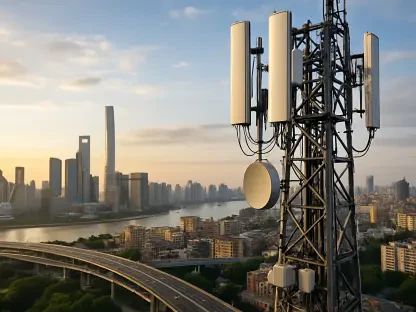
The global telecommunications equipment industry is currently in a state of suspended animation. After a frantic build-out phase, the market for 5G network infrastructure, particularly the Radio Access Network (RAN) products that form its backbone, has cooled significantly. This slowdown directly impacts major vendors whose fortunes are tied to the capital expenditure of large telecom operators. These operators, having made substantial initial investments in 5G, are now pausing to monetize those networks before committing to further large-scale deployments.
This ecosystem is dominated by a few key players. Ericsson stands as a primary architect of these networks, engaged in a fierce global competition with rivals like China’s Huawei and Finland’s Nokia. Their customer base is a concentrated group of the world’s largest mobile carriers, creating a high-stakes environment where market share is hard-won. The technological focus remains squarely on enhancing 5G capabilities while laying the groundwork for the eventual, and still distant, transition to 6G networks, a future that promises even greater speeds and lower latency but requires a clear business case to unlock investment.
Dueling Realities Visionary Tech vs Market Stagnation
The Hyperconnectivity Paradox Future-Forward Vision Clashes with Present-Day Demand
At the heart of Ericsson’s long-term strategy is a compelling vision of a “hyperconnected” society. CEO Börje Ekholm paints a picture of a world where physical AI, in the form of humanoid robots and autonomous drones, interacts seamlessly with our environment, and where extended reality (XR) glasses and real-time translation services become commonplace. The company argues that these transformative technologies are not science fiction but an impending reality, one that is fundamentally unachievable without massive upgrades and densification of current 5G networks to handle the immense data loads and provide ultra-reliable, low-latency communication.
This future-forward narrative, however, runs directly into the wall of present-day market demand. Ekholm himself describes the current environment for 5G equipment as “flattish,” defined by cautious spending and weak demand from telecom operators. These customers are grappling with their own profitability challenges and are hesitant to pour more capital into networks before seeing a clearer return on investment. This creates a paradox for Ericsson: it must sell the dream of a technology-rich future to spur the very investment needed to build it, all while its primary customers remain focused on the economic realities of today.
By the Numbers Decoding a Shrinking Market and Ericsson’s Financial Rebound
The market stagnation is not just anecdotal; it is clearly reflected in industry data. According to market analysis, the global RAN market, Ericsson’s core business, contracted by a significant 20% between 2024 and 2026, shrinking to an estimated $35 billion. While the sharpest declines appear to be stabilizing, forecasters see little prospect for meaningful growth in the immediate term, painting a picture of a challenging operational environment for all equipment vendors.
In stark contrast to this market weakness, Ericsson’s own financial performance has shown remarkable resilience and strength. Through a disciplined and aggressive cost-cutting program, the company has successfully protected its bottom line. Its operating margin surged to 14.9% in the last year, a substantial improvement from 11% previously. This financial rigor translated into a dramatic rise in net income, from approximately $44 million to $3.2 billion. This robust performance has been rewarded by investors, fueling a 9% rise in its share price, an increased dividend payout, and the launch of a new $1.7 billion share buyback program.
The Innovator’s Dilemma Sacrificing R&D for Short-Term Stability
Ericsson now faces a classic innovator’s dilemmhow to balance the long-term imperative of technological leadership with the short-term pressures of a tough market. For years, a cornerstone of Ekholm’s turnaround strategy was a deliberate and substantial increase in research and development spending, which grew from $3.5 billion in 2018 to $5.9 billion by 2025. This investment was critical in restoring the company’s competitive edge and ensuring its products remained at the cutting edge of network technology.
In a significant strategic shift, however, the company reduced its R&D expenditure by 9% in the last year, the first major cut under Ekholm’s tenure. This move has understandably raised concerns that Ericsson might be mortgaging its future innovation for present-day profitability. The CEO has defended the decision, framing it not as a retreat but as a pivot toward greater “R&D efficiency.” He insists that the company can maintain its technological leadership at this lower spending level by focusing resources more strategically, but it remains a calculated risk in an industry where innovation is the ultimate currency.
A Shifting Battlefield How Geopolitics Could Redefine Market Leadership
Beyond market dynamics and internal strategy, the competitive battlefield is being reshaped by powerful geopolitical forces. A major development is the European Union’s proposal to make its “5G toolbox” recommendations mandatory for all member states. This policy would effectively compel countries to remove and replace network equipment supplied by vendors deemed to be “high-risk,” a designation widely understood to apply to Chinese companies like Huawei.
This regulatory shift could present a massive market opportunity for “trusted vendors” such as Ericsson. Ekholm estimates that Chinese suppliers still hold between 33% and 40% of the mobile network market in Europe, a substantial share that would be up for grabs if the EU mandate is enforced. A forced rip-and-replace of this equipment would trigger a new wave of spending, directly benefiting Ericsson and its primary European competitor. Despite the scale of this potential windfall, Ericsson remains prudently cautious, stating that the full impact would take 12 to 18 months to materialize and has therefore not been factored into its current financial forecasts.
Charting a New Course Seeking Growth in Defense and Enterprise Verticals
With its traditional market facing headwinds, Ericsson is actively charting a new course by pivoting toward new growth verticals beyond its core telecom operator business. The company is strategically reallocating resources to cultivate opportunities in mission-critical networks for public safety, the broader enterprise sector, and, most notably, the global defense industry. These sectors represent new revenue streams that are less dependent on the cyclical spending of mobile carriers.
The defense sector, in particular, has been identified as a “sizeable” opportunity. This optimism is fueled by rising NATO defense spending and a technological shift within military communications. Ericsson anticipates that defense agencies will increasingly move away from proprietary, custom-built systems toward more cost-effective and advanced solutions based on global 3GPP standards, the same technology that underpins 5G. This trend positions Ericsson’s commercial technology as a powerful and adaptable platform for next-generation defense applications, from secure battlefield communications to advanced drone detection systems.
The CEO’s Gambit Prudent Cuts and a Bet on the Future
Ericsson’s current posture is a carefully calibrated gambit. The company’s core strategy is one of relentless operational discipline, characterized by aggressive and ongoing cost-cutting to insulate its financial targets from a weak market. The continuous headcount reductions, with the explicit warning of more to come, are the most visible evidence of this pragmatic approach, designed to maintain profitability and shareholder confidence through the downturn.
Ultimately, Ericsson’s future prosperity is tethered to two external factors largely beyond its immediate control: a meaningful recovery in spending from its core telecom customers and a favorable geopolitical realignment that restricts its chief competitors. Until one or both of these conditions materialize, the company’s path is set. The CEO’s message is clear: operational efficiency and cost control remain the top priorities. In this climate of uncertainty, the prudent, though difficult, strategy of trimming expenses is the company’s primary tool for navigating the flatlands of the current 5G market while keeping its sights set on the promise of a more connected future.