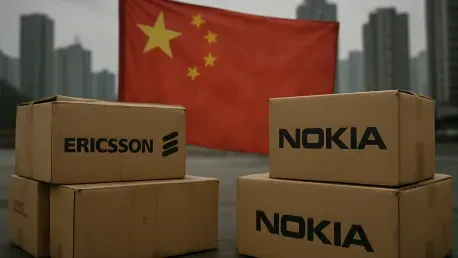

A New Reality Dawns for Western Telecom Giants
The global telecommunications landscape is undergoing a seismic shift, and nowhere is this more apparent than in China, where Western equipment suppliers like Sweden’s Ericsson and Finland’s Nokia once viewed the vast market as an indispensable engine for growth. Today, that engine has stalled, with sales plummeting to a fraction of their former highs. This article explores the dramatic collapse of Ericsson and Nokia’s Chinese operations, dissecting the geopolitical retaliation, shifting market dynamics, and strategic retreats that define this new era. We will examine the forces that turned a key growth market into a major liability and consider the profound implications for the future of global technology standards. The sudden reversal serves as a stark reminder that in the modern technology sector, market access is no longer guaranteed by technological superiority or competitive pricing alone but is increasingly dictated by the unforgiving logic of international politics. This new reality forces a fundamental reevaluation of global strategy for any multinational tech firm navigating an increasingly polarized world.
From Optimism to Exclusion The Road to a Market Collapse
To understand the severity of the current situation, it is essential to look back at the recent past. As China embarked on the world’s largest 5G rollout, its market represented an unparalleled opportunity, with ambitions to deploy millions of basestations and serve a population of 1.4 billion. Chinese operators were critical customers, and in 2019, Ericsson’s leadership vocalized this optimism, stating a clear goal to be “stronger in China in 5G than we were in 4G.” Both Nordic firms secured initial 5G contracts, and for a brief period, it seemed that business could transcend geopolitical friction. This was a time when global supply chains were still seen as robust and cross-border commercial relationships were prioritized, suggesting a future where technology markets remained open and integrated despite rising political tensions between East and West.
However, this period of hope was short-lived. The underlying currents of geopolitical competition began to surface as Western security concerns over Chinese technology champions Huawei and ZTE intensified. The United States and its allies moved to restrict these companies from their next-generation networks, citing national security risks associated with their equipment. This campaign created an environment of suspicion and triggered a powerful and reciprocal response from Beijing, which began to view the presence of Western technology firms in its own critical infrastructure through a similar lens of national security. The stage was set for a dramatic reversal of fortunes, transforming the Chinese market from a land of opportunity into a hostile environment for its once-valued European partners. The rules of engagement were being rewritten in real time, catching many industry players off guard.
The Forces Driving the Nordic Retreat
Geopolitical Retaliation The Primary Driver of the Meltdown
The core reason for Ericsson and Nokia’s market collapse is a direct, tit-for-tat response to Western policies. As the U.S. and its allies moved to exclude Chinese vendors from their 5G networks, China responded in kind, applying the same national security logic to its own market. The decisive turning point came in late 2020 when Sweden, Ericsson’s home country, banned Chinese suppliers from its 5G infrastructure. The fallout was immediate and severe; by 2021, Ericsson’s sales in China had been halved, a clear signal that Beijing was willing to penalize foreign companies based on the actions of their home governments. This established a new precedent where commercial success became inextricably linked to diplomatic relations.
This reciprocal exclusion has effectively closed the door on a market that was once considered essential for growth and scale. Industry leaders have confirmed that Western suppliers are now being systematically excluded from China for national security reasons, mirroring the exact justification used by Europe and the U.S. to bar Huawei and ZTE. This has removed any ambiguity about the situation, making it clear that technical merit or pricing strategies are no longer the primary factors in procurement decisions. The Chinese telecommunications market, at least for mobile network equipment, is now operating under a political framework where market access is granted or denied based on geopolitical alignment, leaving the Nordic giants with little recourse but to accept their diminished role.
By the Numbers Quantifying the Sales Freefall
The financial data paints a stark and unambiguous picture of the collapse. After peaking at nearly $2.1 billion in 2020 on the back of initial 5G contracts, Ericsson’s revenue in China has cratered. By 2025, its sales in the country had fallen to an estimated $798 million, a staggering decline of over 60% from its peak and representing just 3% of the company’s global total. This transforms China from a significant revenue contributor into a marginal market, forcing a complete rethinking of the company’s global sales strategy and resource allocation. The numbers reflect not just a market downturn but a near-complete eviction from one of the world’s most critical technology ecosystems.
Nokia’s decline has been equally precipitous, underscoring that this is a market-wide trend affecting all Western vendors. The company’s revenue from the “Greater China” region, which includes mainland China, Hong Kong, and Taiwan, plummeted by 58% over seven years, falling from nearly €2.2 billion in 2019 to just €913 million in 2025. This sustained erosion of business has led the Finnish company to signal the potential “complete disappearance” of its mobile network business in China, a frank admission of the finality of this market shift. For both companies, the financial statements now serve as a historical record of a lost opportunity, with future projections for the Chinese market approaching zero for their core network businesses.
Strategic Retreat Restructuring in the Face of Exclusion
Faced with a near-total market exclusion, both companies have shifted from a posture of expansion to one of damage control, undertaking significant operational restructuring. This strategic retreat is most visible in drastic workforce reductions across the region. Ericsson’s employee count in Northeast Asia, a region dominated by its Chinese operations, fell from approximately 14,000 in mid-2021 to around 9,500 by the end of 2025. This downsizing has been accompanied by the divestment of a major R&D center and further job cuts, reflecting a permanent reduction of the company’s operational footprint and ambitions in the country.
Similarly, Nokia’s Greater China headcount was nearly halved, dropping from 15,700 in 2019 to 8,700 in 2024. While Nokia’s move to acquire full control of its Nokia Shanghai Bell joint venture might have initially seemed like a deeper investment, industry analysts interpret it as a maneuver to streamline operations and simplify a potential future exit from the Chinese market altogether. Gaining full ownership gives Nokia the agility to manage a controlled wind-down of its operations without the complexities of a joint venture partnership. These actions are not the signs of a temporary downturn but rather a permanent realignment of corporate strategy in response to irreversible market closure.
The Future A Fragmented World and the 6G Divide
The collapse of Ericsson and Nokia in China is more than a story of lost revenue; it signals the fracturing of the once-globalized telecommunications market into distinct geopolitical blocs. As Western vendors are shut out of China, they are increasingly advocating for a larger, protected share of the European market, further hardening the lines between these competing spheres of influence. This dynamic creates a vicious cycle, where exclusion in one market leads to calls for protectionism in another, accelerating the fragmentation of global technology supply chains and standards. The era of a single, interoperable global network appears to be drawing to a close.
The long-term implications of this division are profound, particularly with the advent of 6G. China is expected to be one of the world’s most advanced and aggressive adopters of this next-generation technology, creating a massive market for innovation and deployment. Being excluded from this ecosystem could leave Ericsson and Nokia on the sidelines, unable to benefit from the scale, data, and experience that the Chinese market will generate. This raises the real possibility of a “bifurcation of 6G into Western and Chinese variants,” where different technological standards develop in parallel. Such a split would not only fragment global standards but also intensify the technological divide, creating a more complex and competitive landscape for decades to come.
Navigating a New Geopolitical Landscape
The key takeaway is that the Chinese telecommunications market for mobile network equipment is now effectively closed to Western firms as a direct consequence of geopolitical reciprocity. The days of treating China as a purely commercial market, where decisions are driven by technology and price, are over. For companies like Ericsson and Nokia, the primary strategy is no longer about winning market share in China but about consolidating their positions in politically aligned markets, such as Europe, North America, India, and other nations wary of Chinese technology. Their survival and future growth now depend on their ability to reposition themselves as trusted partners within this Western-led bloc.
Their path forward involves leveraging their status as trusted European and Western vendors to secure business in regions where Chinese competitors are banned or viewed with suspicion. This strategic pivot is a necessary adaptation to a world where market access is increasingly dictated by national security and foreign policy. It requires a new corporate mindset focused on political risk management, supply chain security, and alignment with national industrial strategies. The challenge for these legacy firms is to prove that their technology is not only competitive but also secure and reliable, making them the default choice for critical infrastructure in a world defined by geopolitical rivalry.
Conclusion The End of a Globalized Era
The precipitous decline of Ericsson and Nokia in China had marked the definitive end of an era defined by open, globalized technology markets. Their story became a powerful case study in how quickly geopolitical tensions could unravel decades of commercial integration, transforming a vital growth market into a strategic liability. As the world continued to split into competing technological spheres, the challenge for these legacy giants was to adapt and thrive within their shrinking sphere of influence. Their survival depended not just on innovation, but on their ability to navigate a landscape where political allegiance had become as important as technological prowess.
The long-term significance of this shift extended far beyond corporate balance sheets, signaling a future where technology standards, supply chains, and innovation itself were fractured along geopolitical fault lines. The once-held dream of a single, interconnected global network had given way to a more complex and fragmented reality. For the global telecommunications industry, the message was clear: the new rules of the game had been written in the language of national security and geopolitical competition, and there was no going back to the old world order.