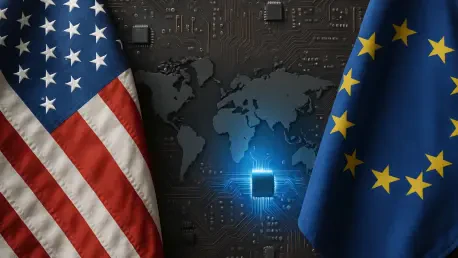

European telecommunications powerhouses Ericsson and Nokia have found themselves cast in an unfamiliar and precarious role as diplomatic brokers, working tirelessly to mend a widening technological chasm between the United States and Europe. Their recent decision to join the newly established Trusted Tech Alliance is not merely a political gesture but a calculated act of corporate self-preservation, aimed squarely at fortifying the vital transatlantic partnership that forms the bedrock of their financial stability. As political tensions rise, particularly under the Trump administration, these Nordic firms are navigating treacherous waters, attempting to prevent a geopolitical schism that could critically endanger their entire business model. The alliance, which pointedly excludes Chinese firms, serves as the primary vehicle for this delicate maneuvering, positioning the companies to defend the economic relationship that is crucial for their survival.
The High-Stakes Balancing Act
Navigating a Geopolitical Minefield
Historically defined by their neutrality, both Ericsson and Nokia have been involuntarily thrust onto a geopolitical tightrope, compelled to perform a delicate balancing act between their foundational European identity and their overwhelming American commercial interests. While their headquarters, ownership structures, and a significant portion of their workforce and customer base remain firmly planted in Europe, the United States has unequivocally emerged as their largest and most lucrative market. This dual allegiance places them in an exceedingly difficult position, particularly as actions from the Trump administration have eroded trust with European leaders. This growing friction forces the Nordic firms into a position of having to “choose sides” in a burgeoning technological conflict they would much rather avoid. Their strategic decisions are no longer purely commercial; they are now deeply intertwined with international diplomacy and the shifting plates of global power dynamics, a reality that reshapes their corporate strategy.
The dilemma facing these telecommunications giants is profound, as the rift between Washington and Brussels threatens to create two distinct and potentially incompatible technological spheres. A push for “tech sovereignty” in Europe, championed by some political leaders, could lead to regulatory frameworks that disadvantage US-based technology partners, which are integral to Ericsson and Nokia’s supply chains. Conversely, retaliatory measures from the United States, such as tariffs or restrictions on technology access, could be equally devastating. For Ericsson and Nokia, whose products are a complex fusion of European engineering and American innovation, such a division would not just be inconvenient; it would be an existential threat. They are therefore compelled to act as intermediaries, leveraging their unique transatlantic position to advocate for a unified approach and warn against the “dangerous” path of technological isolationism, as Ericsson’s CEO has publicly stated.
The Indispensable US Market
The financial health of both Ericsson and Nokia is overwhelmingly and inextricably linked to the American market, a reality supported by stark financial data. For Ericsson, this reliance is particularly pronounced. In 2025, customers in the United States accounted for a staggering 40% of the company’s total sales, a figure that completely overshadows its next-largest market, India, which contributed a mere 6%. This heavy concentration is not just about revenue volume; it is directly correlated with profitability. As Ericsson’s share of sales from the US grew from approximately one-third to 40% over the last five years, its operating margin saw a significant and corresponding increase from 12% to 16.3%. This powerful correlation underscores a simple truth: the company’s financial success is a direct reflection of its performance in the American market, making the stability of that relationship a paramount corporate priority.
Nokia’s situation, while reported with less granularity, reflects a similarly critical dependence on its North American operations. The region constituted 31% of its total sales in 2025, establishing it as a cornerstone of the company’s global business. The severe consequences of this dependency were laid bare by the damaging loss of major 5G contracts with US carriers AT&T and Verizon. This setback was not a minor hiccup; it directly and negatively impacted the company’s profit margins and acted as a catalyst for a sweeping corporate restructuring. This painful experience served as a powerful reminder of Nokia’s vulnerability to shifts in the US telecommunications landscape. It proves unequivocally that for Nokia, maintaining strong, stable access to the American market is not just a matter of growth but a fundamental requirement for its operational stability and long-term viability, forcing it to prioritize the transatlantic relationship above nearly all other geopolitical considerations.
Woven into the Fabric of American Tech
A Deep Technological Integration
Beyond simple sales figures, the Nordic vendors are deeply and technologically integrated with the American technology ecosystem, a codependence that is woven into the very fabric of their products. Nokia, in particular, can be viewed as a composite entity built from significant American technological assets. The company’s 2016 acquisition of Alcatel-Lucent brought the iconic US-based research and development unit, Bell Labs, into its corporate fold. Its corporate heritage also includes foundational components from former American giants Lucent and Motorola, giving it a distinct American DNA. Critically, its high-performance radio access network (RAN) products are powered by key semiconductor components supplied by US firms Marvell Technology and Broadcom. This dependency has only deepened with a recent $1 billion investment from Nvidia, which has led to Nokia designing specialized software to run on Nvidia’s US-developed chips, further cementing its ties to American innovation.
Ericsson shares a parallel story of tight technological integration with its American partners, ensuring its future is closely aligned with the US tech sector. The Swedish firm relies heavily on Intel for the advanced silicon that powers both its traditional and its next-generation cloud-based RAN portfolios. This partnership is fundamental to its ability to compete at the highest level of the global telecommunications market. Furthermore, both Ericsson and Nokia are dependent on the manufacturing prowess of the Taiwanese semiconductor foundry TSMC. This reliance on TSMC is, in itself, an indirect reliance on the United States, as the foundry’s cutting-edge capabilities are heavily dependent on American manufacturing technologies and intellectual property. Recognizing the strategic importance of this market, Ericsson has also invested in localizing its production, establishing a highly automated “smart” factory in Texas to serve its American customers more efficiently and fortify its presence on US soil.
The Fading East and a Calculated Defense
In stark contrast to their deepening ties with the United States, the reliance of Ericsson and Nokia on China is both limited and shrinking, altering their global strategic calculus. While the companies still source some passive components and printed circuit boards from Chinese suppliers, their most critical “active” technologies—the advanced silicon and software that define their products—are procured from the US and other allied nations. More importantly, their commercial footprint in the Chinese market has collapsed, drastically reducing its strategic importance. For Nokia, revenues from Greater China plummeted from over €2.1 billion in 2018 to just €913 million in 2025. Ericsson experienced a similar decline, with its sales in China peaking in 2020 before falling to approximately one-third of that level by 2025. This commercial retreat has emboldened executives to adopt a more assertive stance against Chinese competitors.
This strategic pivot away from China has made their alignment with the United States not just a commercial necessity but a clear geopolitical choice, formalized through their active participation in the Trusted Tech Alliance. The public statements from their leaders reflect this new reality and the urgency of the situation. Ericsson CEO Börje Ekholm has labeled Europe’s push for “tech sovereignty” as “dangerous,” openly questioning the continent’s ability to achieve it without its American partners. Similarly, Nokia CEO Justin Hotard has emphasized the deep technological codependence between Europe and the US. These actions were driven by a palpable fear that a transatlantic bust-up, potentially involving retaliatory tariffs and technology restrictions, would have been catastrophic for their businesses. Their diplomatic maneuvering and public advocacy for cooperation were, in essence, a calculated defense of their commercial prosperity against the nightmare scenario of a fractured Western technology ecosystem.