
As the digital world’s appetite for bandwidth continues its exponential growth, the cable industry is undertaking a monumental strategic pivot to not only meet but anticipate future connectivity demands. Spearheaded by CableLabs, the industry’s innovation engine, this evolution marks a departure from a singular reliance on traditional Hybrid Fiber/Coax (HFC) infrastructure. Instead, a more diversified, technology-agnostic strategy is emerging, one that fully embraces Fiber-to-the-Premises (FTTP) and advanced wireless solutions to expand into new markets and deliver next-generation services. Central to this forward-looking vision is a carefully orchestrated dual-pronged approach. This strategy involves simultaneously maximizing the immense potential of the existing HFC plant through the maturation of the DOCSIS 4.0 standard, while concurrently laying the essential groundwork for a fiber-centric future with the development of groundbreaking Coherent Passive Optical Network (CPON) technology, ensuring a robust and flexible path to a 100G world.
Forging the Fiber Future with Coherent PON
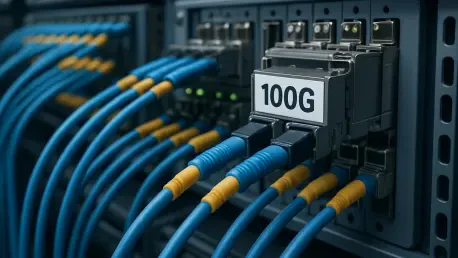
In a decisive move toward an all-fiber future, CableLabs has released a pioneering specification for what it deems the world’s first single-wavelength 100 Gbit/s Passive Optical Network. This Coherent PON initiative represents a significant technological leap, cleverly adapting powerful coherent optical technology—a solution traditionally reserved for high-capacity, long-haul telecommunications—for deployment in the point-to-multipoint local access environment. The primary objective of CPON is to empower network operators with the ability to dramatically increase the capacity of their fiber networks. This enhancement allows them to reclaim valuable optical spectrum and preemptively address the data bottlenecks anticipated from the explosion in data consumption. The specification is meticulously engineered to provide a “true throughput” of 100 Gbit/s. This means the actual line rate is set higher than 100 Gbit/s to compensate for the necessary overhead from processes like Forward Error Correction, guaranteeing a fully usable 100-gigabit capacity for end-users and their applications.
The practical applications for CPON’s immense capacity are already being actively explored, extending far beyond residential broadband. A principal use case is for the Converged Interconnect Network (CIN), which serves as the critical fiber backbone feeding capacity to edge devices within a modern Distributed Access Architecture (DAA). Furthermore, operators can leverage CPON’s advanced capabilities to better serve the lucrative enterprise sector. The technology enables the provisioning of dedicated, high-capacity virtual point-to-point links of 10 Gbit/s or more, supported over significantly greater distances than current PON technologies permit. Curtis Knittle, VP of wired technologies at CableLabs, offered a bold prediction, suggesting that just as DOCSIS and HFC have served as the industry’s workhorses for over three decades, CPON is poised to become the foundational access technology for the next 30 to 40 years, cementing fiber’s role in the long-term network roadmap.
A cornerstone of the CPON vision extends well beyond the confines of the traditional cable industry, aiming to cultivate a broad, interoperable ecosystem. The specification was deliberately developed with the entire telecommunications landscape in mind, seeking to introduce commonality to a PON market historically fragmented between separate ITU and IEEE standards. By thoughtfully incorporating the ITU’s common transmission convergence layer, CableLabs is fostering a more unified and interoperable standard that any service provider can leverage. This unwavering focus on interoperability is a core tenet, designed to prevent vendor lock-in by clearly defining interfaces and endpoint requirements. To accelerate this ecosystem, CableLabs plans to manage interoperability events, or “plug-fests,” once vendors begin developing commercial products. While a proof-of-concept is currently in development with technology partners, commercial availability is still a few years out, but strong backing from vendors like Adtran and Cisco and operators like Comcast and Charter signals powerful industry momentum.
Maximizing the Potential of Existing Networks
While charting a course for a fiber-dense future, CableLabs remains deeply committed to advancing the capabilities of the industry’s vast, existing HFC infrastructure. A critical milestone was recently achieved on this front with the issuance of the first-ever DOCSIS 3.1 Verified for Interoperability (VFI) designation for a DOCSIS 4.0 modem. The significance of this achievement is profound, as it officially confirms that a next-generation DOCSIS 4.0 modem can operate flawlessly on a current-generation DOCSIS 3.1 network. This backward compatibility is a crucial enabler for network operators. It provides them with the confidence to begin “seeding” their networks by deploying D4.0 modems to customers well before the corresponding network-side upgrades—such as the transition to DAA and virtual Cable Modem Termination Systems (vCMTSs)—are fully completed. This strategy allows for a much smoother, more gradual, and ultimately more cost-effective transition to the symmetrical multi-gigabit speeds promised by the new standard.
The specific device that successfully achieved this landmark verification is powered by MaxLinear’s Puma 8 chipset, a versatile piece of silicon that supports not only the full DOCSIS 4.0 standard but also an enhanced variant known as DOCSIS 3.1+, which increases downstream speeds by utilizing additional OFDM channels. This VFI milestone is also a vital stepping stone within the larger DOCSIS 4.0 certification program, which officially commenced in June 2023. While no products have yet completed the full, rigorous D4.0 certification process, this interoperability verification paves the way for more advanced, standard-specific testing in the near future. In the meantime, major cable operators, including Comcast, Mediacom, and Charter, are already actively upgrading their networks to become DOCSIS 4.0-ready. This proactive investment demonstrates a strong industry-wide commitment to maximizing the return on existing infrastructure and delivering competitive multi-gigabit services to millions of customers over their current connections.
A Strategic Vision for Long-Term Growth
The dual-path strategy pursued by CableLabs ultimately provided the cable industry with a remarkably robust and flexible roadmap for the future. By simultaneously pushing the boundaries of HFC with DOCSIS 4.0 while pioneering the next generation of fiber with CPON, the approach ensured that operators could maximize the return on their substantial existing infrastructure investments. This strategic parallelism allowed for a graceful, economically sound migration path toward an all-fiber architecture without demanding a disruptive and cost-prohibitive immediate overhaul. This foresight was further evidenced by continued research into enhancing HFC, which explored pushing network capacity to 25 Gbit/s by raising spectrum to 3GHz, and potentially even to 50 Gbit/s by expanding to 6GHz. This sustained commitment to both established and emerging technologies equipped the industry to not only meet but exceed the escalating connectivity demands of consumers and businesses for decades to come, securing its position at the forefront of digital innovation.