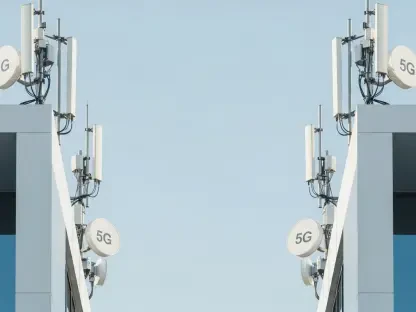

The promising landscape of 5G technology, once envisioned as a vibrant ecosystem teeming with diverse Open RAN suppliers, is now contracting under the immense pressures of market realities. Several key technology providers, including industry mainstays Mavenir and NEC, have recently retreated from the radio access network (RAN) sector, leaving a significant vacuum and challenging the very premise of a multivendor future. Emerging from its own period of profound financial turmoil, American firm Airspan is strategically repositioning itself to capitalize on this industry shakeout. Armed with a newly refined, niche-focused strategy and a series of crucial partnerships, the company is not merely aiming to survive the ongoing consolidation but to thrive, aspiring to become a “US 5G champion” in an increasingly challenging and competitive global market. This ambition is a high-stakes gamble, pitting a pragmatic new business model against powerful market headwinds and lingering skepticism from industry observers.
A Market in Contraction Creates Opportunity
The Open RAN movement, once heralded as the future of telecommunications infrastructure, is facing a harsh and undeniable reality check. Its central goal—to foster a wide and competitive array of suppliers to drive down costs and increase flexibility for network operators—is being systematically undermined by a recent wave of market exits. Since the beginning of 2025, prominent players such as Mavenir, NXP, Kyocera, and most notably the Japanese giant NEC, have either fully or partially withdrawn from the 5G radio hardware business. This trend is a source of deep concern for the very telcos that championed the open concept, as it leads directly back to the supplier consolidation and reduced customer choice they sought to escape. However, for the resilient companies that remain, this market contraction presents a rare and significant opportunity. Airspan’s CEO, Glenn Laxdal, has explicitly framed this development as a strategic advantage, stating that the departure of rivals “leaves a vacuum we can step into,” a sentiment that now forms the cornerstone of the company’s ambitious comeback strategy. This shakeout has effectively cleared a path for smaller, more agile players to capture market share previously held by larger but less committed competitors.
Airspan’s current strategic ambitions are set against the dramatic backdrop of a recent near-death experience, which makes its current position all the more remarkable. The company filed for Chapter 11 bankruptcy protection in April 2024, crippled by an unsustainable debt load that had ballooned to approximately $150 million. The financial data from the preceding year painted a stark picture of a company in crisis: revenues were nearly cut in half to just $77.6 million, resulting in a staggering net loss of almost $79 million. This financial freefall forced a radical restructuring, a move that Laxdal directly attributed to “carrying too much debt,” which necessitated a complete overhaul of its operations, balance sheet, and long-term strategy. The company’s turnaround, however, was remarkably swift. By September 2024, Airspan emerged from bankruptcy after securing a crucial $85 million equity investment from affiliates of Fortress Investment Group, one of its original creditors. This investment was a calculated bet on the belief that a market shakeout was imminent and that a significant opportunity existed for a revitalized, US-based 5G player to fill the gaps left by departing rivals. This fresh capital provided the foundation for Airspan to relaunch with a more sustainable and sharply targeted business model.
A Pragmatic and Focused Strategy
Recognizing the sheer futility of competing head-on with industry titans like Ericsson in a global RAN market that contracted from $45 billion in 2022 to $35 billion in 2024, Airspan has adopted a pragmatic and highly focused new strategy. CEO Glenn Laxdal, himself a former Ericsson executive, candidly calls the idea of a direct challenge to Tier 1 vendors “crazy.” Instead, Airspan’s playbook is now centered on an effort to “plug the gaps” by pursuing specialized opportunities that are often too small or specific to attract the sustained attention of the industry’s larger players. A key element of this approach is a deliberate concentration of its research and development on a specific segment of the radio unit (RU) market. The company is now focused on “Category A radios,” which are defined as those with eight transmitters and eight receivers (8T8R) or fewer. This decision means it is pointedly avoiding the more complex and R&D-intensive massive MIMO (Multiple-Input Multiple-Output) radio sector, a key battleground for major vendors that can feature up to 64 transmitters and receivers. This specialization allows Airspan to manage its development costs while addressing a specific and underserved market need.
A cornerstone of this strategic pivot is a heavy and decisive emphasis on software, which now commands approximately 80% of the company’s total R&D expenditure. This software-centric approach was significantly bolstered by the acquisition of Corning’s wireless assets in April 2025, a move that strengthened its capabilities in network software, particularly for its small cell portfolio. This builds on Airspan’s long history in the sector, where it was a major supplier to Indian telecom giant Reliance Jio during the 4G era, shipping an estimated 250,000 small cells. More recently, the company has productized this expertise by separating its software into a discrete baseband product designed specifically for the in-building sector. This software is built upon Intel’s FlexRAN reference design, which utilizes general-purpose processors instead of custom silicon, aligning perfectly with the principles of virtualized RAN (vRAN). This approach not only provides immense flexibility but also allows Airspan to pair its baseband with RUs from other vendors in scenarios where it lacks a product in its own portfolio, broadening its market appeal and integration potential.
Forging Alliances and Seizing New Frontiers
Airspan’s comeback strategy is heavily dependent on its ability to forge powerful and mutually beneficial strategic partnerships, and early results have been promising. The company recently secured a significant deal with Rakuten, the operator of Japan’s fourth mobile network, to supply mid-band radio units for approximately 5,000 mobile sites. This agreement, which coincided with the news of NEC’s withdrawal as a 5G supplier, sees Airspan stepping into a role previously filled by its departed rival, serving as tangible proof that its strategy to fill market vacuums can be successfully executed. To offer a more comprehensive solution for the outdoor macro market, Airspan has also partnered with Rakuten Symphony, the vendor arm of the Japanese operator. Through this arrangement, Airspan can license Rakuten’s scaled and field-proven baseband software—which currently supports over 10 million subscribers on Rakuten’s network in Japan—and package it with its own RUs, offering customers a fully integrated and credible product. This collaboration leverages Rakuten’s operational expertise and provides Airspan with a powerful software platform to complement its hardware.
Further diversifying its market reach, Airspan has inked an exclusive 5G deal with Gogo, a leading provider of in-flight broadband connectivity in the United States. This partnership involves supplying both software and hardware for a highly complex air-to-ground network, tackling the immense technical challenge of maintaining a high-speed link with aircraft traveling at 30,000 feet. This move represents a strategic entry into a specialized, high-value market segment where its technology can provide a unique solution. Looking ahead, the company’s recent relocation to Dallas, the same city where AT&T is headquartered, positions it for potential “brownfield” opportunities with the US telecom giant. A potential role for Airspan could involve integrating its RUs with Ericsson’s baseband software for AT&T’s evolving multivendor Open RAN network, a prospect that may become more appealing to major vendors as the pool of smaller RU suppliers continues to shrink. This geographic and strategic positioning underscores Airspan’s intent to become a key player in the domestic US market.
Navigating a High-Stakes Future
Airspan’s journey represents a critical test case for the viability of smaller, specialized players in the intensely competitive and consolidating global 5G infrastructure market. The company has emerged from bankruptcy with a clear, albeit challenging, strategy for survival and growth that hinges on its ability to execute flawlessly. By avoiding direct competition with Tier 1 vendors and focusing instead on niche markets, software development, and key strategic partnerships, the company aims to build a sustainable business. The deals with Rakuten and Gogo provide early and tangible validation of this refined approach, demonstrating that a market exists for its specialized offerings. However, significant skepticism remains within the industry, with analysts questioning whether the deal volumes are sufficient to sustain the high R&D costs inherent in RU development. Despite this, the company’s leadership insists that Airspan is now solidly profitable and forecasts continued growth, buoyed by the political momentum favoring a “US 5G champion.” Its ultimate success depends on its capacity to deepen its key partnerships and capitalize on the unique market conditions created by the ongoing industry shakeout.