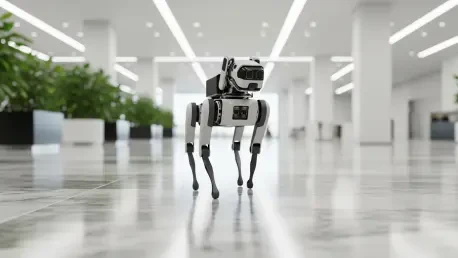

China Mobile’s recent foray into the robotics market with its Lingxi autonomous dog signifies a massive paradigm shift where telecommunications providers transition from passive data carriers to active architects of physical intelligence. This “silicon-based pet” is not merely a novelty; it is a sophisticated mobile edge-computing node designed to bridge the gap between digital infrastructure and domestic assistance. By leveraging its vast network dominance, the company aims to move beyond smartphones, positioning the robot dog as the cornerstone of a new service ecosystem.
Core Technical Capabilities and Features
Full-Domain Super-Sensory Fusion System
The technical foundation of the Lingxi platform rests on a sensory array that integrates LiDAR, RTK, and wide-angle cameras. This fusion allows the machine to construct high-precision 3D maps of its surroundings, ensuring fluid movement through cluttered domestic environments. Unlike basic vacuum robots, this system processes depth and spatial geometry in real-time, providing a level of environmental awareness previously reserved for industrial-grade automation.
Autonomous Navigation and UWB Tracking
Precision is further enhanced by an ultra-wideband (UWB) identifier, which enables the robot to lock onto its owner with pinpoint accuracy. This technology bypasses the limitations of standard visual recognition, allowing the dog to follow users even in low-light conditions or through separate rooms. It represents a leap toward genuine shadowing behavior, where the hardware remains tethered to the human user without manual intervention.
Emotional Intelligence and Health Management
Beyond navigation, the Lingxi dog incorporates voice mimicry and affective computing to foster human-robot bonds. By analyzing vocal tones and patterns, it provides tailored emotional feedback, acting as a companion for children or a health monitor for the elderly. This integration of biometric data and social AI suggests a move toward machines that understand not just where we are, but how we feel.
Emerging Trends in Network-Integrated Robotics
The development of such hardware indicates a broader trend where telecom giants act as central hubs for complex autonomous ecosystems. Instead of just providing bandwidth, these providers now manage diverse robotic hardware through unified network architectures. This strategy allows for seamless software updates and synchronized multi-bot coordination, turning the home into a fully integrated digital living space.
Real-World Applications and Domestic Deployment
Current implementation focuses heavily on the Beijing market, positioning the robot as a proactive caregiver. For the elderly, it serves as a fail-safe that can alert emergency services, while for children, it acts as an interactive educational tool. These specific use cases differentiate the Lingxi from purely recreational robot pets, grounding the technology in practical, high-stakes domestic utility.
Market Obstacles: Challenges in Adoption
However, the transition from prototype to household staple remains fraught with hurdles, most notably the 35,000-yuan price tag. This cost is significantly higher than existing consumer models, which may deter mass-market adoption among average households. Furthermore, regional restrictions and the sheer complexity of physical AI regulation present ongoing barriers to a global or even national rollout.
The Future of Physical AI and Service Ecosystems
As the platform matures, the goal is to create a seamless interface where physical robots become as ubiquitous as smartphones. Future iterations will likely focus on deeper integration with smart-home protocols, allowing the robot to act as a physical manifestation of a digital assistant. The long-term impact could redefine human interaction with technology, shifting from screen-based interfaces to mobile, empathetic hardware.
Final Assessment and Industry Impact
The evaluation of the Lingxi project revealed a robust technical standard that pushed the boundaries of what telecommunications companies traditionally offer. This initiative successfully demonstrated how network-integrated hardware could provide a higher level of autonomy and reliability than standalone units. Ultimately, the robot dog served as a blueprint for a future where digital networks and physical movement become indistinguishably linked in the service of human well-being.