
Imagine a world where your smart glasses not only augment reality with seamless data overlays but also communicate with networks at speeds unthinkable today, all while sensors embedded in the environment track and adapt to your every move. This is the tantalizing vision of 6G, the next leap in mobile network technology, slated to emerge around 2030. Yet, as telecom operators still grapple with the hefty price tag and lukewarm returns of 5G, a pressing question looms: will 6G deliver a transformative breakthrough, or is it destined to be just another expensive step forward with benefits that fail to justify the cost? The telecom industry stands at a crossroads, balancing the allure of cutting-edge innovation against the hard realities of economics and practicality. On one side, pioneering research hints at groundbreaking possibilities in connectivity and efficiency. On the other, lingering doubts about market readiness and clear use cases cast a shadow over the hype. This exploration dives into the heart of 6G’s promise, dissecting the technological hurdles, spectrum conflicts, financial hesitations, and the search for a defining purpose. As the stakes climb higher, the industry must decide whether to embrace this next frontier with optimism or approach it with the caution born from past lessons.
Breaking New Ground: The Tech Challenges of 6G
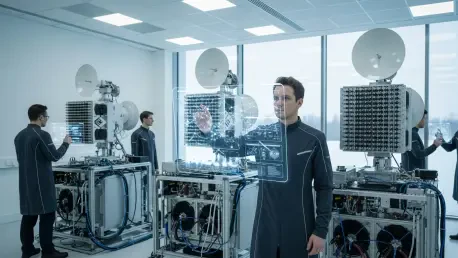
The journey to 6G begins with a daunting technical landscape, particularly the shift to higher frequency bands above 7GHz, where radio signals falter over long distances and struggle to pass through everyday barriers like walls. Research hubs, such as Nokia’s facility in Oulu, Finland, are at the forefront of tackling these barriers, testing sophisticated methods like beamforming and massive MIMO (multiple input, multiple output). These approaches focus signals directly to users with precision, aiming to replicate the coverage of 5G’s 3.5GHz band. Early findings are encouraging, revealing that 7GHz frequencies can penetrate obstacles like windows with surprising effectiveness, hinting at a future where coverage doesn’t come at the expense of impractical infrastructure. This progress sparks optimism that 6G might overcome some of its inherent limitations without reinventing the wheel.
However, not all challenges yield so easily. Packing an unprecedented number of antenna elements—sometimes up to 768—into compact radios creates a serious heat dissipation problem, potentially leading to larger, more expensive equipment despite the advantages of smaller wavelengths in higher bands. This tension between efficiency and practicality remains unresolved, as engineers wrestle with designing hardware that can handle the thermal load without sacrificing cost-effectiveness. Moreover, while the tech shows promise in controlled tests, real-world deployment across diverse environments could reveal new complications. The path to making 6G a viable successor to 5G is anything but straightforward, raising questions about whether these innovations will scale as hoped or stumble under the weight of unforeseen obstacles.
Spectrum Wars: A Battle for Bandwidth
Beyond the lab, 6G faces a fierce fight over spectrum, the lifeblood of any mobile network. With lower frequency bands already jammed by 2G, 3G, 4G, and 5G, 6G is pushed into higher, less favorable territories like the 6GHz range and above. Forecasts predict a sharp rise in global network traffic through 2034, amplifying the urgency to secure adequate bandwidth. In Europe, a recent move by regulators to allocate a significant chunk of the 6GHz band to cellular technology over Wi-Fi has ignited debate. Critics argue that Wi-Fi, which carries the bulk of indoor smartphone data, is being shortchanged, potentially congesting home and office networks at a time when reliable broadband is non-negotiable. This decision, still subject to change, reflects the high stakes of spectrum allocation and the competing interests at play.
Globally, the situation grows even more complex. The US has leaned toward unlicensed Wi-Fi use in the 6GHz band, while China has dedicated it entirely to cellular networks, leaving Europe caught in a middle ground. Such disparities threaten to fragment the 6G ecosystem, forcing manufacturers and operators to navigate a patchwork of standards that could inflate costs and slow deployment. Harmonizing spectrum policies seems a distant goal, and without it, the dream of a seamless global rollout dims. The spectrum crunch isn’t just a technical issue; it’s a geopolitical and economic chess game, with 6G’s success hinging on whether regulators and industry players can find common ground before the window of opportunity narrows further.
Counting the Cost: Telecoms’ Financial Fears
For telecom operators, the shadow of 5G’s financial disappointments looms large over 6G. Many companies poured billions into 5G infrastructure only to see underwhelming returns, leaving them gun-shy about another massive investment. Industry bodies like the Next Generation Mobile Networks Alliance are advocating for 6G to evolve from 5G through software updates, minimizing the need for costly hardware replacements. This approach promises a smoother, more affordable transition, leveraging existing infrastructure to keep expenses in check. Yet, the reality of operating in higher frequency bands suggests that new radios may still be necessary, challenging the notion of a low-budget rollout and reigniting fears of spiraling costs.
Compounding this uncertainty is the lack of a standout application to drive revenue. While concepts like smart glasses are tossed around as potential catalysts for 6G demand, skepticism abounds about whether consumers will see enough value to justify higher connectivity fees. Without a compelling reason to upgrade, telcos risk struggling to convince shareholders that 6G is a sound bet. The financial caution is palpable, as operators weigh the gamble of innovation against the safer route of incremental improvement. If 6G cannot prove its worth in tangible returns, it risks being branded as a luxury the industry can ill afford, especially in an era where every dollar spent must be fiercely justified.
AI and Hardware: A Fork in the Road
Amid the uncertainty, Artificial Intelligence emerges as a potential game-changer for 6G, offering a way to squeeze more efficiency from limited spectrum. Trials in Japan by NTT Docomo have demonstrated staggering improvements, doubling throughput in outdoor settings through AI-driven optimizations. Such breakthroughs suggest that intelligent algorithms could ease capacity constraints without demanding more bandwidth, painting a future where networks adapt dynamically to user needs. This possibility injects a dose of optimism into the 6G narrative, hinting that technology might outsmart some of the physical and economic barriers standing in the way.
Yet, the industry remains divided on the nuts and bolts of building 6G. Nokia, in collaboration with Nvidia, is pouring resources into graphics processing units (GPUs) to replace traditional signal-processing methods with neural networks, betting on a high-tech foundation. In contrast, voices from companies like Verizon argue that existing CPU platforms, upgraded via software, can handle 6G’s demands without breaking the bank. This split on hardware strategy underscores a broader uncertainty: will 6G require a costly tech overhaul, or can it ride on the back of what’s already in place? Until a consensus emerges, the debate keeps operators and vendors on edge, unsure whether to double down on innovation or stick to the tried-and-true. The resolution of this divide could shape not just 6G’s timeline but its very feasibility.
Looking Ahead: Defining 6G’s Purpose
Reflecting on the past, the rollout of 5G taught harsh lessons about overpromising and underdelivering, as many heralded use cases failed to materialize into widespread adoption. With 6G, the industry grappled with similar uncertainties, striving to pinpoint a defining purpose that could validate the enormous efforts and investments poured into its development. The absence of a clear, market-ready application stood as a stark reminder of past missteps, pushing stakeholders to think harder about what would truly set 6G apart from its predecessors.
Moving forward, the focus must shift to actionable strategies that bridge the gap between ambition and reality. Collaboration between telcos, regulators, and tech innovators becomes essential to align on spectrum policies and hardware standards, reducing fragmentation and costs. Equally critical is the pursuit of a compelling use case—be it through AI-enhanced networks or novel devices—that can ignite consumer interest and drive revenue. Industry players should prioritize pilot programs and real-world testing over the next few years to refine 6G’s value proposition. Only by learning from earlier cycles and addressing both technical and economic skepticism can 6G hope to emerge as more than an incremental upgrade, carving a path toward a connectivity future that justifies every step taken.