
The silent hum of a factory floor today is no longer just the sound of moving parts, but the physical manifestation of billions of data points being processed in near-instantaneous intervals to optimize global commerce. This technological shift represents a departure from traditional automation, where machines followed rigid, pre-programmed paths. Today, the industrial landscape is defined by systems that perceive, learn, and react to their environments, effectively bridging the gap between digital intelligence and physical execution. This review examines the current state of this integration, focusing on how it has moved from a theoretical concept to an essential pillar of global infrastructure.
Evolution and Core Principles of Industrial AI
The evolution of industrial intelligence has been marked by a transition from reactive systems to predictive and eventually prescriptive models. In the early stages of this journey, data was largely siloed, and its primary use was for historical reporting rather than active decision-making. However, as sensor technology became more affordable and robust, the volume of high-fidelity data available from the factory floor exploded. This created the necessary environment for machine learning algorithms to thrive, moving the technology from the laboratory into the high-stakes world of live operational technology.
At its core, this technology operates on the principle of closing the loop between data collection and physical action. Unlike general-purpose AI, which might focus on language or image generation, industrial AI is specialized for high-stakes environments where reliability and precision are paramount. It integrates with existing hardware to provide a layer of cognitive awareness that allows machines to understand their own mechanical health and the context of their work. This relevance is underscored by the current shift toward live operational integration, where the technology is no longer an experiment but a fundamental requirement for maintaining a competitive edge.
Key Components and Enabling Technologies
Edge Computing and Real-Time Processing
The move toward edge computing has been the most significant architectural change in recent years, allowing for data processing at the exact point of origin. By placing computational power directly on the factory floor or within remote grid assets, organizations can eliminate the latency associated with sending data to a centralized cloud. This is not merely a matter of convenience; in high-speed manufacturing, a millisecond of delay can mean the difference between a successful operation and a total system failure. Edge hardware must be exceptionally rugged, capable of operating in environments with extreme temperatures, dust, and vibrations while maintaining high-performance throughput.
Furthermore, edge processing provides a layer of resilience that centralized models lack. If a primary network connection fails, an edge-enabled machine can continue to operate autonomously, making safety-critical decisions based on its localized data stream. This decentralized approach also addresses bandwidth constraints, as the system only sends relevant insights or anomalies to the cloud rather than an unmanageable flood of raw sensor data. Consequently, the edge has become the primary site for the most sophisticated AI workloads, from high-speed vision inspection to real-time motion control in robotics.
High-Reliability Connectivity and Networking
The effectiveness of any industrial intelligence system is limited by the strength and reliability of its underlying network. Industrial-grade wireless technologies, such as private 5G and advanced Wi-Fi 6, have become the standard for supporting mobile AI applications like autonomous mobile robots. These networks are designed to provide deterministic connectivity, ensuring that data packets arrive with predictable timing and zero loss, even in environments filled with metallic interference and heavy machinery. Without this high-bandwidth nervous system, the most advanced algorithms would remain trapped in static hardware, unable to coordinate across a dynamic environment.
Emerging Trends and Market Dynamics
The current market is characterized by an aggressive push toward scaling operations, moving beyond the “messy middle” of pilot programs into full enterprise deployment. Investment trends indicate a significant shift in corporate behavior, with a vast majority of organizations now expecting a tangible return on investment within a narrow two-year window. This urgency is driving a massive increase in capital expenditure, as companies realize that delaying AI adoption is no longer a matter of missing out on efficiency, but a risk to their very survival in a rapidly consolidating market.
Moreover, the global AI manufacturing market is experiencing exponential growth, reflecting a broader industry realization that intelligence is the key to managing complexity. As supply chains become more volatile and labor markets tighten, the ability to automate complex decision-making processes becomes a primary differentiator. We are seeing a move away from generic AI solutions toward highly specialized, industry-specific models that are trained on the unique physics and constraints of specific manufacturing or energy sectors.
Real-World Applications and Industrial Use Cases
In the energy sector, AI is being deployed to manage the inherent instability of renewable energy sources within modern power grids. By predicting fluctuations in wind and solar output, these systems can automatically adjust grid loads and storage levels to prevent outages, a task that was previously impossible for human operators alone. Similarly, in logistics networks, AI is used to dynamically re-route entire fleets based on real-time traffic, weather, and demand, significantly reducing fuel consumption and operational overhead while improving delivery reliability.
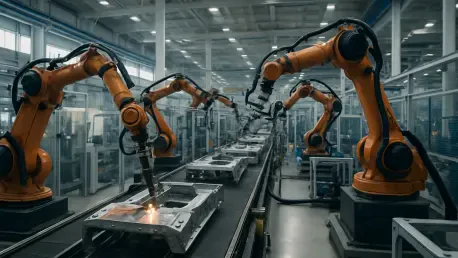
Beyond logistics and energy, the factory floor remains the most fertile ground for innovation. Automated quality inspection systems use high-speed computer vision to detect microscopic defects that would be impossible for human inspectors to catch, while predictive maintenance models identify the early signatures of mechanical failure before a breakdown occurs. These applications do more than just save money; they contribute to a significant reduction in a company’s carbon footprint by minimizing waste and optimizing the energy consumption of every machine on the line.
Critical Challenges and the Cybersecurity Paradox
The rapid adoption of industrial AI has highlighted a fundamental “cybersecurity paradox” where the technology is viewed as both a primary vulnerability and the ultimate solution. Connecting legacy systems—many of which were never designed for internet connectivity—to an AI network creates a vast new attack surface for malicious actors. However, the volume and sophistication of modern cyberattacks are such that only AI-driven defense systems can monitor network traffic and detect anomalies at the speed required to protect critical infrastructure.
Beyond security, the lack of collaboration between Information Technology and Operational Technology departments remains a persistent obstacle. These two groups often have different priorities, with IT focusing on data security and OT focusing on system uptime. Bridging this cultural and technical gap is essential for any organization that hopes to scale its AI initiatives effectively. Integration into legacy systems also poses a significant technical hurdle, requiring sophisticated middleware that can translate between modern AI protocols and decades-old industrial communication standards.
Future Outlook and Technological Trajectory
The trajectory of industrial AI is pointing toward a future defined by fully autonomous machine-to-machine decision-making. In this scenario, humans will step away from the minute-to-minute management of processes and instead focus on setting high-level strategic goals and supervising safety protocols. Breakthroughs in AI-ready infrastructure, such as specialized neural processing units integrated directly into sensors, will allow for even more granular intelligence at the extreme edge of the network.
As these systems become more interconnected, we will likely see the emergence of “self-organizing” factories that can reconfigure themselves in real-time to produce different products based on shifting market demand. This level of agility will fundamentally change the global competitive landscape, favoring organizations that have invested in a robust, flexible technological foundation. The long-term impact of this shift will be a world where industrial output is more efficient, more sustainable, and more resilient to global shocks than ever before.
Summary and Overall Assessment
The review of industrial artificial intelligence indicated that the technology reached a critical tipping point where the ability to scale became the primary measure of success. While the deployment of AI across various sectors was widespread, the maturity of these systems varied significantly, leaving many organizations in a transitional phase. It was clear that the successful integration of intelligence required more than just software; it demanded a fundamental rethink of networking, edge infrastructure, and organizational culture. Those who successfully bridged the gap between information and operations found themselves at a distinct advantage.
Ultimately, the verdict on the current state of industrial AI was one of immense potential tempered by significant infrastructure requirements. The technology proved its worth in use cases ranging from energy optimization to predictive maintenance, but the cybersecurity paradox remained a defining challenge for the industry. To reach the projected market milestones, the focus shifted from proving that AI worked to ensuring that it could be deployed safely and reliably at a global scale. This transition marked the beginning of a new era for operational technology, where intelligence was no longer an add-on, but the very core of industrial design.