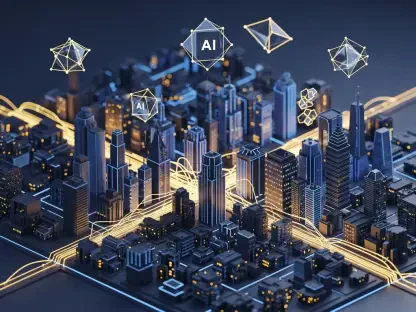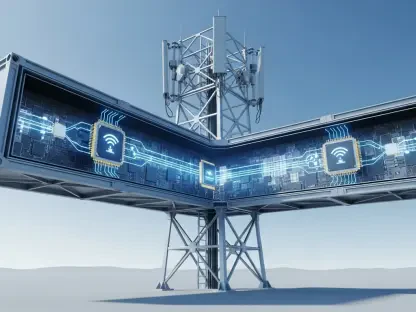

The global telecommunications landscape is currently undergoing a structural transformation that mirrors the monumental shift from age-old wooden sailing ships to the high-speed era of commercial aviation. Just as those historical advances did not merely increase the volume of travel but fundamentally redefined the nature of international trade and logistics, the AI supercycle is rewriting the rules of digital connectivity. This period marks a departure from a decade of optimization focused on delivering static content to human eyes, moving instead toward a complex web of interactions where data is generated, filtered, and consumed by autonomous systems. The challenge for modern infrastructure is no longer confined to expanding the capacity of data pipes; rather, it involves managing a profound shift in the directionality, timing, and consistency of traffic. As this supercycle gains momentum, the distinction between a network that simply delivers information and one that actively participates in intelligent decision-making is becoming the defining characteristic of the technological era.
Quantitative Traffic Surges and the Erosion of Asymmetry
The scale of this transformation is best understood by looking at the projected growth of data through the middle of the next decade. While traditional Wide Area Network traffic remains the bulk of the load in 2026, the trajectory for AI-driven data tells a very different story for the coming years. Current industry projections suggest that between 2026 and 2034, non-AI traffic will continue to grow at a steady rate of about 15% annually, but AI-related traffic is set to expand at a much more aggressive rate of 23%. This divergence indicates that while legacy internet usage is maturing, the intelligence layer of the internet is just beginning its exponential climb. By 2034, even though non-AI sources might still represent the majority of total volume, the operational priority for every network provider will have shifted entirely toward supporting the high-intensity requirements of machine learning models and automated reasoning.
This surge in AI data is causing the erosion of the traditional network asymmetry that has defined the internet since its inception. For decades, networks were built with a “fat” downlink to accommodate users downloading movies, web pages, and files, while the uplink remained relatively “thin” because human interaction was limited to small requests. However, as AI becomes the primary filter of information, this model is becoming obsolete. The modern network must now support a massive influx of data being sent upward from sensors, devices, and user prompts to be processed by large language models and computer vision systems. This shift requires a symmetrical architecture that can handle heavy traffic in both directions, ensuring that the context needed for AI inference is delivered to the processing core as efficiently as the resulting insights are returned to the end-user.
The Evolution of User Interaction and Immersive Connectivity
Digital experiences are rapidly moving away from passive consumption toward a new era of active, immersive engagement. In the recent past, the peak of network demand was defined by high-definition video streaming, which is a largely linear and predictable process. Today, however, the rise of multiplayer Virtual Reality environments, collaborative 3D industrial modeling, and real-time spatial computing has introduced a new set of demands. These services do not just require high bandwidth; they require a level of interactivity that makes the slightest delay noticeable and disruptive. This evolution is transforming the internet into a participatory medium where the network must synchronize multiple high-bandwidth streams simultaneously to maintain a shared sense of presence for users across different continents.
For network operators, the primary challenge of this immersive shift is the transition from managing raw speed to ensuring predictable performance. In a traditional streaming environment, a few seconds of buffering is a minor inconvenience handled by local device memory. In contrast, an immersive application like remote robotic surgery or high-stakes competitive gaming cannot tolerate even milliseconds of jitter or latency without the experience breaking down entirely. Consequently, the focus of infrastructure planning is moving toward the elimination of variance. Providers are investing in technologies that guarantee a perfectly smooth, real-time connection, prioritizing consistency over the theoretical maximum speed. This ensures that as users interact with digital twins or virtual workspaces, the network remains an invisible and reliable conduit for their actions.
Industrial Migration and the Imperative of Edge Computing
The second major trend defining the current supercycle is the massive relocation of enterprise and industrial operations to the network edge. For several years, sectors such as automotive manufacturing and aerospace have utilized digital twins to simulate and optimize their physical assets. Now, the integration of AI into these processes is forcing a change in where data is processed. Modern industrial robots and personalized medical diagnostic tools generate such vast quantities of real-time data that sending it all to a centralized cloud center hundreds of miles away is no longer practical. The speed of light itself becomes a bottleneck, creating delays that can compromise safety in a factory or accuracy in a surgical suite. To solve this, processing power is being moved as close to the physical site as possible.
This shift to the edge is creating a more distributed and variable traffic pattern that requires a fundamental redesign of the backbone network. Instead of a simple hub-and-spoke model, the infrastructure must now behave like a flexible grid capable of handling sudden bursts of activity between localized edge nodes and the core cloud. These bursts often occur when an industrial system identifies an anomaly and requires a massive infusion of processing power to simulate a solution. Networks must be able to recognize these high-priority events and dynamically allocate resources to ensure that data is processed where it is most effective. This decentralized approach is essential for maintaining the high-speed synchronization required for the next generation of autonomous industrial automation and smart city infrastructure.
The Rise of Autonomous Traffic and AI Taxonomy
A revolutionary shift is occurring in how network traffic is initiated, as machine-to-machine communication begins to eclipse human-triggered activity. Historically, almost every bit of data moving across the globe was the result of a human clicking a link, opening an app, or sending a message. However, by 2034, it is estimated that over a third of all network traffic will be generated autonomously by AI systems. These machines operate around the clock, with AI chatbots constantly syncing data, predictive maintenance sensors monitoring infrastructure 24/7, and automated content tools generating media without direct human prompts. This constant background hum of machine intelligence is expected to drive a threefold increase in traffic specifically between datacenters as different AI models collaborate and synchronize their knowledge.
To manage this complex future, the industry has developed a taxonomy that categorizes AI into three distinct types: Generative, Agentic, and Physical. Generative AI, which focuses on media and text creation, places a massive burden on the uplink as rich media prompts are submitted for inference. Agentic AI, which performs complex planning like managing global supply chains, creates bursty traffic patterns that require advanced network slicing to prevent congestion. Finally, Physical AI, such as autonomous delivery vehicles, demands ultra-low latency for split-second environmental sensing. Each category places a unique demand on the underlying infrastructure, requiring network operators to move beyond a one-size-fits-all approach. By tailoring the network to these specific needs, providers can ensure that the diverse ecosystem of artificial intelligence remains stable and responsive.
Designing AI-Native Architectures for Global Resilience
The transition toward an AI-native future represents a comprehensive rethinking of how global connectivity is managed and maintained. It has become clear that network operators can no longer achieve success by simply adding more capacity to existing, human-centric frameworks. Instead, the focus has shifted toward building architectures that are inherently designed to support the unique and fluctuating requirements of artificial intelligence. These AI-native networks utilize internal machine learning models to monitor traffic patterns in real-time, allowing the system to self-heal and adapt before a congestion point can even form. This internal intelligence allows the network to function as a dynamic organism, prioritizing critical Physical AI tasks like autonomous safety systems while managing the heavy data loads of Generative AI in the background.
The telecommunications industry moved toward a model where the network serves as the central nervous system of a global, automated society. By integrating edge computing, network slicing, and symmetrical high-speed connectivity, providers laid the groundwork for a world where intelligence is available everywhere and at all times. The strategy for the coming years involved moving away from traditional infrastructure silos and toward a unified, automated fabric that could support the interaction between billions of autonomous agents. This transformation ensured that as AI systems became more sophisticated, the global network was capable of matching that growth, providing the reliable foundation necessary for the next wave of economic and technological innovation. The mission remains focused on ensuring that the evolution of connectivity and the advancement of intelligence continue in a synchronized, mutually reinforcing cycle.