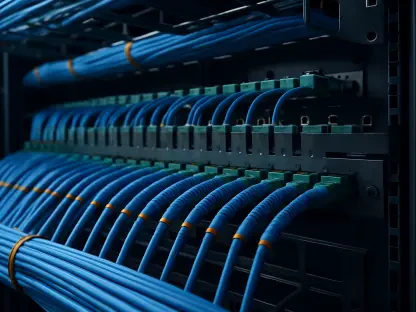

As the artificial intelligence revolution continues its relentless march forward, a fascinating and critical shift in market focus has become increasingly apparent, moving investor attention away from the celebrated creators of large language models and toward the often-overlooked companies constructing the physical world AI inhabits. The true momentum is now found not in the algorithms themselves, but in the “picks and shovels” of the digital age: the power, cooling, and networking systems that form the bedrock of data centers. This trend underscores a growing realization that the future of AI is inextricably linked to the speed and scale at which its essential physical infrastructure can be deployed, turning a technological sprint into a complex logistical and engineering marathon. The market’s re-evaluation highlights the tangible constraints that govern digital expansion, making the providers of these foundational components the unexpected front-runners in the race for AI dominance.
The Foundational Pillars of AI Growth
The Outsized Returns of Infrastructure Providers
An examination of market performance reveals a compelling narrative where the suppliers of essential data-center components have significantly outpaced the very tech titans they empower. Over the last three years, companies like Vertiv, a specialist in data-center cooling and power solutions, have demonstrated extraordinary financial momentum. The company reported a 70.4% increase in revenue, which, while impressive, is dwarfed by its staggering 1,250% surge in net income. This astronomical growth in profitability points to immense operational leverage and pricing power as demand for its specialized equipment soars. Similarly, Arista Networks, a key player in high-speed networking equipment crucial for connecting thousands of AI processors, saw its revenue climb by a remarkable 92.8%. These figures stand in stark contrast to the still-strong but comparatively modest growth of AI leaders like Alphabet and Microsoft, whose revenues grew by 37.3% and 44%, respectively, over the same period. This divergence illustrates that while the AI model developers are capturing headlines, the infrastructure builders are capturing an even more dramatic share of the financial upside driven by the industry’s explosive expansion.
This exceptional performance has not gone unnoticed by investors, who have priced these infrastructure companies for near-perfect execution and sustained, rapid growth. The market’s enthusiasm is reflected in their premium valuations, which signal a strong belief that the data-center construction boom is still in its early stages. Vertiv and Arista currently trade at high forward earnings multiples of approximately 41 and 46, respectively. This is a significant premium compared to the multiples for Alphabet and Microsoft, which hover around 30. Such elevated valuations indicate that investors are willing to pay more for each dollar of future earnings from these infrastructure providers, betting that the demand for their products will continue to outstrip supply. It is a clear financial signal that the market anticipates the physical buildout of AI capabilities to be one of the most durable and profitable investment themes for the foreseeable future, placing immense pressure on these companies to deliver on the monumental expectations that are now priced into their shares.
The Looming Infrastructure Bottleneck
While investor optimism runs high, a significant and sobering concern is emerging around the physical limitations that could throttle the pace of AI development. Industry analysts have pointed to this year as a potential “make-or-break” moment for the AI trade, with a growing consensus that real-world constraints, rather than software innovation, could become the primary impediment to growth. The most acute of these challenges is the availability of electricity. The massive, power-hungry data centers required to train and run advanced AI models are placing an unprecedented strain on already aging electrical grids. The prospect of an inadequate power supply is no longer a distant threat but a clear and present danger that could “apply the brakes” on AI spending and deployment. If companies cannot secure the energy required to power their new facilities, the entire ecosystem, from chip manufacturers to AI application developers, could face a significant slowdown, transforming the industry’s trajectory from exponential growth to one dictated by the slower pace of energy infrastructure upgrades.
Beyond the critical issue of electricity, the AI expansion faces a confluence of other logistical hurdles that threaten to create a comprehensive infrastructure bottleneck. The specialized cooling systems needed to dissipate the intense heat generated by AI accelerators are complex and subject to supply chain disruptions. Furthermore, the construction of new data centers is a capital-intensive and time-consuming process, complicated by land acquisition, zoning regulations, and the need for access to vast water resources for cooling. The sheer scale of the required buildout is testing the limits of the global construction and manufacturing sectors. As AI giants race to expand their capacity, they are competing for a finite pool of resources, from specialized hardware to the skilled labor needed to build and operate these sophisticated facilities. This intense competition for the foundational elements of AI infrastructure is creating a high-stakes environment where the ability to execute on physical construction is becoming as important as the ability to innovate in software.
Alternative Pathways to AI Investment
Diversified Strategies Beyond Pure-Play Infrastructure
For investors seeking exposure to the AI revolution without concentrating solely on the high-valuation infrastructure sector, established technology behemoths offer a more diversified approach. Alphabet, for instance, represents what many analysts consider a “high floor” investment in the space. The company’s formidable core advertising business generates a massive and consistent cash flow, providing a stable financial foundation to fund its ambitious and capital-intensive AI research and development efforts without succumbing to short-term market pressures. This financial strength is complemented by two other strategic advantages: its Google Cloud platform, which is a major beneficiary of enterprise AI adoption, and its unparalleled repository of first-party data, a critical ingredient for training more effective and sophisticated AI models. This combination of stable funding, a growing cloud business, and a deep data moat positions Alphabet as a resilient, long-duration participant in the AI landscape, capable of weathering market volatility while continuing to push the boundaries of innovation.
In sharp contrast to the stability offered by a company like Alphabet, Tesla presents a higher-risk, robotics-centric bet on a transformative vision of AI’s future. The investment thesis for Tesla has increasingly pivoted from its dominance in the electric vehicle market to its potential as a leader in artificial intelligence and robotics. This strategy is heavily intertwined with CEO Elon Musk’s vision for a future where humanoid robots perform a wide range of tasks, powered by the same AI that enables the company’s autonomous driving technology. While this vision is compelling, it also carries significant risk, especially given the recent challenges and increased competition the company has faced in its primary vehicle business. An investment in Tesla is therefore less about its current financial performance and more a speculative wager on its ability to solve some of the most complex challenges in AI and robotics, potentially unlocking a market that is orders of magnitude larger than the automotive industry but with a far more uncertain timeline and outcome.
The Steady and Unconventional AI Contenders
A unique and often overlooked player in the AI investment landscape is IBM, which offers a distinct, dividend-oriented approach for those seeking a more conservative entry point. With a current dividend yield of approximately 2.2% and a long, celebrated history of consistently increasing its payouts to shareholders, IBM appeals to income-focused investors. The company has strategically centered its AI ambitions on the enterprise market, focusing on hybrid cloud computing and practical AI applications that help large organizations streamline operations and extract value from their data. This enterprise-first strategy differentiates it from competitors focused on consumer-facing applications or general-purpose AI models. Analysts project steady, albeit not spectacular, earnings growth for the company in the coming years, driven by the ongoing adoption of its AI and cloud platforms within its established corporate client base. This makes IBM a compelling option for those who believe in the long-term potential of AI but prefer a more measured and income-generating investment vehicle.
Ultimately, the evolving market landscape revealed that the most astute investment approaches were those that acknowledged the full spectrum of the AI ecosystem. The initial fervor for pure-play model developers had given way to a more mature understanding that the industry’s growth was fundamentally tethered to its physical foundations. It became clear that the true enablers of the AI revolution were not just the creators of intelligent algorithms, but also the providers of power, cooling, and networking. Simultaneously, diverse strategies emerged, from the stable, cash-rich model of Alphabet to the high-stakes robotics vision of Tesla and the steady, enterprise-focused path of IBM. The narrative had shifted from a singular focus on software to a holistic appreciation of the intricate interplay between tangible infrastructure and varied corporate strategies, a realization that proved critical for navigating this transformative technological era.